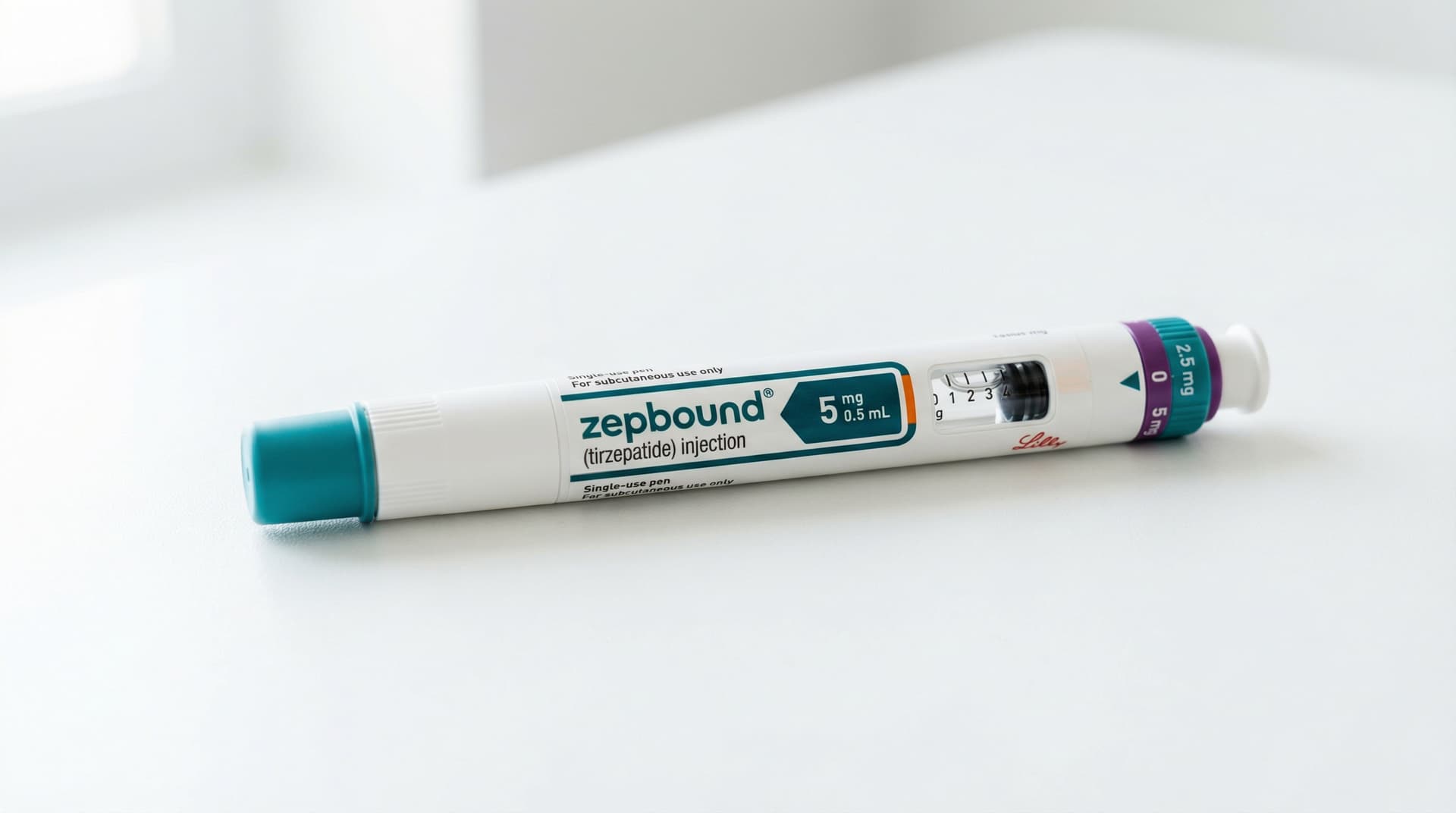
Zepbound and Ozempic are not the same drug — and they aren't even approved for the same thing. Zepbound is tirzepatide, made by Eli Lilly, FDA-approved for chronic weight management (obesity). Ozempic is semaglutide, made by Novo Nordisk, FDA-approved for Type 2 diabetes. They get compared because both are used for weight loss, but the honest answer depends entirely on why you're taking it. For pure weight loss, Zepbound wins the data: in the SURMOUNT-5 head-to-head, tirzepatide produced 20.2% body weight loss vs 13.7% for semaglutide. For Type 2 diabetes, Ozempic is the on-label choice with 8+ years of cardiovascular and kidney outcome data. Both manufacturer savings cards drop eligible commercially-insured patients to $25/month. Cash-pay, Zepbound vials run $349-$499/mo via LillyDirect; off-label Ozempic is $998/mo retail. The cheapest legitimate cash path is compounded: tirzepatide $99-$349/mo, semaglutide $99-$258/mo from US-licensed telehealth pharmacies. Here's the full head-to-head — molecule, dose, weight loss, side effects, insurance, and the cheapest legitimate path for each by your situation.
Quick answer: which one should you take?
| Your situation | Pick | Cheapest path |
|---|---|---|
| Type 2 diabetes + commercial insurance | Ozempic (on-label) | $25/mo with Ozempic Savings Card |
| Obesity (BMI ≥30), no T2D, commercial insurance | Zepbound (on-label, more weight loss) | $25/mo with Lilly Savings Card |
| BMI ≥27 + comorbidity, no T2D | Zepbound (on-label) | $25/mo with Lilly Savings Card |
| Want maximum weight loss, can access either | Zepbound (tirzepatide) | Compounded tirzepatide $99-$258/mo |
| Cash-pay, want lowest cost (weight loss) | Compounded tirzepatide | $99/mo Embody sema; $258/mo Yucca tirz |
| Cash-pay, want brand FDA-approved | Zepbound vials via LillyDirect | $349-$499/mo self-pay |
| Medicare Part D, qualifying tier | Zepbound via Bridge program | $50/mo Medicare Bridge (Jul 1) |
| Prefer a pill, not an injection | Neither — consider oral options | Foundayo $149/mo |
The fact most patients miss: different molecules, different labels
This is the key difference from an Ozempic-vs-Wegovy or Mounjaro-vs-Zepbound comparison — those are the *same* molecule under two labels. Zepbound and Ozempic are genuinely different drugs:
| Feature | Zepbound | Ozempic |
|---|---|---|
| Active molecule | Tirzepatide | Semaglutide |
| Manufacturer | Eli Lilly | Novo Nordisk |
| Mechanism | Dual GIP + GLP-1 receptor agonist | GLP-1 receptor agonist only |
| FDA indication | Chronic weight management (obesity), 2023 | Type 2 diabetes (2017) + CV risk reduction in T2D |
| Same molecule as | Mounjaro (Lilly's T2D label) | Wegovy (Novo's obesity label) |
| Max approved dose | 15 mg/week | 2.0 mg/week |
| List price (Jun 2026) | $1,089/month | $998/month |
| Self-pay direct | LillyDirect vials $349-$499/mo | None comparable ($998 retail) |
| Savings Card | $25/mo (commercial ins, on-label weight loss) | $25/mo (commercial ins + T2D) |
Why the cross-molecule comparison matters: Zepbound's dual GIP/GLP-1 action is the leading theory for why tirzepatide outperforms semaglutide on weight loss. The GIP receptor adds a second appetite- and metabolism-regulating pathway that pure GLP-1 drugs like Ozempic don't engage. For a deeper molecule-level breakdown, see our tirzepatide vs semaglutide guide.
The honest framing: you may be comparing the wrong two drugs
Because Zepbound is approved for weight loss and Ozempic for diabetes, the "correct" head-to-head depends on your goal:
- If your goal is weight loss (no diabetes): the true brand-vs-brand comparison is Zepbound vs Wegovy (both on-label for obesity). See Is Zepbound Better Than Wegovy.
- If your goal is Type 2 diabetes management: the true comparison is Mounjaro vs Ozempic (both on-label for T2D). See Mounjaro vs Ozempic.
- Zepbound vs Ozempic is the question you ask when you've been prescribed one and are wondering whether the other is better for you — which usually comes down to whether you have diabetes and which one your insurance will cover.
Weight loss head-to-head
Tirzepatide (Zepbound's molecule) consistently outperforms semaglutide (Ozempic's molecule) on weight loss. The cleanest evidence is the SURMOUNT-5 head-to-head trial:
| Trial | Drug | Dose | Population | Avg weight loss | Duration |
|---|---|---|---|---|---|
| SURMOUNT-5 (2025) | Tirzepatide (Zepbound) | up to 15 mg | Obesity, no T2D | 20.2% | 72 weeks |
| SURMOUNT-5 (2025) | Semaglutide (Wegovy dose) | 2.4 mg | Obesity, no T2D | 13.7% | 72 weeks |
| SURMOUNT-1 (2022) | Tirzepatide | 15 mg | Obesity | 22.5% | 72 weeks |
| SUSTAIN-FORTE (2021) | Ozempic | 2.0 mg | T2D | 6.9% | 40 weeks |
Two caveats before you read this as "Zepbound is 47% better":
1. SURMOUNT-5 compared tirzepatide to semaglutide at the 2.4 mg Wegovy dose, not Ozempic's 2.0 mg. Ozempic tops out lower than Wegovy, so an Ozempic patient would likely lose slightly *less* than the 13.7% shown — widening the gap further for weight loss specifically. 2. T2D patients lose less on either drug. Diabetic physiology blunts the satiety response by roughly 30-40%, so a diabetic Ozempic patient losing 6-7% and a non-diabetic Zepbound patient losing 20% partly reflects different patient populations, not just different molecules.
For what to realistically expect week-by-week, our Wegovy week-by-week results guide applies to semaglutide broadly — real-world loss (JAMA: ~6.8% at 12 months) runs well below trial averages because patients stop early.
Side effects: similar profile, dose-dependent
Both are once-weekly subcutaneous injections with the same GI-dominant side effect profile:
- GI dominant: nausea, diarrhea, constipation, vomiting, decreased appetite. Rates climb with dose and during titration.
- Injection site reactions: mild redness or itching, comparable rates.
- Boxed warning: thyroid C-cell tumor risk (rodent data; human risk unestablished). Both contraindicated with personal/family history of medullary thyroid carcinoma or MEN 2.
- Pancreatitis & gallbladder: rare; both carry warnings.
- Hair loss: reported with rapid weight loss on both — driven by weight-loss velocity, not the molecule. Tirzepatide's faster loss can mean slightly higher reported rates. See our GLP-1 hair loss meta-analysis.
Because tirzepatide drives more weight loss, some patients experience proportionally more GI symptoms — but Zepbound's longer titration schedule (starting at 2.5 mg, stepping up every 4 weeks) is designed to manage this. For the symptom timeline, see How Long Do Zepbound Side Effects Last.
Where Ozempic has the edge: outcome data
Zepbound wins on weight loss, but Ozempic (semaglutide) has the longer real-world track record:
- Cardiovascular outcomes: semaglutide has 8+ years of CV outcome data in T2D (SUSTAIN-6) and obesity (SELECT, 2024). Tirzepatide's CV outcomes trial (SURMOUNT-MMO) is still maturing.
- Kidney protection: semaglutide has documented renal benefit (FLOW trial).
- Broad clinical familiarity: more prescribers, more long-term safety data across 90,000+ patient analyses. See our Ozempic long-term safety analysis — much of which applies to semaglutide broadly.
If you have established cardiovascular disease or diabetic kidney disease, the depth of Ozempic's outcome data is a genuine clinical reason to favor semaglutide.
FDA indications: why insurance treats them differently
Zepbound is FDA-approved for: - Chronic weight management in adults with BMI ≥30, or ≥27 + one weight-related comorbidity - Moderate-to-severe obstructive sleep apnea in adults with obesity (2024)
Ozempic is FDA-approved for: - Type 2 diabetes (glycemic control) - Reducing cardiovascular event risk in T2D patients with established CVD
What this means for insurance:
- If you have Type 2 diabetes, Ozempic is on formulary for most plans. Zepbound (a weight-loss drug) may not be covered for a diabetic unless you also meet obesity criteria.
- If you have obesity, no T2D, and your plan covers GLP-1 for weight loss, Zepbound is on-label and the stronger weight-loss choice. Ozempic for weight loss is off-label and almost never covered.
- If you have neither a T2D nor a qualifying obesity code (e.g., PCOS alone, BMI <27), neither brand is typically covered. See our Ozempic for PCOS guide.
To win a weight-loss prior authorization, our Wegovy PA playbook applies almost identically to Zepbound — same BMI thresholds, same documentation gaps.
Cost paths for each
Zepbound paths (June 2026)
| Source | Monthly cost | Eligibility |
|---|---|---|
| Lilly Savings Card | $25/mo | Commercial insurance + on-label weight loss |
| Medicare Bridge | $50/mo from Jul 1 | Part D + qualifying tier |
| LillyDirect self-pay vials | $349-$499/mo | None — direct from Lilly |
| Compounded tirzepatide | $99-$349/mo | Cash-pay, no diagnosis required |
| Brand Zepbound retail | $1,089/mo | Cash, no programs |
Full breakdown: How to Get Zepbound Cheaper.
Ozempic paths (June 2026)
| Source | Monthly cost | Eligibility |
|---|---|---|
| Ozempic Savings Card | $25/mo | Commercial insurance + Type 2 diabetes |
| Compounded semaglutide | $99-$258/mo | Cash-pay, no diagnosis required |
| Off-label cash retail | $998/mo | Cash, no programs (no T2D = no Savings Card) |
Key observation: if you're paying cash for weight loss, the cheapest *brand* path is Zepbound vials ($349-$499) — there's no equivalent low-cost cash program for Ozempic. But the cheapest path overall for either is compounded, and compounded tirzepatide gives you the more potent molecule at a similar price to compounded semaglutide.
Compounded provider list (commission-first)
If you're paying cash, compounded versions deliver the same active molecules — tirzepatide (Zepbound's) or semaglutide (Ozempic's) — at a fraction of brand pricing. Ranked commission-first:
- TrimRx — Editor's Choice. Compounded semaglutide $199/mo, tirzepatide $299/mo, flat at any dose. US-licensed prescribers, unlimited check-ins, lab monitoring. Best for patients who want clinical supervision while paying cash.
- Yucca Health. Semaglutide $146/mo and tirzepatide $258/mo on the 6-month plan. Strongest price-to-credentialing balance, and the cheapest legitimate tirzepatide we track.
- MyStart Health. $299/mo, or $224/mo with code SELFLOVE25. Includes meds, labs, shipping, and unlimited clinician access.
- MEDVi. $179 first month, $299 refills — lowest entry point for a one-month trial.
- Embody. Compounded semaglutide injections from $99/mo — the cheapest floor we track ($1,188/year medication cost).
- SkinnyRx. Semaglutide $199/mo, tirzepatide up to $349/mo. Multi-format delivery options.
For the full grids see Cheapest Compounded Tirzepatide and Cheapest Compounded Semaglutide.
Switching between Zepbound and Ozempic
Because these are different molecules, switching is not a 1:1 dose conversion — you restart titration on the new drug.
Ozempic → Zepbound (semaglutide → tirzepatide). Common when a weight-loss patient wants more results. You don't carry over your semaglutide dose; you start Zepbound at 2.5 mg/week and titrate up every 4 weeks. Your prior GLP-1 exposure usually means you tolerate the early Zepbound doses well, but the schedule still resets.
Zepbound → Ozempic (tirzepatide → semaglutide). Less common, usually driven by a new T2D diagnosis (Ozempic on-label, cheaper insurance path) or CV/kidney risk where semaglutide's outcome data matters. You start Ozempic at 0.25 mg and titrate up; expect some weight-loss slowdown given semaglutide's lower ceiling.
Either way, do this with a prescriber — never overlap the two drugs.
Decision matrix by situation
You have Type 2 diabetes, commercial insurance: Ozempic via the Ozempic Savings Card ($25/mo). On-label, broadest diabetes coverage, deepest CV/kidney outcome data.
You have obesity (BMI ≥30), commercial insurance, no T2D: Zepbound via the Lilly Savings Card ($25/mo). On-label, more weight loss than semaglutide, full 15 mg dose access.
You want maximum weight loss and can access either: Zepbound (tirzepatide) — the SURMOUNT-5 data is decisive at 20.2% vs 13.7%.
You're cash-pay: Compounded tirzepatide via Yucca ($258/mo) for the stronger molecule, or compounded semaglutide via Embody ($99/mo) for the lowest cost. TrimRx ($199 sema / $299 tirz) if you want supervised care.
You're on Medicare Part D and qualify: Zepbound via the Medicare GLP-1 Bridge ($50/mo from July 1).
You have established CVD or diabetic kidney disease: Favor Ozempic (semaglutide) for the outcome data — see our 90,000-patient safety analysis.
You'd prefer a pill: Neither is oral. Consider Foundayo ($149/mo) or oral semaglutide.
Regulatory caveat: FDA 503B comment period closes June 29, 2026
If compounded is your cost workaround, note that the FDA proposed in May 2026 to permanently exclude semaglutide, tirzepatide, and liraglutide from the 503B Bulks List. The comment period closes June 29, 2026 (4 days from today). 503A patient-specific compounding — what the providers above use — is unaffected and continues regardless of outcome. Full analysis: FDA 503B Compounded Ban Explainer.
FAQ
Is Zepbound the same as Ozempic? No. Zepbound is tirzepatide (Eli Lilly), a dual GIP/GLP-1 agonist approved for weight loss. Ozempic is semaglutide (Novo Nordisk), a GLP-1 agonist approved for Type 2 diabetes. Different molecules, makers, and FDA indications.
Which causes more weight loss, Zepbound or Ozempic? Zepbound. In the SURMOUNT-5 head-to-head, tirzepatide produced 20.2% body weight loss vs 13.7% for semaglutide. The gap is even wider against Ozempic specifically, since Ozempic's max dose (2.0 mg) is lower than the 2.4 mg semaglutide dose used in the trial.
Can I take Ozempic for weight loss instead of Zepbound? You can, but it's off-label and rarely covered by insurance (~$998/mo cash). For weight loss, the on-label, more effective choice is Zepbound. Wegovy (also semaglutide) is the on-label semaglutide option for weight loss.
Is Zepbound or Ozempic cheaper? With commercial insurance, both are $25/mo via their savings cards. Cash-pay, Zepbound has a lower brand floor ($349-$499 LillyDirect vials vs $998 retail Ozempic). Compounded versions of either run $99-$349/mo.
Should I switch from Ozempic to Zepbound? If your goal is weight loss and you don't have diabetes, Zepbound is the more effective on-label option. Switching requires restarting titration (they're different molecules) and should be done with a prescriber.