

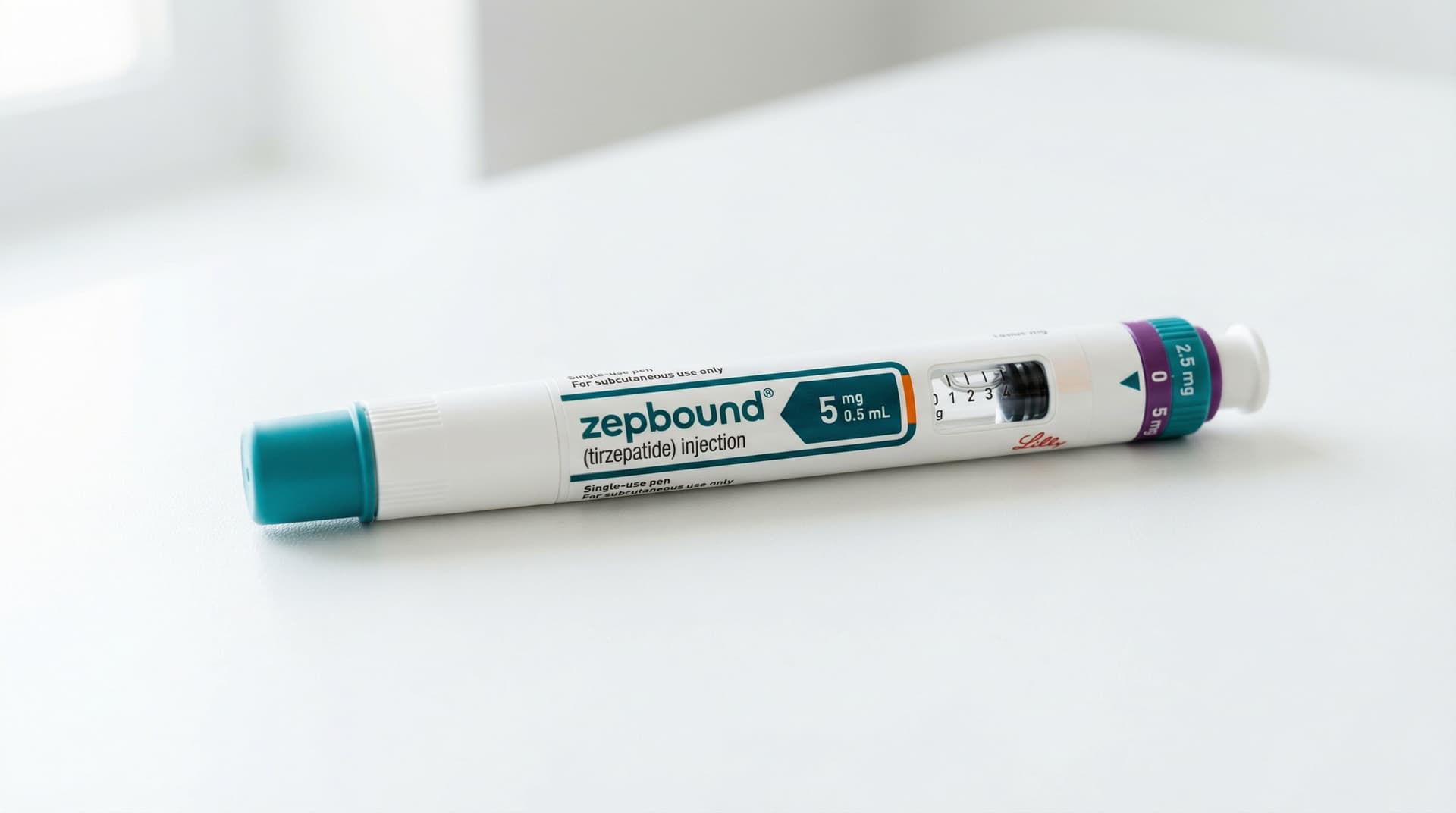
Yes, Zepbound (tirzepatide) is more potent than Wegovy (semaglutide) — by a clinically meaningful margin. In SURMOUNT-5, the only head-to-head trial of the two drugs, tirzepatide produced 20.2% body-weight loss at 72 weeks vs 13.7% for semaglutide. That gap holds across nearly every weight-loss subgroup.
But "more weight loss" isn't the same as "better for you." Cost, side-effect tolerance, oral-pill availability, and what your insurance actually covers all flip the answer for specific patients. Here's the 2026 head-to-head — clinical data, real prices, and where to get either one cheapest if you're paying out of pocket.
How does Zepbound work vs Wegovy?
Both are weekly injections that mimic gut hormones controlling appetite and blood-sugar regulation. The mechanisms are similar but not identical:
- Wegovy (semaglutide) is a single GLP-1 receptor agonist. Made by Novo Nordisk. FDA-approved for chronic weight management in 2021.
- Zepbound (tirzepatide) is a dual GIP and GLP-1 receptor agonist. Made by Eli Lilly. FDA-approved for chronic weight management in November 2023.
The dual-action mechanism is the reason for the bigger weight-loss numbers. GIP (glucose-dependent insulinotropic polypeptide) appears to enhance the insulin- and appetite-modulating effects of the GLP-1 component, particularly at higher doses.
Is Zepbound stronger than Wegovy?
Yes, by a meaningful margin in head-to-head data. The pivotal evidence comes from SURMOUNT-5, an Eli Lilly-funded but independently adjudicated trial published in the New England Journal of Medicine in 2025:
- Tirzepatide 10–15 mg weekly: mean weight loss 20.2% at 72 weeks
- Semaglutide 1.7–2.4 mg weekly: mean weight loss 13.7% at 72 weeks
- Patients losing ≥15% of body weight: 65% on tirzepatide vs 36% on semaglutide
- Patients losing ≥25% of body weight: 32% on tirzepatide vs 16% on semaglutide
These results were consistent with the earlier non-head-to-head trial data. SURMOUNT-1 (Zepbound only) reported 20.9% mean weight loss at 72 weeks. STEP 1 (Wegovy only) reported 14.9% at 68 weeks.
In short: Zepbound produces roughly 1.4–1.5× the weight loss of Wegovy at maximum tolerated doses, with a similar safety profile.
Zepbound vs Wegovy: cost in 2026
This is where the answer flips for many patients. Here's what each costs right now (May 2026):
Wegovy
- List price (injection): $1,349/month
- Insurance copay: typically $25–$200/month if covered
- Self-pay cash: $499/month via Novo Nordisk's NovoCare direct-pay program (lowered from $649 in early 2026)
- Oral Wegovy (pill): $149/month at the lowest dose via NovoCare — launched January 2026
- Hims partnership: $149/month entry pricing as of April 2026
Zepbound
- List price (injection): $1,060/month
- Insurance copay: typically $25–$200/month if covered
- Self-pay (LillyDirect vials or KwikPens): $299 (2.5 mg) to $449 (7.5-15 mg) per month — the same self-pay schedule for both formats, far below the $1,060 list price
- Foundayo (oral orforglipron pill, a different molecule): $149–$299/month by dose — FDA-approved April 2026, shipping now via LillyDirect
For state-by-state breakdowns including Medicaid coverage, see our Wegovy cost analysis and Zepbound cost analysis.
The 2026 price war is real. A year ago, both drugs ran $1,300+ at list price with limited self-pay options. Now, both manufacturers offer $149/month oral entry products and $299–$449 self-pay injectable programs. For the complete pricing comparison see our GLP-1 price war breakdown.
Zepbound vs Wegovy: side effects
The side-effect profiles are remarkably similar — both drugs work on the GLP-1 axis and produce slow gastric emptying, which drives most adverse events.
Gastrointestinal (most common)
- Nausea: Wegovy 44% vs Zepbound 33% in pivotal trials — Wegovy edges out as worse here
- Diarrhea: Wegovy 30% vs Zepbound 22%
- Vomiting: Wegovy 24% vs Zepbound 13%
- Constipation: Wegovy 24% vs Zepbound 17%
Counter-intuitively, the more potent drug (Zepbound) tends to be better tolerated at maximum dose. Most clinicians attribute this to the dual GIP/GLP-1 mechanism partially offsetting the GLP-1-driven nausea.
Hair loss
- Wegovy (STEP-1): ~3% of adult patients reported hair loss vs 1% on placebo
- Zepbound (SURMOUNT-1): ~5.7% of patients on the highest dose
The 2026 dermatology meta-analysis of 84,000 patients found GLP-1 users were 3.4× more likely to experience hair loss than non-users — but this is largely a function of weight-loss velocity, not the molecule itself. See our GLP-1 hair loss meta-analysis for the full mechanism and prevention protocol.
Serious adverse events
Both drugs carry boxed warnings for thyroid C-cell tumors (based on rodent studies) and warnings for pancreatitis, gallbladder disease, and severe gastroparesis. Real-world incidence of serious events is similar between the two — under 5% across published cohorts.
Should you switch from Wegovy to Zepbound?
A common 2026 question. Three scenarios where switching makes clinical sense:
- You've plateaued on max-dose Wegovy and have more weight to lose. SURMOUNT-5 showed roughly 6–7 percentage points of additional weight loss from switching to tirzepatide. Talk to your prescriber about a structured cross-over.
- You're hitting intolerable GI side effects on Wegovy. Zepbound is generally better tolerated. The dual mechanism appears to mute the nausea component for most patients.
- Your insurance covers Zepbound but not Wegovy (or vice versa). Coverage shifted dramatically in 2025–2026: CVS Caremark dropped Zepbound, several BCBS plans dropped Wegovy. Check your formulary, not what was true last year.
Scenarios where you should not switch:
- You're losing weight comfortably on Wegovy and tolerating it well. Switching always restarts the titration ladder, which means new side effects and new prior-authorization paperwork.
- You're near goal weight and considering maintenance. Microdose maintenance protocols work well on either molecule. See our GLP-1 microdosing guide.
- The pill format matters to you. Both have oral pills now (oral Wegovy launched January 2026, Foundayo, orforglipron, approved April 2026). If injection is the dealbreaker, that solves it on whichever drug you're already on.
Which is harder to get?
In 2024 and early 2025, Zepbound supply was constrained and Wegovy was easier to obtain. Both shortages resolved by mid-2025. As of May 2026:
- Wegovy: widely available through every major pharmacy and via NovoCare direct-pay
- Zepbound: widely available through every major pharmacy and via LillyDirect (vials + Foundayo pills)
There is no longer a meaningful access gap based on supply. The real access gap is now based on:
- Insurance formulary (which plan you have)
- Provider willingness (some clinics prescribe one but not both)
- Price (Zepbound vials are cheaper than Wegovy injections; oral options are equivalent at $149)
How to get the cheapest version of either drug
If you have insurance coverage, both drugs are typically $25–$200/month copay — pick whichever your plan covers without prior-authorization complications.
If you're paying cash, the cheapest paths in May 2026:
- Foundayo (oral orforglipron), $149–$299/month by dose — easiest entry point, daily pill, no injection. See our Foundayo how-to guide.
- Oral Wegovy (semaglutide pill), $149/month — lowest dose only at this price, escalates with dose. NovoCare direct-pay.
- Zepbound vials or KwikPens via LillyDirect, $299–$449/month — full-strength injectable tirzepatide, self-administered with a syringe rather than auto-injector.
- Telehealth providers offering compounded versions — pricing varies $99–$399/month. Quality varies even more. We rank the top options in our best GLP-1 providers list.
Providers our readers most frequently report success with for either drug, in our most recent comparison:
- TrimRx — personalized doctor consultations, willingness to prescribe lower or higher doses, all-inclusive monthly pricing.
- Ro — only prescribes FDA-approved Wegovy and Zepbound (not compounded). Higher cost, but no compounding-related risk.
For the full comparison of every GLP-1 provider we track, including pricing tiers and credentialing, see our best GLP-1 telehealth programs ranking.
Frequently asked questions
Is Zepbound better than Wegovy for diabetes? Mounjaro (the diabetes label of tirzepatide) is approved for type 2 diabetes; Zepbound is the same molecule labeled for chronic weight management. Wegovy is approved only for weight management; Ozempic is the diabetes label of semaglutide. For a patient with both diabetes and obesity, tirzepatide-based therapy typically produces better A1C reductions alongside weight loss than semaglutide-based therapy.
Can I take both Zepbound and Wegovy? No. Both are GLP-1 receptor agonists; combining them stacks the mechanism, dramatically increases adverse-event risk, and isn't supported by any clinical evidence. Pick one.
Does insurance cover Zepbound or Wegovy in 2026? Coverage is changing rapidly. Roughly 24 million Americans lost commercial GLP-1 coverage in 2025–2026 — CVS Caremark dropped Zepbound, BCBS Massachusetts and Harvard Pilgrim restricted Wegovy. See our coverage status update for the current list.
What about the upcoming Medicare GLP-1 program? CMS's GLP-1 Bridge program launches July 1, 2026, capping copays for Wegovy, Zepbound, and Foundayo at roughly $50/month for Part D enrollees who meet criteria. Full timeline: Medicare GLP-1 Bridge Program guide.
How long do I have to take Zepbound or Wegovy? Both are designed for chronic weight management. Stopping abruptly leads to roughly two-thirds of weight regain within a year on average. Maintenance dosing (often microdosing) is the standard long-term plan. See our stop-restart muscle loss data.
Is the oral pill (Foundayo or oral Wegovy) as good as the injection? Roughly. Foundayo Phase 3 trial data showed 12.4–14.7% weight loss at the highest dose — slightly less than the injection but in the same range as injectable Wegovy. The pill format is significantly more convenient and currently the same price as the lowest-dose injection.
Where can I see all 30+ providers compared? Compare every GLP-1 telehealth provider, or jump to our Wegovy vs Zepbound side-by-side comparison for the complete drug-level breakdown.
Bottom line
For raw weight loss, Zepbound wins by 6–7 percentage points in the only head-to-head trial we have. It's also typically slightly better tolerated and cheaper than Wegovy at the cash-pay vial price.
For most patients in 2026, the better question isn't "Zepbound vs Wegovy" but "which formulation can I actually access affordably?" With oral options now at $149/month on both sides, self-pay injectable programs at $299–$449, and Medicare copays capping at ~$50/month from July, the affordability gap that mattered in 2024 has largely closed.
If your priority is maximum weight loss and you have access to either: pick Zepbound. If your priority is the cheapest legitimate pill format and you can tolerate either: pick Foundayo or oral Wegovy. If your priority is "what does my insurance actually cover this quarter": check your formulary first, because the answer is changing every few weeks.
Whichever you pick, the difference between "this works" and "this is a year of frustration" is usually the prescribing provider, not the molecule. See our list of top-rated providers prescribing both for the shortlist we'd send a friend.