

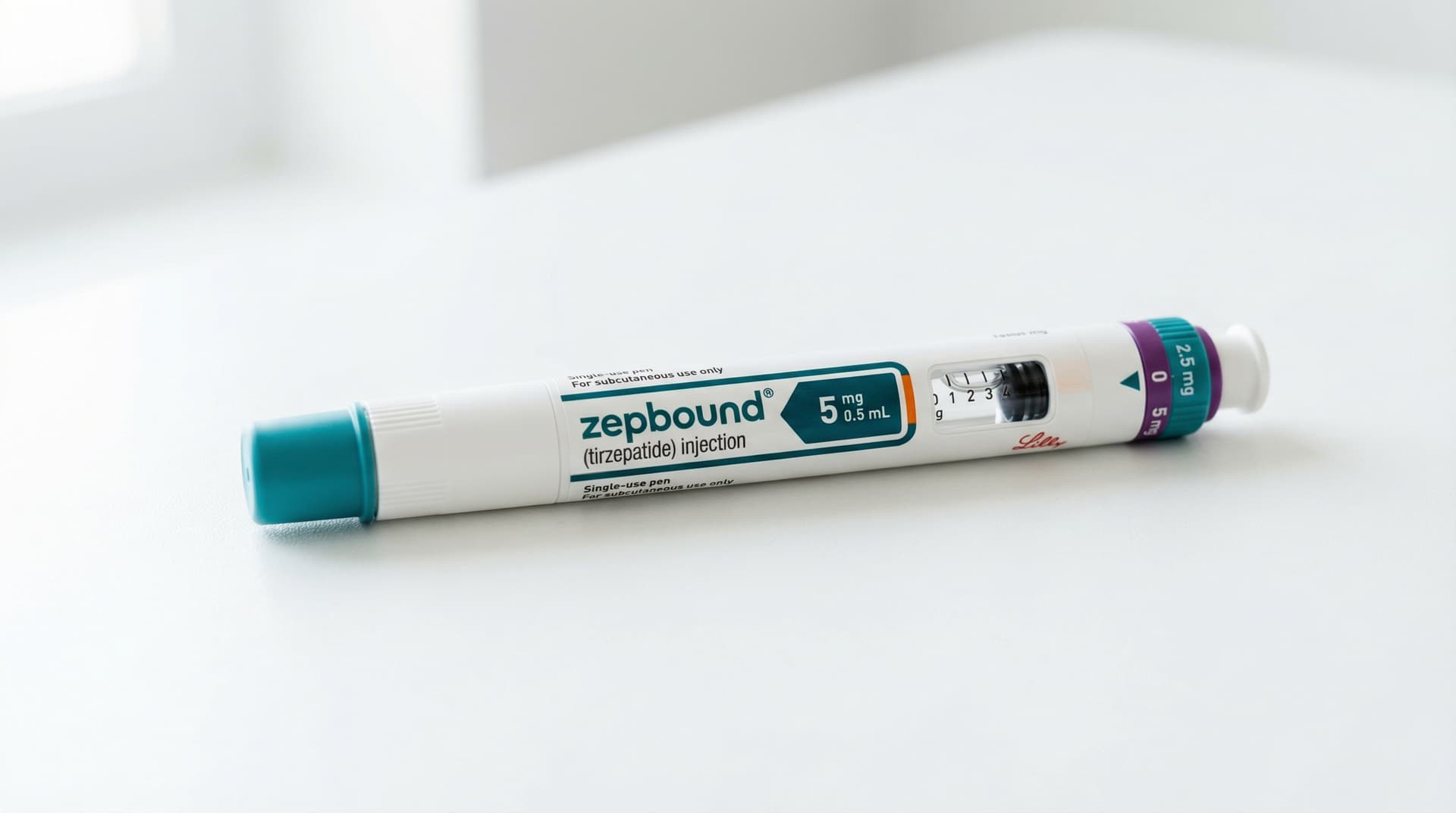
Zepbound lists at $1,086/month — but most patients never pay that. The six legitimate cheaper paths in September 2026: $25/mo via Lilly Savings Card (insured), $50/mo via Medicare Bridge (live since July 1), $119-$299/mo via compounded tirzepatide telehealth, $25/mo via Mounjaro Savings Card (if you have type 2 diabetes), and $299-$449/mo via LillyDirect vials or KwikPens (self-pay). The path that actually works for you depends on your insurance, your diagnosis, and how much paperwork you can handle. Here's the full breakdown.
The 6 paths to cheaper Zepbound (September 2026)
| Path | Monthly cost | Eligibility | Speed |
|---|---|---|---|
| Zepbound Savings Card | $25/mo (13 fills) | Commercial insurance + Zepbound coverage | 1-7 days |
| Medicare Bridge | $50/mo | Part D, BMI ≥35 (or ≥30/≥27 with a qualifying condition), live since Jul 1, 2026 | After prior auth |
| Mounjaro Savings Card | as low as $25/mo | Commercial insurance + Type 2 diabetes diagnosis | 1-7 days |
| Compounded tirzepatide | $119-$299/mo | None — cash-pay only | Same week |
| LillyDirect Zepbound vials or KwikPens | $299-$449/mo | None — direct order | 3-5 days |
| Brand Zepbound retail | $1,086/mo | None — full self-pay or insured | Standard |
The pure-cash buyer's cheapest legitimate path is compounded tirzepatide at $119/month via Embody or SnagRx. The insured buyer's cheapest path is the Zepbound Savings Card at $25/month if your plan covers Zepbound, or the Mounjaro Savings Card at $25/month if you have a type 2 diabetes diagnosis. Everyone else lands somewhere in between.
Path 1: Zepbound Savings Card — $25/month if you're insured
Eli Lilly's Zepbound Savings Card is the cheapest path for patients with commercial insurance whose plan covers Zepbound.
What it costs: $25/month copay for up to 13 fills per calendar year. After the 13 fills, the card resets if your plan still covers Zepbound in the next calendar year (the current card runs through December 31, 2026).
Who qualifies:
- Commercial (employer or marketplace) insurance — NOT Medicare, Medicaid, TRICARE, or VA
- Your plan must cover Zepbound (varies by employer formulary)
- BMI documentation per FDA label (≥30, or ≥27 with one weight-related condition)
- US resident
The catch: Many commercial plans dropped Zepbound coverage in 2025-2026. CVS Caremark removed Zepbound from formulary in mid-2026, affecting roughly 12 million members. If your plan doesn't cover Zepbound, the Savings Card can't get you to $25 — its non-covered tier brings a 1-month KwikPen down to as low as $299 (up to 11 fills per calendar year), roughly what LillyDirect self-pay charges anyway.
How to enroll: Visit Zepbound.com, click "Savings Card," fill out the eligibility form, and your prescriber transmits the script with the savings card code attached.
If your insurance dropped Zepbound, skip to Path 4 (Compounded) — same molecule, no insurance required.
Path 2: Medicare Bridge Program — $50/month, live since July 1, 2026
The Bridge Program is Medicare Part D's first GLP-1 weight-loss coverage in history. It launched July 1, 2026 and covers Wegovy (injection or tablet), the Zepbound KwikPen (not vials), and Foundayo at $50/month for eligible Part D enrollees.
Who qualifies:
- Medicare Part D enrolled
- BMI ≥35; or BMI ≥30 plus diastolic heart failure, uncontrolled hypertension, or CKD stage 3a+; or BMI ≥27 plus prediabetes, a prior heart attack or stroke, or symptomatic peripheral artery disease
- Documented obesity diagnosis from a prescriber
- Within Bridge program enrollment window (rolling enrollment, no annual lock-in)
Cost details: $50/month flat copay regardless of dose. Prior authorization (BMI documentation and a record of lifestyle modification) is required, and approved prior auths stay valid through December 31, 2027. The $50 copay stands on its own — it does not count toward your Part D deductible or out-of-pocket limit.
The catch: prior authorization (BMI documentation, a record of lifestyle modification) can take weeks, so start the paperwork with your Part D plan before you need the first fill. Full breakdown in our Medicare Bridge guide and Bridge prep checklist.
Path 3: Mounjaro Savings Card — $25/month if you have type 2 diabetes
This is the path most patients miss because it's not branded as "Zepbound." Mounjaro and Zepbound are chemically identical — same molecule (tirzepatide), same manufacturer (Eli Lilly), same dose strengths — just different FDA labels. Mounjaro is approved for type 2 diabetes; Zepbound is approved for chronic weight management.
At the same dose it is the same drug. If you have type 2 diabetes AND obesity, your prescriber can write you for Mounjaro instead of Zepbound — and the Mounjaro Savings Card drops your copay to $25/month.
Who qualifies:
- Commercial insurance (NOT Medicare/Medicaid/TRICARE/VA)
- Confirmed type 2 diabetes diagnosis (HbA1c ≥6.5% or fasting glucose ≥126 mg/dL)
- US resident
Detailed eligibility + enrollment walkthrough in our Mounjaro $25 savings card guide. Same-molecule explainer in Zepbound vs Mounjaro.
Path 4: Compounded tirzepatide — $119-$299/month, no insurance required
This is the cheapest path for patients without commercial insurance or with insurance that doesn't cover Zepbound. Compounded tirzepatide contains the same active ingredient as Zepbound, prepared by a US-licensed compounding pharmacy in dose-flexible vials rather than fixed-dose pre-filled pens.
The six verified programs, re-checked September 2026 (ranked by advertised tirzepatide price, lowest first):
- Embody — $119/month (our #1 pick; ties the cheapest verified tirzepatide price). Named-MD oversight, no membership fee, free shipping, cancel anytime.
- SnagRx — $119/month (12-month plan; $149 month-to-month). Ties the verified floor, holds one flat price as your dose escalates, free 1–2 day shipping.
- Trimi — $125/month (annual plan; $235 month-to-month). One flat price at every dose, free overnight shipping, no membership fee.
- bmiMD — $179/month (12-month plan; $249 month-to-month). No insurance required, flat pricing across doses.
- ShedRx — $239/month (12-month plan; $299 monthly). Both compounded and brand (Zepbound/Wegovy) pathway under one account, conditional 120-day guarantee.
- TrimRx — $259/month (advertised; month-to-month runs higher). Personalized MD consultations, price stays flat as your dose escalates, free shipping.
Why this is legitimate: All six dispense through 503A or 503B pharmacies registered with state boards or the FDA. Licensed US physicians prescribe after a real telehealth consult. The molecule itself is the same tirzepatide — same pharmacology, though compounded versions have no trial of their own and the outcomes.
What disqualifies a compounder: Selling "research-grade" tirzepatide (illegal for human use), importing API from unverified overseas sources, skipping the prescription requirement, or appearing in FDA enforcement actions.
Full ranking and credentialing comparison: Cheapest compounded tirzepatide online 2026.
Path 5: LillyDirect Zepbound vials or KwikPens — $299-$449/month self-pay
LillyDirect is Eli Lilly's direct-to-patient self-pay option for Zepbound. You skip the pharmacy markup and buy vials or KwikPens directly from Lilly's portal — and since March 2026 the self-pay KwikPens are sold at the same prices at major retail pharmacies too.
What it costs: $299-$449/month depending on dose, on the same schedule for vials and KwikPens. The 2.5 mg starting dose is $299; 5 mg is $399; every dose from 7.5 mg to 15 mg is $449 — provided you refill within 45 days of your previous fill (Lilly's Zepbound Journey Program). Miss that window and the regular prices apply: $499 for 7.5 mg and $699 for 10-15 mg. A month is 28 days — one KwikPen or four vials.
Who qualifies: Anyone with a valid Zepbound prescription. No insurance required, no income limit, no diagnosis requirement beyond the standard prescribing criteria.
How it works:
1. Your prescriber writes a Zepbound prescription 2. The prescription is transmitted to LillyDirect 3. You order vials or KwikPens online through your LillyDirect account 4. Lilly ships directly to your home in 3-5 days
The catch: Self-pay vials or KwikPens at $299-$449/month are still roughly 2.5-4× the cheapest compounded tirzepatide ($119). The only reasons to choose this path: you specifically want Eli Lilly's branded sterile-fill product, you're transitioning off the savings card, or your prescriber strictly refuses to write compounded.
Path 6: International pharmacy — not recommended
Some patients import Zepbound or Mounjaro from Canadian, Mexican, or UK pharmacies at lower prices. The FDA's official position is that personal-use importation of unapproved prescription drugs is illegal but rarely enforced for small quantities.
Why we don't recommend it:
- Quality control varies dramatically by source. Counterfeit GLP-1 injectables have been seized at US customs throughout 2024-2026.
- No US prescriber to manage side effects when something goes wrong (and tirzepatide has GI side effects that often need dose adjustment).
- Cost savings are smaller than they look. Imported Zepbound still costs several hundred dollars a month before currency conversion and shipping. Compounded tirzepatide at $119-$299 is cheaper AND legal AND comes with a US prescriber.
- Customs seizure risk. Larger orders get held; you lose both the medication and the payment.
There's no scenario in 2026 where international importation makes sense if compounded tirzepatide is available in your state — which it is in all 50.
Which path fits which patient?
A decision matrix based on your situation:
- Commercial insurance + your plan covers Zepbound: Savings Card (Path 1) at $25/month.
- Commercial insurance + type 2 diabetes diagnosis: Mounjaro Savings Card (Path 3) at $25/month — even if you're primarily using it for weight loss.
- Medicare Part D + obesity diagnosis: Enroll in the Bridge (Path 2) at $50/month.
- No insurance OR insurance dropped Zepbound: Compounded tirzepatide (Path 4) at $119-$299/month — Embody $119 is our #1 pick and ties the verified floor with SnagRx $119, and Trimi $125 holds one flat price at every dose.
- You specifically want branded Lilly product + can afford it: LillyDirect vials or KwikPens (Path 5) at $299-$449/month.
- Anyone considering international pharmacy: Don't. Pick Path 4 instead.
How much does Zepbound cost on each path over 12 months?
Annual cost comparison for each access path:
- Zepbound Savings Card: $300/year ($25 × 12)
- Medicare Bridge: $600/year ($50 × 12)
- Mounjaro Savings Card: $300/year ($25 × 12)
- Compounded tirzepatide (Embody or SnagRx): $1,428/year ($119 × 12)
- Compounded tirzepatide (TrimRx): $3,108/year ($259 × 12)
- LillyDirect vials or KwikPens: $3,588-$5,388/year ($299-$449 × 12, by dose)
- Brand Zepbound retail: $13,032/year ($1,086 × 12)
The savings card paths beat compounded by a wide margin if you qualify. If you don't, compounded beats LillyDirect by $2,160–$3,960/year ($299–$449 × 12 minus $1,428) and beats retail by $11,000+/year. The $1,086 retail price almost no one actually pays in 2026 — it's the "list price" that establishes the ceiling, not the floor.
Zepbound coupon FAQ
Does Zepbound have a manufacturer coupon?
Yes. The Zepbound Savings Card from Eli Lilly drops your copay to $25/month for up to 13 fills per calendar year, available to patients with commercial (not Medicare/Medicaid) insurance whose plan covers Zepbound. Enroll at Zepbound.com.
Can I get Zepbound for $25/month without insurance?
No — the $25 Savings Card requires commercial insurance coverage. If you're uninsured or your plan doesn't cover Zepbound, the cheapest legitimate path is compounded tirzepatide (same active ingredient) at $119-$299/month, or LillyDirect vials or KwikPens at $299-$449/month.
What's the cheapest way to get Zepbound without insurance?
Compounded tirzepatide at $119/month via Embody (SnagRx matches it) is the cheapest legitimate self-pay path. Same active ingredient as Zepbound (tirzepatide), prepared by a US-licensed compounding pharmacy, prescribed by a licensed US physician after a telehealth visit. LillyDirect vials or KwikPens from $299/month (2.5 mg) are the cheapest brand-name self-pay path.
Will my insurance cover Zepbound in 2026?
Coverage varies dramatically by plan. CVS Caremark dropped Zepbound from formulary in 2026, affecting ~12 million members. UnitedHealthcare, Cigna, Aetna, and most BCBS plans still cover Zepbound with prior authorization. Check your specific plan's formulary or use our insurance checker tool.
What's the difference between Zepbound Savings Card and Mounjaro Savings Card?
Same drug (tirzepatide), different FDA labels. Zepbound Savings Card requires a Zepbound prescription (obesity diagnosis). Mounjaro Savings Card requires a Mounjaro prescription (type 2 diabetes diagnosis). Both drop copays to $25/month for commercially insured patients. If you have both conditions, your prescriber can write either — pick the path with the better current savings card terms.
Is compounded tirzepatide really the same as Zepbound?
The active ingredient is identical — both contain tirzepatide. Differences: compounded comes in dose-flexible vials rather than fixed-dose pens, the inactive carrier solution may differ, and compounded versions don't carry FDA brand approval (the molecule itself has FDA approval). The pharmacology — dual GIP/GLP-1 receptor agonism — is the same regardless of dispensing pharmacy.
When does Medicare cover Zepbound?
Medicare Part D's Bridge Program has covered Zepbound, Wegovy, and Foundayo since July 1, 2026, at $50/month for eligible enrollees — BMI ≥35, or ≥30/≥27 with a qualifying condition (Zepbound KwikPen only). Original Medicare and Medicare Advantage plans did NOT cover GLP-1s for weight loss before July 2026. Full eligibility breakdown: Medicare GLP-1 Bridge guide.
How long can I use the Zepbound Savings Card?
Up to 13 fills per calendar year per eligible patient (11 on the non-covered tier). The current card expires December 31, 2026, and typically resets at the start of each calendar year if your plan still covers Zepbound. Lilly retains the right to modify or end the program.
---
The bottom line: the headline $1,086/month Zepbound retail price is almost never the price patients actually pay in 2026. With the right combination of insurance status, diagnosis, and pharmacy choice, the same tirzepatide molecule is available for $25, $50, $119, or $299/month — every legitimate path covered above.
For full provider-level pricing and credentialing data on the compounded paths, see our cheapest compounded tirzepatide ranking and the best GLP-1 programs page. For the long-term cardiovascular and kidney case for staying on a tirzepatide-class drug, see our Ozempic long-term safety post.