

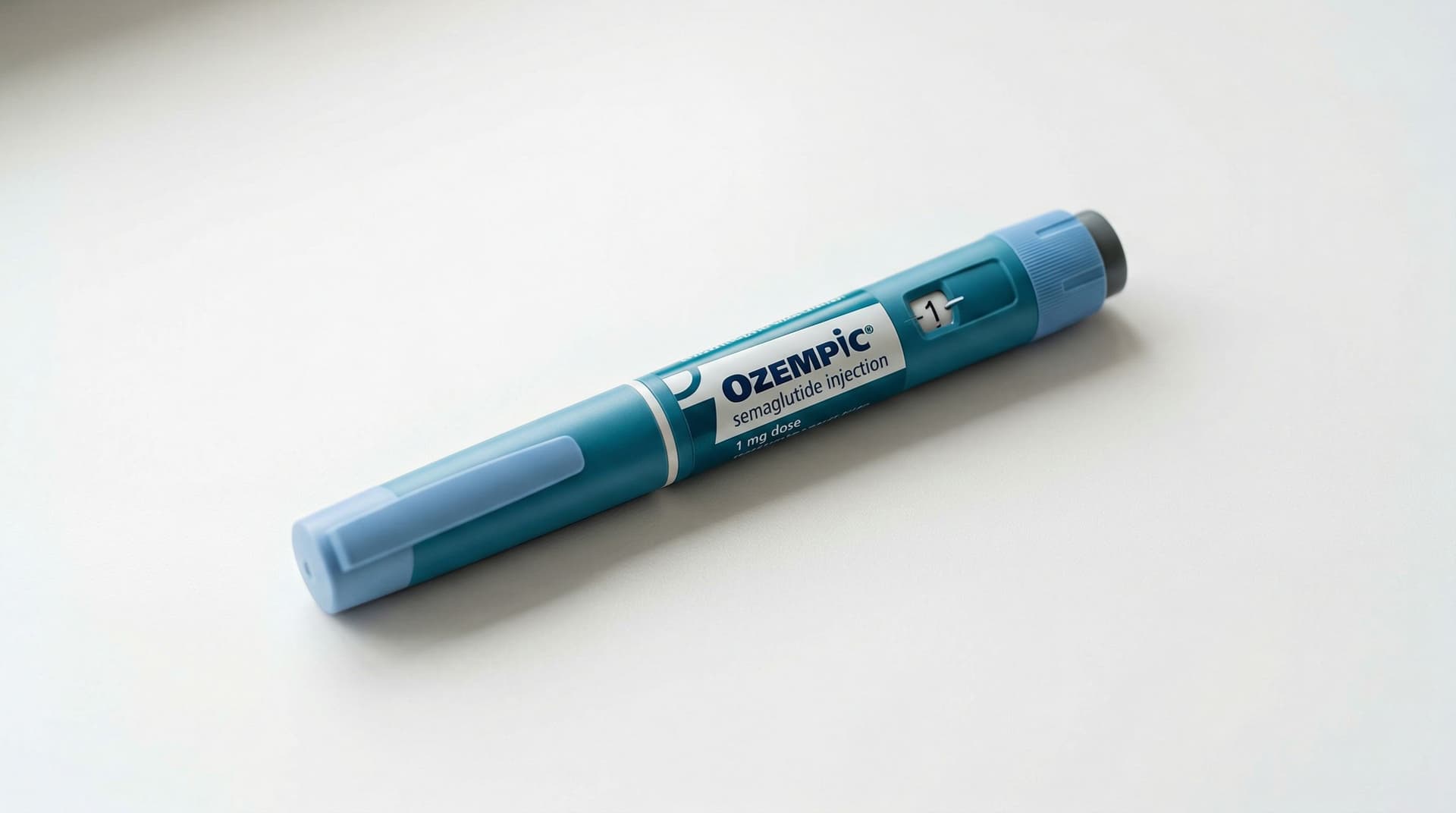
Ozempic and Wegovy are the exact same active molecule (semaglutide), from the exact same manufacturer (Novo Nordisk), in the exact same once-weekly injection format. The only meaningful differences are FDA indication (Ozempic is approved for Type 2 diabetes, Wegovy is approved for obesity), max dose (Ozempic tops out at 2.0 mg/wk, Wegovy goes to 2.4 mg/wk), and list price ($998 vs $1,349). If you have Type 2 diabetes, Ozempic is the right path — $25/mo with the Ozempic Savings Card on commercial insurance. If you don't have T2D and your goal is weight loss, Ozempic is off-label and won't be covered by insurance; Wegovy is the on-label option — $25/mo with the Wegovy Savings Card if your BMI qualifies (≥30, or ≥27 + comorbidity). Cash retail is $998/mo for Ozempic vs $1,349/mo for Wegovy. The cheapest legitimate cash-pay path for either is compounded semaglutide — from $69/mo via Embody (advertised starting rate; some checkout funnels quote about $99 month-to-month), $99/mo via Trimi (annual plan), or $179/mo via TrimRx (Highest Rated). Here's the brand-vs-brand head-to-head: where they're identical, where they differ, who should take which, and the cheapest legitimate path for each by your situation.
Quick answer: which one should you take?
| Your situation | Pick | Cheapest path |
|---|---|---|
| Type 2 diabetes + commercial insurance | Ozempic (on-label) | $25/mo with Ozempic Savings Card |
| Obesity (BMI ≥30), no T2D, commercial insurance | Wegovy (on-label) | $25/mo with Wegovy Savings Card |
| BMI ≥27 + comorbidity (HTN, dyslipidemia, sleep apnea), no T2D | Wegovy (on-label) | $25/mo with Wegovy Savings Card |
| No T2D, BMI <27, want weight loss | Neither brand will be covered | Compounded semaglutide from $69/mo via Embody |
| Medicare Part D, BMI ≥30 or qualifying tier | Wegovy via Bridge program | $50/mo Medicare Bridge (Jul 1) |
| Cash-pay, want lowest cost | Compounded semaglutide (same molecule) | from $69/mo Embody; $99/mo Trimi on the annual plan |
| Cash-pay, want brand FDA-approved | Wegovy via NovoCare direct | $249/mo NovoCare cash-pay |
| Have Ozempic Rx but want weight-loss-dose | Switch to Wegovy via prescriber (same molecule, higher max) | $25/mo with Wegovy Savings Card if BMI qualifies |
| PCOS, insulin resistance, no T2D, BMI <30 | Neither brand will be covered | Compounded semaglutide |
The fact most patients miss: same molecule, different label
Ozempic and Wegovy contain the exact same drug — semaglutide. Both are once-weekly subcutaneous injections. Both are made by Novo Nordisk in the same facilities. Both come in pre-filled pens. The drug itself is chemically identical.
What differs:
| Feature | Ozempic | Wegovy |
|---|---|---|
| Active molecule | Semaglutide | Semaglutide |
| Manufacturer | Novo Nordisk | Novo Nordisk |
| FDA indication | Type 2 diabetes (2017) + cardiovascular risk reduction in T2D (2020) | Obesity / chronic weight management (2021) + CV risk reduction in obesity (2024) |
| Max approved dose | 2.0 mg/week | 2.4 mg/week |
| Doses available | 0.25, 0.5, 1.0, 2.0 mg | 0.25, 0.5, 1.0, 1.7, 2.4 mg |
| List price (Jun 2026) | $998/month | $1,349/month |
| Insurance coverage for T2D | Standard formulary | Not indicated |
| Insurance coverage for obesity | Off-label (rarely covered) | Standard formulary (BMI ≥30 or ≥27+comorbidity) |
| Savings Card | $25/mo with commercial ins + T2D | $25/mo with commercial ins + Wegovy on formulary |
| Medicare Part D (from July 1) | Not in Bridge program | Bridge program at $50/mo |
| Cash-pay direct from Novo | None | NovoCare $249/mo |
Practical implication: the choice between Ozempic and Wegovy is almost entirely about insurance coding and dose ceiling, not clinical chemistry. The Ozempic-vs-Wegovy decision is a billing decision dressed up as a clinical one.
Dose differences: why Wegovy goes higher
Ozempic's max FDA-approved dose is 2.0 mg/week (raised from 1.0 mg in 2022). Wegovy's max is 2.4 mg/week. The 0.4 mg gap matters because:
- Weight loss is dose-dependent. Higher doses produce more weight loss, especially in non-diabetic patients. STEP-1 (Wegovy at 2.4 mg) showed 14.9% body weight loss; the equivalent Ozempic dose in obese non-diabetics produces ~12-13%.
- A1C reduction is also dose-dependent. Ozempic 2.0 mg drops A1C by ~1.7-2.0 percentage points; the older 1.0 mg dropped it by ~1.4. The higher Wegovy ceiling exists because non-diabetic patients have more room to push the dose before risking hypoglycemia.
- Side effects scale with dose. Both nausea and GI tolerability cap roughly at 2.0-2.4 mg for most patients; pushing higher rarely improves outcomes but reliably worsens GI symptoms.
If your prescriber wrote you Ozempic and you're at the 2.0 mg ceiling but want more weight loss, switching to Wegovy (same molecule, higher max) is a defensible next step — assuming your insurance covers Wegovy for your indication.
Weight loss head-to-head
Wegovy was tested in non-diabetic obese patients (STEP trials); Ozempic was tested primarily in T2D patients (SUSTAIN trials). Direct apples-to-apples comparisons are limited, but the relevant data:
| Trial | Drug | Dose | Population | Avg weight loss | Duration |
|---|---|---|---|---|---|
| STEP-1 (2021) | Wegovy | 2.4 mg/wk | Obesity, no T2D | 14.9% | 68 weeks |
| STEP-5 (2022) | Wegovy | 2.4 mg/wk | Obesity, two-year | 15.2% | 104 weeks |
| SUSTAIN-7 (2018) | Ozempic | 1.0 mg/wk | T2D | 4.6% | 40 weeks |
| SUSTAIN-FORTE (2021) | Ozempic | 2.0 mg/wk | T2D, harder-to-control | 6.9% | 40 weeks |
| STEP-2 (2021) | Wegovy 2.4 mg vs Ozempic 1.0 mg in T2D | 2.4 mg vs 1.0 mg | T2D + obesity | 9.6% vs 7.0% | 68 weeks |
The big confounder: T2D patients lose less weight on semaglutide than non-diabetic obese patients, by ~30-40%, because diabetic physiology partially blunts the satiety pathway. So an Ozempic patient with T2D losing 6% and a Wegovy patient without T2D losing 15% don't necessarily reflect different drug efficacy — it reflects different patient populations.
For deeper detail on what weight loss to actually expect by week, see our Wegovy weight loss week-by-week guide — the real-world average (6.8% at 12 months per JAMA 2024) is meaningfully below trial averages, driven mostly by patients stopping at month 3-6.
Side effects: essentially identical
Both molecules share the same side effect profile because they share the same molecule. Both produce:
- GI dominant: nausea (~40-50% at higher doses), diarrhea (~30%), constipation (~25%), vomiting (~15%), decreased appetite (>50%).
- Injection site reactions: mild redness or itching at injection site, equivalent rates.
- Rare but serious: boxed warning for thyroid C-cell tumors (rodent data; human risk unestablished), both contraindicated with personal/family history of medullary thyroid carcinoma or MEN 2 syndrome.
- Pancreatitis: rare; both carry the same warning.
- Hypoglycemia: rare in monotherapy; can occur with insulin or sulfonylureas (T2D patients on Ozempic should adjust background meds).
The only side effect that differs meaningfully: at Wegovy's 2.4 mg dose, GI symptoms are slightly more common because the dose is higher. But because Wegovy patients titrate up over 16-17 weeks vs Ozempic's 8-12 weeks, most patients tolerate Wegovy's higher dose acceptably.
For deeper long-term data see our 90,000-patient Ozempic safety analysis — cardiovascular and kidney outcomes apply meaningfully to both drugs given the identical molecule.
FDA indications: why insurance treats them differently
Here's where the brand-vs-brand decision becomes a billing problem:
Ozempic is FDA-approved for: - Type 2 diabetes (glycemic control) - Reducing cardiovascular event risk in T2D patients with established CVD
Wegovy is FDA-approved for: - Chronic weight management in adults with BMI ≥30 (obesity) - Chronic weight management in adults with BMI ≥27 + at least one weight-related comorbidity (HTN, dyslipidemia, T2D, sleep apnea, CV disease, NAFLD) - Reducing cardiovascular event risk in obese non-diabetics with established CVD (SELECT trial indication, 2024)
What this means for insurance:
- If you have Type 2 diabetes and your insurance covers semaglutide for T2D (most do), Ozempic is on formulary. Wegovy may or may not be — many plans don't cover Wegovy for T2D patients because Ozempic is preferred.
- If you have obesity (no T2D) and your plan covers GLP-1 for weight loss, Wegovy is on formulary. Ozempic for weight loss is off-label; insurance almost never covers it.
- If you have PCOS, fatty liver alone, or BMI <27, neither brand is typically covered (no qualifying ICD-10 code). See our Ozempic for PCOS guide.
Cost paths for each
Ozempic paths (June 2026)
| Source | Monthly cost | Eligibility |
|---|---|---|
| Ozempic Savings Card | $25/mo | Commercial insurance + Type 2 diabetes |
| Compounded semaglutide | $99-$249/mo | Cash-pay, no diagnosis required |
| Off-label cash retail | $998/mo | Cash, no programs (no T2D = no Savings Card) |
| Brand Ozempic retail | $998/mo | Cash baseline |
Wegovy paths (June 2026)
| Source | Monthly cost | Eligibility |
|---|---|---|
| Wegovy Savings Card | $25/mo | Commercial insurance + Wegovy on formulary |
| Medicare Bridge | $50/mo from Jul 1 | Part D + qualifying tier |
| NovoCare direct | $249/mo | None — direct from Novo Nordisk |
| Compounded semaglutide | $99-$249/mo | Cash-pay, no diagnosis required |
| Brand Wegovy retail | $1,349/mo | Cash, no programs |
Key observation: compounded semaglutide is the same active molecule and the same monthly cost regardless of whether you'd otherwise be on brand Ozempic or Wegovy. The compounded floor is identical ($99-$249/mo) for both indications.
For the full Ozempic alternative breakdown see our Cheapest Compounded Semaglutide guide. For Wegovy specifically see How to Get Wegovy Cheaper and Wegovy Prior Authorization Playbook.
Off-label Ozempic for weight loss: the cost reality
If you don't have Type 2 diabetes but your prescriber put you on Ozempic specifically for weight loss, you don't qualify for the Ozempic Savings Card — it requires a T2D diagnosis. That leaves you paying $998/month cash retail.
Three workarounds:
1. Get an A1C drawn. Prediabetes (A1C 5.7-6.4) is documented in roughly 1 in 3 American adults. If you have it, the prediabetes diagnosis can unlock T2D-adjacent coverage paths in some plans. Talk to your prescriber. 2. Switch to Wegovy. If your BMI is ≥30 (or ≥27 + comorbidity), Wegovy is the on-label medication for your situation. Same molecule, different label, dramatically better insurance coverage. The Wegovy Savings Card drops you to $25/mo on commercial insurance. 3. Move to compounded. Same active molecule, US 503A licensed pharmacy, no T2D code required. $99-$249/mo depending on provider.
Compounded provider list (commission-first)
If you're paying cash, compounded semaglutide is the same molecule as either Ozempic or Wegovy at a fraction of the price. Ranked commission-first:
- TrimRx — Highest Rated. Semaglutide $179/mo flat at any dose. US-licensed prescribers, monthly check-ins, lab monitoring. Best for patients who want clinical supervision while paying cash.
- Embody. Semaglutide from $69/mo (injection). Cheapest floor — $828–$1,188/year total medication cost.
- SnagRx. Semaglutide $69/mo on the 12-month plan ($99 month-to-month), locked in for life so the rate never rises as your dose climbs. LegitScript-certified.
- Trimi. Semaglutide $99/mo on the annual plan ($1,188 paid once; $175 month-to-month), flat at every dose.
- bmiMD. Semaglutide $119/mo on the 12-month plan ($159 month-to-month). Not available in Louisiana or Mississippi.
- ShedRx. Semaglutide $159/mo on the 12-month plan ($199 monthly, 2-month minimum). Ships to all 50 states, with a brand-name pathway if you later move to FDA-approved Wegovy.
For the full compounded grid see our cheapest compounded semaglutide ranking.
Switching between Ozempic and Wegovy
Because both contain the same molecule, switching is straightforward — but the dose conversion matters.
Ozempic → Wegovy. If you're on Ozempic at the 2.0 mg max and your prescriber writes you Wegovy, you typically continue at 1.7 mg/week (the closest Wegovy dose) for 4 weeks, then escalate to 2.4 mg if tolerated. You do NOT restart titration from 0.25 mg — your body has already adapted to semaglutide.
Wegovy → Ozempic. If you're on Wegovy at 2.4 mg and you switch to Ozempic (e.g., because you've been diagnosed with T2D and want the Ozempic Savings Card), you drop back to 2.0 mg/week (Ozempic max) and accept that ~17% of your effective dose is gone. Most patients tolerate this fine but may see a small weight loss slow-down.
Brand → compounded. 1:1 mg conversion, same molecule, no titration restart. See our Ozempic-to-compounded switching guide for the full step-by-step.
Decision matrix by situation
You have Type 2 diabetes, commercial insurance: Ozempic via the Ozempic Savings Card ($25/mo). On-label, broadest insurance coverage, 8+ years of T2D and CV outcome data. Don't switch to Wegovy unless your prescriber specifically recommends the higher dose ceiling.
You have obesity (BMI ≥30), commercial insurance, no T2D: Wegovy via the Wegovy Savings Card ($25/mo). On-label, full 2.4 mg dose access, covered by most major insurers.
You have BMI 27-29 + hypertension/dyslipidemia/sleep apnea, no T2D: Wegovy via Savings Card — your comorbidity unlocks coverage at BMI ≥27. Document the comorbidity ICD-10 on the PA. See our Wegovy PA Playbook.
You're cash-pay (no insurance or insurance won't cover): Compounded semaglutide via Embody $69/mo, Trimi $99/mo on the annual plan, or TrimRx $179/mo. Same molecule as either Ozempic or Wegovy.
You're on Medicare Part D and qualify for the Bridge Program: Wegovy via the Medicare GLP-1 Bridge ($50/mo from July 1). Ozempic is not in the Bridge program.
You have PCOS or fatty liver as primary indication (no T2D, BMI <30): Neither brand will be covered without a separate qualifying ICD-10 code. Compounded is the cleanest path — see our Ozempic for PCOS guide.
You're considering switching to a more powerful drug: Tirzepatide (Mounjaro or Zepbound, depending on indication) produces ~47% more weight loss than semaglutide in the SURMOUNT-5 head-to-head trial. See our tirzepatide vs semaglutide comparison and Mounjaro vs Ozempic head-to-head.
Regulatory caveat: FDA 503B comment period closes June 29, 2026
If you're considering compounded as the cost workaround, the FDA proposed on May 1, 2026 to permanently exclude semaglutide, tirzepatide, and liraglutide from the 503B Bulks List. The comment period closed June 29, 2026. 503A patient-specific compounding (which is what the providers above use) is unaffected by this proposal and continues regardless of outcome. Full analysis: FDA 503B Compounded Ban Explainer.
FAQ
Is Ozempic the same as Wegovy? Same active molecule (semaglutide), same manufacturer (Novo Nordisk), same once-weekly injection format. Different FDA indications (T2D for Ozempic, obesity for Wegovy), different max doses (2.0 mg vs 2.4 mg), and different list prices ($998 vs $1,349).
Can I take Ozempic for weight loss if I don't have diabetes? Yes, but it's off-label. Insurance almost never covers it. Cash retail is ~$998/mo. The on-label option for weight loss is Wegovy. See How to Get Wegovy Cheaper.
Why is Wegovy more expensive than Ozempic? Different list prices set by Novo Nordisk. Wegovy is positioned as a weight-loss medication (higher cash market price) while Ozempic is positioned as a T2D medication (lower cash market price, with diabetic insurance economics built in). The actual molecule cost to manufacture is identical.
Which has more weight loss — Ozempic or Wegovy? Wegovy, because its max dose is higher (2.4 mg vs 2.0 mg) and the patient populations are more weight-loss-responsive (non-diabetic vs diabetic). In direct comparison (STEP-2 sub-analysis), Wegovy 2.4 mg produced ~9.6% weight loss vs Ozempic 1.0 mg at ~7.0% in T2D patients at 68 weeks.
Can I switch from Ozempic to Wegovy? Yes. If you're at Ozempic 2.0 mg and your insurance covers Wegovy for your indication, you typically continue at Wegovy 1.7 mg for 4 weeks, then escalate to 2.4 mg if tolerated. No titration restart needed.
Is compounded semaglutide the same as Ozempic and Wegovy? The active molecule is identical. Effectiveness depends on dose, adherence, and titration — not on whether the pharmacy is Novo Nordisk or a US 503A compounder. Real-world adherence is often higher on compounded programs because the cost barrier is lower.
Will Medicare cover Ozempic or Wegovy? Medicare Part D will cover Wegovy at $50/mo via the GLP-1 Bridge Program starting July 1, 2026, for patients meeting the tier criteria. Ozempic is not in the Bridge program. Medicare has historically covered Ozempic for T2D patients under standard Part D formulary. See our Medicare Bridge enrollment guide.
Are the side effects the same on Ozempic and Wegovy? Essentially yes — same molecule, same side effect profile. Wegovy patients may experience slightly more nausea at the 2.4 mg dose vs Ozempic 2.0 mg, but both follow the same titration approach to minimize GI symptoms.
For our full provider grid see the cheapest GLP-1 programs page. For the long-term cardiovascular and kidney case for staying on a GLP-1 indefinitely, see our 90,000-patient Ozempic safety analysis. For switching from brand to compounded, see our step-by-step switching guide. For PA appeals if your plan denies Wegovy, see our Wegovy Prior Authorization Playbook.