

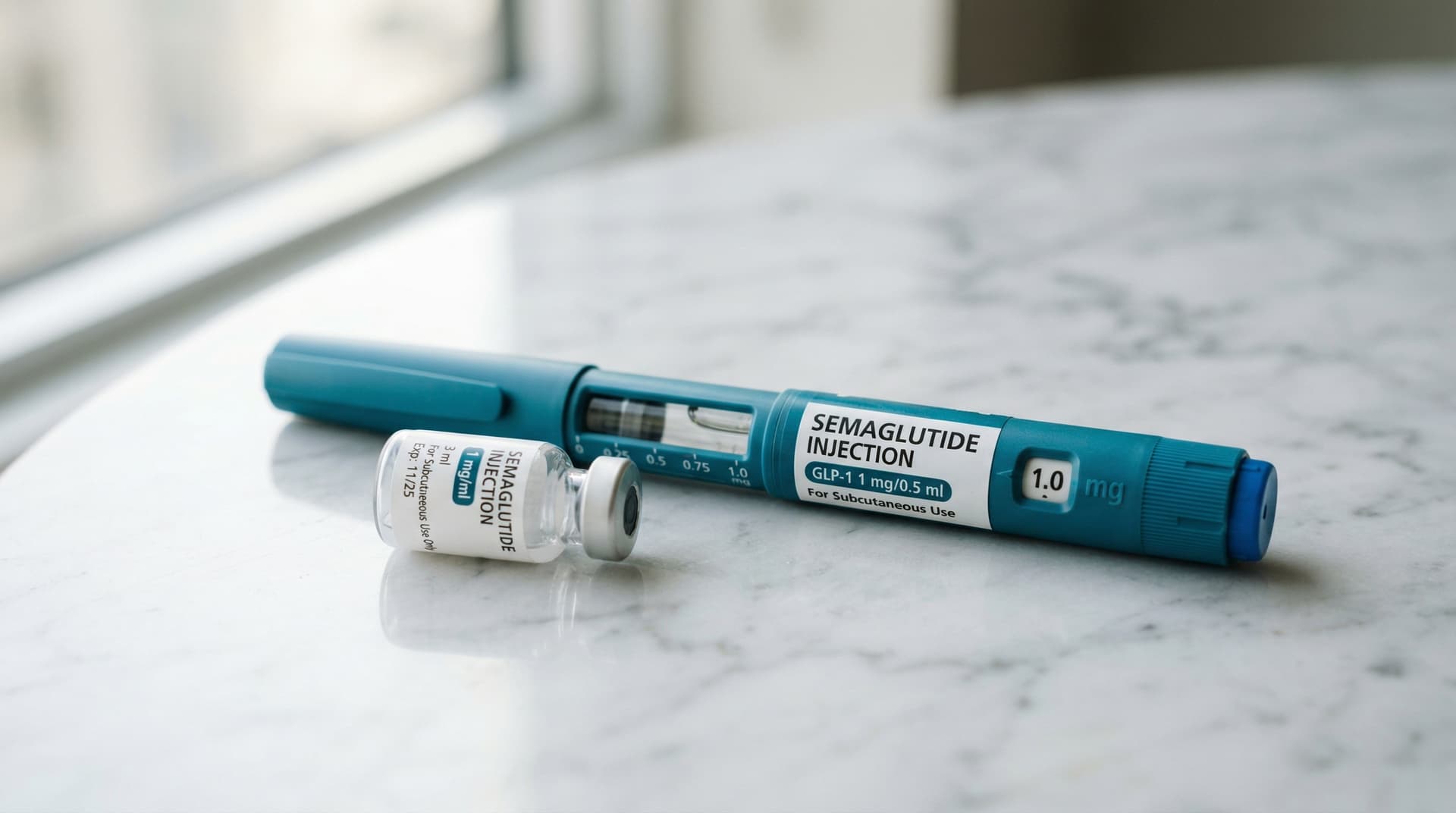
Your prescription is written in milligrams (mg), but you draw the medicine in units on an insulin syringe — and the two are not the same thing. Units measure *volume*, not dose: on a standard U-100 insulin syringe, 100 units equals 1 mL of liquid. How many milligrams that volume contains depends entirely on your vial's concentration (its mg per mL). Get the concentration wrong and you can be off by 2x, 5x, even 10x. Here is exactly how the two connect, the full chart, and why your unit count changes the moment you switch providers.
Important: this is general educational information, not medical advice or a dosing instruction. Your prescriber and pharmacy tell you your dose and how to draw it — always follow their directions, and confirm with them if anything looks different after a change. Use this only to understand and sanity-check the numbers.
Switched providers and your syringe count suddenly looks different? That is usually normal — a different vial strength, not a mistake — but it is worth confirming. If you are shopping for a lower price, see the best verified GLP-1 providers or the lowest verified price at Embody (from $69/mo), and always re-check your units against the new vial.
Why your prescription is in mg but your syringe is in units
The dose that matters clinically is the milligram amount — 0.25 mg, 0.5 mg, 1.0 mg, and so on. That is what your prescriber titrates.
But a syringe cannot measure milligrams directly. It measures volume — how much liquid you pull into the barrel. On the U-100 insulin syringes used for GLP-1s, the markings are in "units," where 100 units = 1 mL. So "20 units" simply means 0.20 mL of liquid, nothing more.
The bridge between the two is concentration — how many milligrams are packed into each mL of your vial. A more concentrated vial delivers more mg in the same volume, so you draw fewer units for the same dose.
The formula: how to convert mg to units
There is one formula, and it always works:
Units = (your dose in mg ÷ the vial's concentration in mg/mL) × 100
The "× 100" is just the U-100 conversion (100 units per mL). Two quick examples with a 0.5 mg dose:
- Vial is 2.5 mg/mL: 0.5 ÷ 2.5 = 0.2 mL → 20 units
- Vial is 5 mg/mL: 0.5 ÷ 5 = 0.1 mL → 10 units
Same 0.5 mg dose, half the units, because the second vial is twice as strong. This is the entire concept in one line.
Semaglutide dosage chart (units by vial strength)
Compounded semaglutide most commonly comes in 2.5 mg/mL, 5 mg/mL, or 10 mg/mL. Find your dose in the left column, then read across to your vial's concentration. Confirm your vial's mg/mL first — the wrong column is a real dosing error.
| Semaglutide dose | 2.5 mg/mL vial | 5 mg/mL vial | 10 mg/mL vial |
|---|---|---|---|
| 0.25 mg | 10 units | 5 units | 2.5 units |
| 0.5 mg | 20 units | 10 units | 5 units |
| 1.0 mg | 40 units | 20 units | 10 units |
| 1.7 mg | 68 units | 34 units | 17 units |
| 2.0 mg | 80 units | 40 units | 20 units |
| 2.4 mg | 96 units | 48 units | 24 units |
Notice how the same 1.0 mg dose is 40 units, 20 units, or 10 units depending only on the vial. The dose is identical; the syringe count is not.
Why your unit count changes when you switch providers
This is the single most common source of confusion — it comes up constantly in patient forums, usually as "my new provider's meds feel different" or "am I underdosing?"
Here is what is actually happening: when you switch telehealth providers or pharmacies, your mg dose usually stays the same, but the new pharmacy often compounds at a different concentration. So the number of units you draw changes even though your actual dose did not. Someone moving from a 2.5 mg/mL vial to a 5 mg/mL vial at the same 1.0 mg dose goes from 40 units to 20 units — and if they kept drawing 40 units out of habit, they would take a double dose.
The takeaways:
- Never carry over your old unit number to a new vial. Re-derive it from the new concentration every time you switch.
- Never copy someone else's units from a forum. Their vial strength is probably not yours. Copy the *mg dose* if anything, never the units.
- A different unit count after a switch is not a red flag by itself — it is expected. What matters is that the *mg* matches what your prescriber ordered.
Tirzepatide dosage chart (units by vial strength)
The same formula applies to tirzepatide (Mounjaro, Zepbound, or compounded). Concentrations vary more widely here, so these are two common example strengths — again, check your own vial. At around 10 mg/mL the top doses exceed a single 1 mL syringe, which is one reason higher-dose vials are usually more concentrated.
| Tirzepatide dose | 10 mg/mL vial | 20 mg/mL vial |
|---|---|---|
| 2.5 mg | 25 units | 12.5 units |
| 5 mg | 50 units | 25 units |
| 7.5 mg | 75 units | 37.5 units |
| 10 mg | 100 units | 50 units |
| 12.5 mg | 125 units (over 1 mL) | 62.5 units |
| 15 mg | 150 units (over 1 mL) | 75 units |
How to find your vial's concentration
Your concentration is on the vial label or your pharmacy paperwork. Two ways it is shown:
- Stated directly, e.g. "Semaglutide 5 mg/mL." Use that number.
- As a total, e.g. "Semaglutide 20 mg / 2 mL." Divide: 20 ÷ 2 = 10 mg/mL.
If the label only lists a total amount and a total volume, concentration is just total mg ÷ total mL. If you cannot find it or the label is ambiguous, call the pharmacy and ask before you draw — do not estimate.
Dosing safety: don't guess with units
The FDA has specifically warned about dosing errors with compounded injectable semaglutide, and unit-versus-mg-versus-concentration confusion is a big reason why. A patient who mixes up units and milligrams, or applies the wrong concentration, can accidentally take several times their intended dose — which is how people end up in the ER with severe nausea, vomiting, and dehydration.
Protect yourself with a few habits:
- Confirm the mg dose your prescriber ordered, then derive the units from *your* vial's concentration.
- Double-check the label every refill — compounded concentrations can change between batches or providers.
- When in doubt, ask your pharmacist to confirm the units for your dose. It takes two minutes.
- Use the right syringe. A U-100 insulin syringe is standard; the chart above assumes it.
What this means when you switch to a cheaper provider
None of this should scare you off switching to a lower-cost provider — compounded semaglutide runs about $69-$99/month and compounded tirzepatide about $119-$150/month, far below brand prices, and switching to save money is completely reasonable. It just means one extra step: when your new vial arrives, read its concentration and recalculate your units. Same dose, possibly a different number on the syringe.
| Option | Typical monthly cost | Same molecule as |
|---|---|---|
| Compounded semaglutide (cash) | ~$69-$99 | Ozempic / Wegovy |
| Compounded tirzepatide (cash) | ~$119-$150 | Mounjaro / Zepbound |
| Brand Wegovy (self-pay) | ~$499 | — |
| Brand retail (no discounts) | ~$1,000-$1,350 | — |
If you are comparing providers, start with the best verified GLP-1 providers ranked by price and credentialing, or see the cheapest GLP-1 guide — and whichever you pick, confirm your units against the vial they send.
FAQ
How do I convert my semaglutide mg dose to units? Use units = (dose in mg ÷ vial concentration in mg/mL) × 100. For example, a 0.5 mg dose from a 2.5 mg/mL vial is 0.5 ÷ 2.5 × 100 = 20 units. The "× 100" is because a U-100 insulin syringe has 100 units per mL.
How many units is 0.25 mg of semaglutide? It depends on your vial's concentration. At 2.5 mg/mL it is 10 units, at 5 mg/mL it is 5 units, and at 10 mg/mL it is 2.5 units. Always confirm your vial's mg/mL before drawing.
Why did my unit count change when I switched providers? Because the new pharmacy likely compounds at a different concentration. Your mg dose is usually the same, but a stronger vial means fewer units for that same dose. Re-derive your units from the new vial rather than reusing the old number.
Are units and milligrams the same thing? No. Milligrams are the actual drug dose; units measure the volume of liquid you draw (100 units = 1 mL on a standard insulin syringe). How many mg are in a given number of units depends entirely on the vial's concentration.
Can I use another patient's unit count from a forum? No — that is dangerous. Their vial concentration is probably different from yours, so the same units could be a very different dose. Match the mg your prescriber ordered and calculate units from your own vial.
What if I can't find my vial's concentration? Look for a stated mg/mL, or divide the total mg by the total mL on the label (for example, 20 mg / 2 mL = 10 mg/mL). If it is unclear, call your pharmacy and confirm before injecting rather than estimating.
The bottom line
Milligrams are your dose; units are just the volume you draw to deliver it, and the link between them is your vial's concentration. Keep the formula handy — units = mg ÷ mg/mL × 100 — read your own label, and recalculate every time you switch providers or refill, because a different vial strength changes the units even when your dose does not. When in doubt, confirm with your pharmacist. If you are switching to save money, start with the best verified providers or the cheapest GLP-1 guide, and check your units against the new vial.