
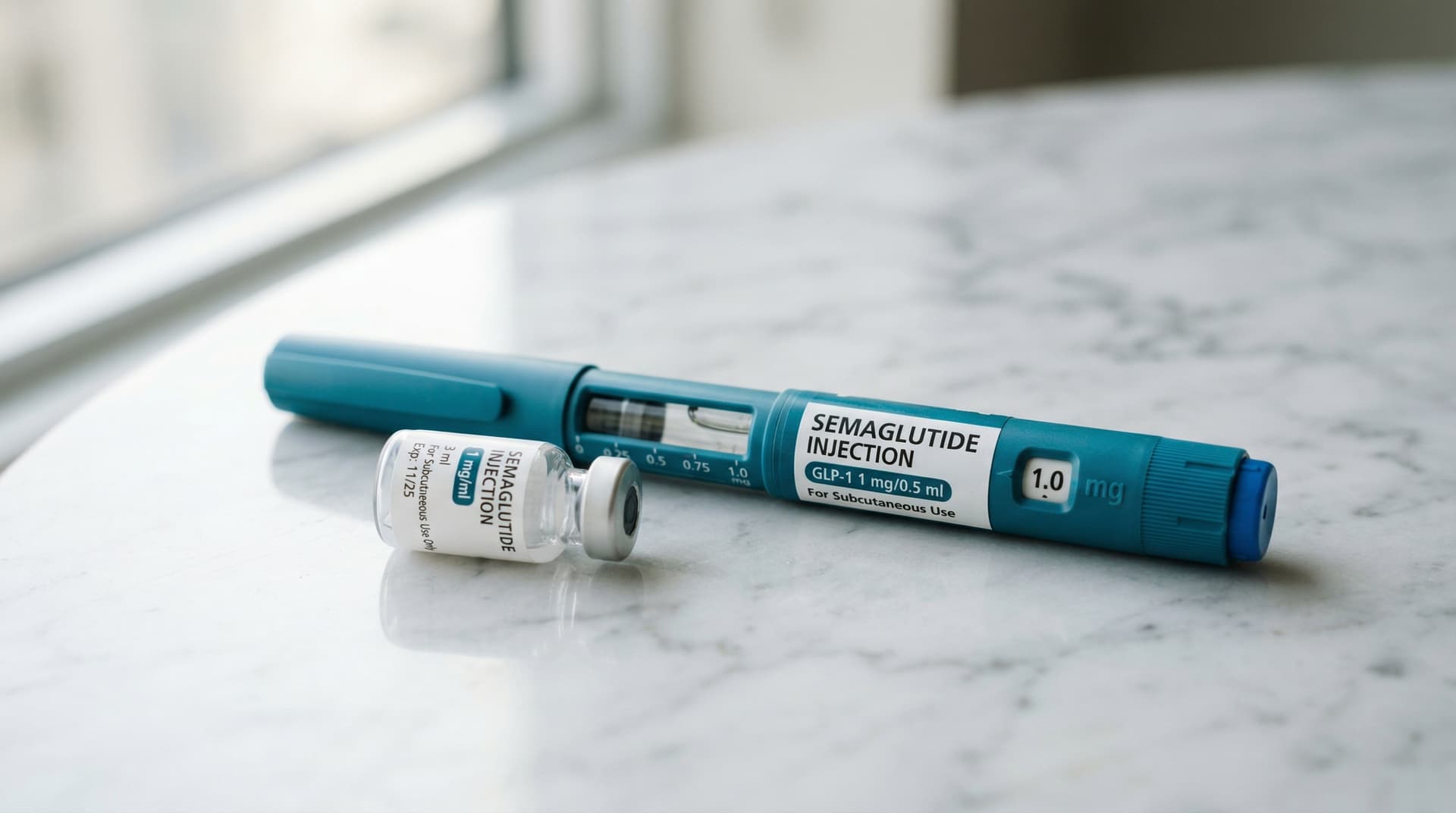
Brand Ozempic retails at $998/month. Compounded semaglutide — the same active molecule — costs $69-$199/mo from a licensed US telehealth pharmacy. If your insurance just dropped semaglutide coverage or you were paying cash, switching saves $700-$900/month with no clinical compromise on dose, frequency, or efficacy. The 5 tracked programs that ship reliably: TrimRx at $179/mo (Provider record), Embody at $69/mo (cheapest), SnagRx at $69/mo on the 12-month plan, bmiMD at $119/mo on the 12-month plan, and ShedRx at $159/mo on the 12-month plan. Below: the exact dose conversion, the timing trick to switch mid-cycle, what to do with leftover Ozempic, and when NOT to switch.
Should you switch from Ozempic to compounded semaglutide?
Yes, if any of these apply: - Your insurance dropped semaglutide coverage in 2025 or 2026 (millions did — see our 24M lost coverage report) - You were paying cash retail ($700-$1,000/mo) for Ozempic off-label for weight loss - Your Ozempic savings card maxed out at 12 fills and you're now at full copay - You're on Medicare Part D and don't qualify for the July 1 $50/mo bridge
No, wait, or rethink, if: - You have a Type 2 diabetes diagnosis AND commercial insurance — your Ozempic copay is likely $25-$50/month and that's already cheaper than compounded - You qualify for Medicare's $50/month GLP-1 bridge starting July 1, 2026 (Part D + BMI ≥35, or ≥30/≥27 with qualifying conditions — check the tiers) — wait the 25 days - You're within 2 weeks of a planned dose escalation — finish that cycle on Ozempic first - You have pancreatitis, gallbladder disease, or thyroid C-cell tumor history — the compounded path uses the same molecule and same risks; talk to your prescriber
The cost math: why switching saves $700+/month
| What you pay for Ozempic | Monthly cost |
|---|---|
| Cash retail (no insurance / off-label) | $998-$1,060/mo |
| Insured copay (Type 2 diabetes, commercial) | $25-$50/mo |
| Insured copay (no T2D, dropped coverage) | Full retail or denied |
| Ozempic Savings Card (T2D, commercial, max 12 fills) | $25/mo |
| What you'd pay for compounded semaglutide | Monthly cost |
|---|---|
| SnagRx (12-month plan; $99 month-to-month) | $69/mo |
| Embody | from $69/mo (advertised starting rate; some checkout funnels quote about $99 month-to-month) |
| bmiMD (12-month plan; $159 month-to-month) | $119/mo |
| ShedRx (12-month plan; $199 monthly) | $159/mo |
| TrimRx (Provider record, flat) | $179/mo |
Net savings if you were paying cash retail: $699-$990/month, or $9,600-$11,880/year. Net savings if your insurance just dropped you: the difference between full retail ($998+) and $69-$199, which is also in the $700-$900/month range.
Dose conversion: Ozempic → compounded semaglutide
The active molecule is identical (semaglutide). The dose conversion is 1:1 by milligram. You stay on the exact mg you were on with Ozempic — no titration restart needed if the new provider continues your existing dose.
| Your Ozempic dose | Switch to compounded at |
|---|---|
| 0.25 mg / week (starting) | 0.25 mg / week |
| 0.5 mg / week | 0.5 mg / week |
| 1.0 mg / week | 1.0 mg / week |
| 1.7 mg / week | 1.7 mg / week |
| 2.0 mg / week (max) | 2.0 mg / week |
| 2.4 mg / week (Wegovy-equivalent) | 2.4 mg / week |
Important nuance: Compounded semaglutide is dispensed as a multi-dose vial measured in mg per mL (usually 2.5 mg/mL or 5 mg/mL). You'll draw your dose with a small insulin syringe rather than clicking a pre-filled pen. Every legitimate program ships with syringes, alcohol wipes, and a dose chart. The first injection is the only awkward part — by week two it's routine.
Programs that handle dose continuity best: TrimRx — its intake form explicitly asks your current Ozempic dose and prescribes the matching compounded dose without restarting titration.
The 5 programs ranked for switchers
1. TrimRx — $179/month (Provider record for switchers)
TrimRx ("Jrnys") is the cleanest switch experience: $179/month flat covers medication at any dose, no surprise charges when you continue at 1.0mg or 2.4mg. The intake form has a dedicated "currently taking Ozempic" path that skips the titration restart most programs default to.
Switch-friendly because: Flat pricing at all doses (some programs charge 30-50% more at higher doses); explicit continuity from brand prescriptions; 5-7 day shipping; LegitScript-listed 503B pharmacy.
2. Embody — $69/month (cheapest legit)
Embody is the cheapest credentialed compounded GLP-1 program from $69/month for injections. For a pure cost-driven switch — you know compounded works and you want the lowest monthly bill — Embody is the floor.
Switch-friendly because: Lowest ongoing cost (literally 1/10th of Ozempic retail); HSA/FSA eligible; oral GLP-1 gum option for needle-averse switchers.
Worth knowing: Embody's advertised rate covers a starting dose; if you were on Ozempic 1.0mg+ and need to continue at that dose, ask their intake about higher-dose pricing during the call.
3. SnagRx — $69/month on the 12-month plan ($99 month-to-month)
SnagRx matches the category-low price and locks it in for life on the 12-month plan, so continuing at 1.0 mg or 2.4 mg costs the same as the starter dose. If you don't want a year-long commitment while you test the compounded experience, the $99 month-to-month rate is the cheapest no-commitment option among tracked programs.
Switch-friendly because: Price locked for life at any dose; month-to-month option with no long lock-in; LegitScript-certified.
4. bmiMD — $119/month on the 12-month plan ($159 month-to-month)
bmiMD prices compounded semaglutide at $119/month on the 12-month plan or $159 month-to-month. It does not ship to Louisiana or Mississippi, so confirm your state at intake.
Switch-friendly because: Month-to-month option if you want to test before committing to a year.
5. ShedRx — $159/month on the 12-month plan ($199 monthly)
ShedRx prices compounded semaglutide at $159/month on the 12-month plan or $199 monthly with a 2-month minimum, ships to all 50 states, and runs a brand-name pathway — so if you ever want to go back to Ozempic or Wegovy, you can do it without changing providers.
Switch-friendly because: Brand-name pathway if you switch back; all-50-state shipping.
Step-by-step: how to actually switch this month
Day 0 — Order your last Ozempic refill (don't skip it). You want overlap, not a gap. If your insurance just dropped coverage, fill any final approved scripts. If you're cash-pay, pick up enough to cover the 7-14 days between today and your first compounded shipment.
Day 1 — Pick a program, complete intake. TrimRx runs intake same-day. Be specific about your current Ozempic dose (mg) and the date of your last shot. The clinician will write a continuation prescription, not a starter dose.
Day 2-3 — Prescription transmitted to compounding pharmacy. This is the fastest leg. 503B outsourcing pharmacies queue compounded doses in batches; expect compounding to start within 24-48 hours of clinician approval.
Day 5-10 — Compounded shipment arrives. Refrigerated, multi-dose vial, syringes, alcohol wipes, dose chart. Verify the mg/mL concentration matches what the clinician told you.
Day 7 (or your next scheduled Ozempic day) — Take your first compounded dose. Draw the exact mg you'd have injected from your Ozempic pen. Same day of week. Same injection site rotation (abdomen, thigh, upper arm). The drug is identical — the only thing changing is the dispensing format.
Day 14 — Check in. Most programs prompt a 14-day follow-up. Side effects should match your prior Ozempic experience (nausea, mild GI). If they're meaningfully worse, message your prescriber — sometimes the inactive ingredients (B12, glycine) in compounded formulations cause mild differences.
What to do with leftover Ozempic pens
If you stop Ozempic mid-pen, you have ~3-4 doses left in the pen at any given dose. Two options:
1. Use them. Pens are stable refrigerated. You can finish the pen on the same week-of-the-week schedule, then start compounded the following week. This is the lowest-waste path. 2. Don't gift, sell, or share. Federal law prohibits transferring prescription medications. Local pharmacy take-back programs accept unused pens.
If your final Ozempic dose was the same mg as your compounded prescription, you can run them in parallel during the transition week — finish the pen on its normal day, take compounded the following week. Don't double-dose.
Red flags: when NOT to switch
- The program won't show their pharmacy's name. Legitimate programs name the 503A or 503B partner. If they dodge, walk away.
- No LegitScript verification. Most tracked programs are LegitScript-listed. Cross-check at legitscript.com before paying.
- Pricing more than $249/month for compounded semaglutide alone. That's the ceiling for legitimate cash-pay compounded sema in June 2026. Higher prices usually mean the program is bundling clinical fees, but it's also a margin signal.
- Pre-payment longer than 6 months. Programs asking for 12-month upfront are a financial-risk red flag, even if they're licensed. Compounding regulations could shift (see our update on the FDA personalized formulation rule).
- Generic "doctor on call" with no name or NPI. Every legitimate telehealth prescriber has a verifiable NPI number. Ask. They should provide it without resistance.
A note about July 1, 2026 (Medicare bridge)
If you're on Medicare Part D, the federal $50/month GLP-1 bridge program has been live since July 1, 2026. It covers brand Wegovy, Zepbound KwikPen, and Foundayo at $50/month flat. For Medicare patients who hit the eligibility tiers, this beats every compounded option on price.
Who qualifies for the $50/mo bridge (CMS's three tiers): - Medicare Part D enrollee, AND one of: - BMI ≥35, or - BMI ≥30 with heart failure, uncontrolled hypertension, or chronic kidney disease, or - BMI ≥27 with prediabetes, prior heart attack, prior stroke, or peripheral artery disease
Who doesn't qualify: - BMI 27-34.9 without one of the listed qualifying conditions - Medicare Advantage plans that don't include Part D - Medicaid-only (separate program in each state — see our Medicaid coverage tracker for state-by-state details) - Commercial insurance enrollees (use the Wegovy NovoCare $249/mo program instead) - Anyone without a documented BMI in their Medicare record
Full eligibility detail and enrollment steps: our Bridge Program guide.
If you're 60+, on Medicare Part D, and have been paying for Ozempic out of pocket — wait 25 days. If you're cash-pay under 65 or your insurance dropped you, the switch math doesn't change: compounded semaglutide at $69-$199/month wins.
FAQ
Will I lose weight-loss progress switching? No. Same molecule, same dose, same dosing schedule. The half-life of semaglutide is ~1 week. Switching the dispensing format mid-cycle (Ozempic pen → compounded vial) has no clinical effect on continuity.
Can I switch directly from Wegovy instead of Ozempic? Yes. Wegovy is the same molecule (semaglutide) approved specifically for obesity at higher doses (up to 2.4mg/week). The compounded path covers all Wegovy doses. The conversion is identical — match the mg.
Do I need to tell my primary care doctor? You should. Compounded semaglutide is a prescription medication; documenting the switch in your primary chart prevents drug-interaction issues if you need labs, surgery, or are prescribed other medications later. Most telehealth programs will fax records on request.
What if the FDA pulls compounded semaglutide off the market? The FDA removed semaglutide from the official shortage list in February 2025; pharmacies pivoted to "personalized formulations" (most add B12 or glycine) which remain legal under 503A/503B compounding rules. If that loophole closes in 2026 or 2027, your fallback paths: brand Wegovy at $249/mo via NovoCare, brand Ozempic at $25/mo if you have T2D + commercial insurance, or switching molecules entirely to compounded tirzepatide or oral Foundayo from $149/mo.
Is compounded semaglutide as effective as Ozempic in real-world data? The active molecule is identical. Clinical effectiveness depends on dose, adherence, and individual response — not on whether the pharmacy is Novo Nordisk or a 503B compounder. Real-world adherence is actually higher on compounded programs because the cost barrier is lower.
For the full provider comparison see our cheapest compounded semaglutide ranking and the cheapest GLP-1 programs page. For the long-term cardiovascular and kidney case for continuing GLP-1 therapy after switching, see our Ozempic long-term safety post.