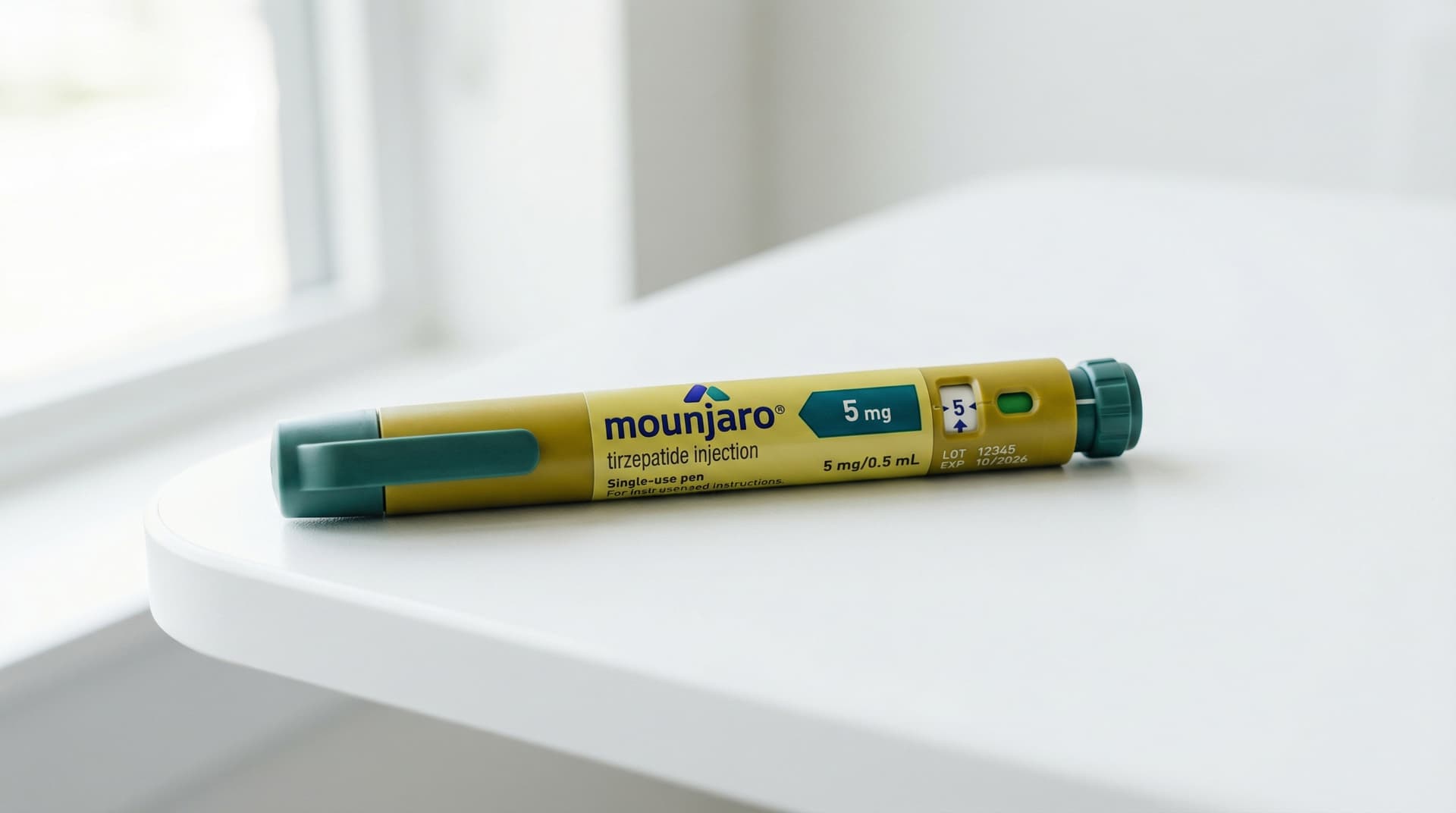
Mounjaro (tirzepatide) side effects affect roughly 55-65% of patients in the first 4 weeks: nausea (18-22% in SURPASS-2), diarrhea (17%), constipation (17%), vomiting (8-13%), and decreased appetite (40-50% — usually wanted). The tirzepatide-specific pattern that differs from semaglutide (Ozempic): more constipation (the GIP receptor's effect on gut motility appears additive to GLP-1's slowing of gastric emptying), slightly later peak symptom timing (week 5-8 vs week 2-4 on semaglutide), and overall slightly lower nausea at equivalent weight-loss-effective doses. Most side effects resolve in 4-6 weeks; constipation can persist for months. The five red flags that mean stop immediately are: severe upper abdominal pain (pancreatitis), persistent vomiting >24 hours (dehydration), gallbladder pain (acute cholecystitis), neck swelling or hoarseness (rare thyroid signal), and severe allergic reaction. If side effects PLUS $1,069/month cash price is what would push you to quit, the cheapest legitimate paths to stay on long enough for them to settle are the Mounjaro Savings Card ($25/mo with T2D + commercial insurance), Medicare Bridge $50/mo (launches tomorrow, July 1, Zepbound-sister-brand), or compounded tirzepatide at $149/mo via Embody, $258/mo via Yucca Health, or $299/mo via TrimRx (Editor's Choice, US-licensed prescribers with side-effect management protocols built in). Here's the realistic week-by-week Mounjaro side effect timeline, what's different from semaglutide-class drugs, management protocols that work, and how cost drives premature discontinuation.
Quick answer: what to expect and when
| Week | Dose | Most common side effects | What to do |
|---|---|---|---|
| 1-4 | 2.5 mg | Mild nausea, fatigue, occasional constipation | Eat smaller meals, hydrate, magnesium citrate at bedtime |
| 5-8 | 5 mg | Nausea may peak here (slightly later than semaglutide), constipation common | Pause 6-8 weeks if symptomatic before next step-up |
| 9-12 | 7.5 mg | New constipation common; fatigue easing | Increase fiber + water; magnesium citrate 200-400mg PM |
| 13-16 | 10 mg | Side effects largely manageable; "food noise" quiets | Maintain protein 1.0-1.2 g/kg/day to preserve muscle |
| 17-20 | 12.5 mg | Possible new nausea after step-up | Slow titration if symptomatic — return to prior dose 4-6 wks |
| 21+ | 15 mg max | Largely tolerable for those who reach max | Monitor for hair shedding (telogen effluvium at month 3-6) |
| Any week | — | Severe abdominal pain, persistent vomiting, neck swelling | Stop immediately, call prescriber, ER if severe |
How Mounjaro side effects differ from Ozempic side effects
Both drugs share the GLP-1 mechanism, but Mounjaro (tirzepatide) also activates the GIP receptor — and that second pathway has measurable effects on the side effect profile.
| Side effect | Ozempic (semaglutide) | Mounjaro (tirzepatide) | Why the difference |
|---|---|---|---|
| Nausea | 44% (SUSTAIN-6) | 18-22% (SURPASS-2) | Semaglutide hits GLP-1 receptor harder; tirzepatide's dual mechanism produces appetite suppression with less GI-receptor amplification |
| Constipation | 24% | 17-25% at max dose | GIP receptor's effect on gut motility appears additive to GLP-1's slowing of emptying |
| Diarrhea | 30% | 17% | Lower on tirzepatide |
| Vomiting | 24% | 8-13% | Lower on tirzepatide |
| Hypoglycemia (with insulin/SU) | Moderate risk | Higher risk | Larger A1C drop → more aggressive background med adjustment needed |
| Injection site reactions | <5% | <5% | Equivalent |
Practical implication: if you tolerated Ozempic poorly because of nausea/vomiting/diarrhea, Mounjaro is often better-tolerated despite the higher weight loss. If your problem was constipation, Mounjaro is often worse. Talk to your prescriber about the molecule fit, not just the efficacy data.
For the deeper molecule-level comparison see our tirzepatide vs semaglutide guide and the brand-level head-to-head in our Mounjaro vs Ozempic comparison.
The five most common Mounjaro side effects (and the management protocols that work)
Constipation — the tirzepatide signature side effect
The most distinctive Mounjaro complaint and the one most likely to persist past the first month. Combined GLP-1 + GIP receptor action slows GI motility throughout the digestive tract.
What works: - Magnesium citrate at bedtime, 200-400 mg. Reliable, non-habit-forming, well-tolerated. Most prescribers consider this a default for Mounjaro patients. - Gradual fiber increase to 25-30g/day. Sudden fiber loading causes gas and bloating on tirzepatide; ramp up over 2-3 weeks. - Water — fiber without water makes constipation worse, not better. Target 80-100 oz/day. - Movement — walking 30 min/day improves motility measurably. - Stool softener (docusate) for occasional use. Avoid stimulant laxatives long-term.
When to call your prescriber: no bowel movement >5 days, severe abdominal pain, vomiting along with constipation (small bowel obstruction signal — uncommon but a surgical emergency).
Nausea — 18-22% in trials, often peaks weeks 5-8
Lower than semaglutide-class drugs but still common during dose escalation. Mounjaro's slower titration timeline (every 4 weeks across 6 dose steps) means nausea episodes can recur with each step-up.
What works: - Smaller meals, more often. 4-5 small meals beat 3 large ones. Full stomach + delayed emptying = sustained discomfort. - Avoid greasy, fatty, fried food during titration. Delayed gastric emptying amplifies fat-related nausea. - Cold, bland foods. Crackers, plain yogurt, broth, popsicles. The BRAT diet (bananas, rice, applesauce, toast) works. - Ginger — measurable antiemetic effect in trials. - Stay upright after eating for 30-60 min. - Slow your titration. If nausea is bad after a step-up, drop back to the prior dose for 4-6 weeks before retrying. There's no medal for hitting 15 mg fast.
When to call your prescriber: persistent vomiting >24 hours, inability to keep fluids down, dizziness or lightheadedness.
Diarrhea — 17% in trials, less common than on semaglutide
Less common on tirzepatide than semaglutide. When it happens, it's usually mild and resolves in 1-2 weeks.
What works: - Identify trigger foods. Dairy, high-fat meals, artificial sweeteners (especially sugar alcohols), and spicy food are common triggers. - Hydration. Diarrhea + appetite suppression = rapid dehydration. - Soluble fiber (oats, banana, psyllium) helps bulk stools. - Probiotics — small effect, worth trying.
When to call your prescriber: >5 days, blood in stool, severe abdominal pain, signs of dehydration.
Vomiting — 8-13% in trials, usually after specific meals
The lowest rate among the major GI side effects. Usually triggered by specific foods (large meals, fatty meals, alcohol) rather than the drug alone.
What works: - Identify the trigger and eliminate it. - Step back on dose. If vomiting starts after a dose increase, return to the prior dose for 4-6 weeks. - Pre-emptive ondansetron (Zofran) for breakthrough days — prescription required.
Decreased appetite — 40-50% in trials, the mechanism by which it works
For most patients the goal, not a problem. Tirzepatide's appetite suppression is often described as more profound than semaglutide's — patients commonly report feeling completely uninterested in food rather than just full.
What to watch: - Eating <1,200 cal/day (women) or <1,500/day (men) consistently → likely under-eating. - Losing >2-3 lbs/week consistently → losing muscle alongside fat. - Feeling weak, dizzy, cold → undereating signals.
What to do: - Protein-first eating. 1.0-1.2 g/kg/day target. Eat protein at the START of meals before appetite vanishes. - Eat by schedule, not hunger. Set 3-4 meal/snack reminders. - Calorie-dense additions. Olive oil, nut butter, Greek yogurt.
Less-discussed Mounjaro side effects
Hair shedding — telogen effluvium at month 3-6 Same rate (~10-15%) as on semaglutide. Triggered by rapid weight loss + metabolic stress, not the drug. Self-resolves by month 6-9. Mitigations: protein ≥1.2 g/kg/day, iron + zinc + biotin levels checked.
Muscle loss A larger concern on Mounjaro than Ozempic because the weight loss is more dramatic. Without intervention, 25-30% of lost weight is lean mass. With intervention (protein ≥1.2 g/kg/day + resistance training 2-3×/week), that drops to ~10-15%. See our Wegovy weight loss week-by-week guide for the body-comp protocol — applies identically to Mounjaro.
Gallbladder symptoms Rapid weight loss + GLP-1's effects on gallbladder motility = increased risk of gallstones (~2-3% on Mounjaro vs 0.4% placebo). Watch for upper-right abdominal pain (especially after fatty meals), nausea + pain after eating, jaundice. Significant pain → urgent ultrasound.
Fatigue More common at the lowest titration doses (weeks 1-8) when caloric intake drops faster than your body adapts. Usually resolves by month 3. Mitigations: ensure adequate protein, B12 level checked, sleep ≥7 hours, hydrate.
Hypoglycemia (in T2D patients on insulin or sulfonylureas) Higher risk on Mounjaro than Ozempic because the A1C drop is larger. T2D patients on insulin or sulfonylureas should have those doses reviewed at every Mounjaro step-up. Patients NOT on insulin or sulfonylureas rarely experience hypoglycemia from Mounjaro alone.
Heart rate increase Small but measurable — average 2-4 bpm increase at max dose. Clinically unimportant in most patients; relevant if you have pre-existing arrhythmia.
Rare but serious — the five red flags to stop immediately
1. Severe upper abdominal pain (especially radiating to the back) — possible pancreatitis. Pancreatitis is rare (~0.2-0.3% per year on tirzepatide) but treatable if caught early. Stop, ER evaluation. 2. Persistent vomiting >24 hours — risk of severe dehydration. Stop, hydrate, call prescriber. ER if you can't keep fluids down. 3. Gallbladder pain — right upper abdominal pain after fatty meals, nausea, jaundice. Stop, urgent ultrasound. Acute cholecystitis is a surgical emergency. 4. Neck swelling, hoarseness, difficulty swallowing — rare thyroid C-cell tumor signal (boxed warning, rodent data, unestablished in humans but contraindicated). Stop, urgent ENT/endocrine evaluation. 5. Severe allergic reaction (rare): difficulty breathing, throat swelling, widespread hives. Stop, 911 / ER.
Why cost makes side effects feel worse
Same dynamic as on Ozempic — and worse on Mounjaro because the cash retail price is $1,069/month (vs $998 for Ozempic). A 2024 JAMA Internal Medicine study (50,395 tirzepatide and semaglutide patients) showed:
- 47% of patients stopped within 12 months
- Top reason: cost (~30%) — not side effects
- Second reason: side effects (~20%) — but mostly in the first 8 weeks
- Patients who got past month 3 had a 73% 12-month retention rate
The fix isn't grit — it's a cheaper path that lets you stay on long enough for your gut to adapt.
The four cheaper paths to stay on long enough
Path 1 — Mounjaro Savings Card $25/mo Commercial insurance + Type 2 diabetes diagnosis. Prediabetes A1C (5.7-6.4) can unlock this on some plans — talk to your prescriber. See our Mounjaro for $25 path guide.
Path 2 — Switch to Zepbound (on-label for obesity) Same molecule (tirzepatide), same Eli Lilly. If your BMI is ≥30 (or ≥27 + comorbidity), Zepbound is the on-label medication for weight loss. Zepbound Savings Card drops you to $25/mo with commercial insurance. See our How to Get Zepbound Cheaper guide.
Path 3 — Medicare GLP-1 Bridge $50/mo (launches tomorrow) Medicare Part D + qualifying tier. Covers Zepbound (tirzepatide sister brand), not Mounjaro specifically. Launches July 1, 2026. See our Medicare Bridge guide.
Path 4 — Compounded tirzepatide $99-$349/mo Same active molecule, US 503A licensed pharmacy, no T2D code required. The biggest practical advantage: the cost barrier disappears, so you can ride out the first 8 weeks of side effects without quitting for financial reasons. See our Cheapest Compounded Tirzepatide ranking.
Compounded provider list (commission-first)
If you're on Mounjaro off-label for weight loss and the cost is what's making side effects feel insurmountable, compounded tirzepatide is the cleanest workaround. Ranked by what we'd actually recommend:
- TrimRx — Editor's Choice. Tirzepatide $299/mo flat at any dose. US-licensed prescribers, monthly check-ins, side-effect management protocols built in. Best for patients who want clinical supervision while paying cash.
- Yucca Health. Tirzepatide $258/mo on 6-month plan. Strong price-to-credentialing balance.
- MyStart Health. Tirzepatide via SELFLOVE25 code. Built-in brand pathway if you transition to brand Mounjaro/Zepbound later.
- MEDVi. Tirzepatide low-entry refill structure. Lowest entry point for one-month trial.
- Embody. Tirzepatide $149/mo (injection). Cheapest floor in the entire compounded tirzepatide market.
- SkinnyRx. Tirzepatide $349/mo. Multi-format delivery (injection, drops, lozenges, tablets) — useful if injection-related nausea is bad.
For the molecule-level comparison see our tirzepatide vs semaglutide guide. For switching from brand to compounded mid-titration see our step-by-step switching guide (the same logic applies to brand Mounjaro → compounded tirzepatide).
Regulatory caveat: FDA 503B comment period closes today
The FDA proposed on May 1, 2026 to permanently exclude semaglutide, tirzepatide, and liraglutide from the 503B Bulks List. The comment period closes today, June 29, 2026. 503A patient-specific compounding (which is what the providers above use) is unaffected by this proposal and continues regardless of outcome. Full analysis: FDA 503B Compounded Ban Explainer.
When to switch from Mounjaro to a different drug
Some side effects don't resolve with management. After 12-16 weeks of full titration, if you're still significantly symptomatic:
Consider switching to semaglutide (Ozempic or Wegovy). GLP-1-only mechanism = less constipation, less GIP-receptor-related GI symptoms. Slightly less weight loss but better tolerability for the "constipated on tirzepatide" patient. See our Mounjaro vs Ozempic head-to-head.
Consider lowering your maintenance dose. Many patients do well at Mounjaro 7.5-10 mg/week maintenance even though the package says 15 mg is the max — slightly less weight loss but dramatically better tolerability.
Consider Zepbound (same molecule, weight-loss indication). If your insurance covers Zepbound but not Mounjaro for weight loss, the switch is medically identical — just different label. Continue at your current Mounjaro dose. See Zepbound = Mounjaro identity explainer.
Consider an oral GLP-1. If injection-related nausea is part of the issue, Foundayo (oral orforglipron, a different molecule) avoids injections entirely with comparable weight loss. See our Foundayo launch post.
FAQ
How long do Mounjaro side effects last? Most side effects peak in weeks 5-8 (slightly later than semaglutide because of Mounjaro's slower titration) and resolve by weeks 10-14 as your gut adapts. Constipation can persist for months — the tirzepatide-specific symptom that needs the longest management.
Are Mounjaro side effects worse than Ozempic? Not generally. Mounjaro has lower rates of nausea, diarrhea, and vomiting than Ozempic at equivalent weight-loss-effective doses (SURPASS vs SUSTAIN comparison). The exception is constipation — that's somewhat higher on Mounjaro because of GIP receptor effects.
Will my Mounjaro side effects get better? For most patients yes, within 4-6 weeks of starting any given dose. Each dose step-up may trigger 1-3 weeks of returning symptoms before re-adaptation. Patients who titrate slowly (waiting 6-8 weeks between steps if symptomatic) tolerate dose increases better than those on the standard 4-week schedule.
Can I take anti-nausea medication with Mounjaro? Yes. Ondansetron (Zofran) is commonly prescribed for breakthrough nausea, short-term. Pepcid (famotidine) helps reflux-like nausea. Talk to your prescriber.
Does Mounjaro cause hair loss? Indirectly — same mechanism as Ozempic. The hair shedding (telogen effluvium) seen in 10-15% of patients is triggered by rapid weight loss + metabolic stress, not the drug. Usually self-resolves by month 6-9 with adequate protein and slower weight loss pace.
Are compounded tirzepatide side effects the same as brand Mounjaro? The active molecule is identical — same side effect profile. Real-world adherence on compounded programs is often higher because cost isn't compounding the discontinuation pressure. See our Cheapest Compounded Tirzepatide ranking.
Can I switch from Mounjaro to Zepbound? Yes, easily — they're the same molecule from the same manufacturer at the same doses. You continue at your current dose, just under a different brand label. The reason to switch is usually insurance: many plans cover Zepbound for obesity but not Mounjaro for off-label weight loss. See Zepbound = Mounjaro explainer.
What if my Mounjaro nausea gets bad after a dose increase? Drop back to the prior dose for 4-6 weeks before re-attempting the step-up. There's no medal for hitting 15 mg fast — patients who titrate slowly and pause at problem doses end up at higher final maintenance doses than those who push through severe symptoms.
For our full provider grid see the cheapest GLP-1 programs page. For the molecule-level comparison covering all 5 brand names see our tirzepatide vs semaglutide guide. For the parallel write-up on semaglutide-class side effects, see yesterday's Ozempic side effects guide. For switching from brand to compounded mid-titration, see our step-by-step switching guide.