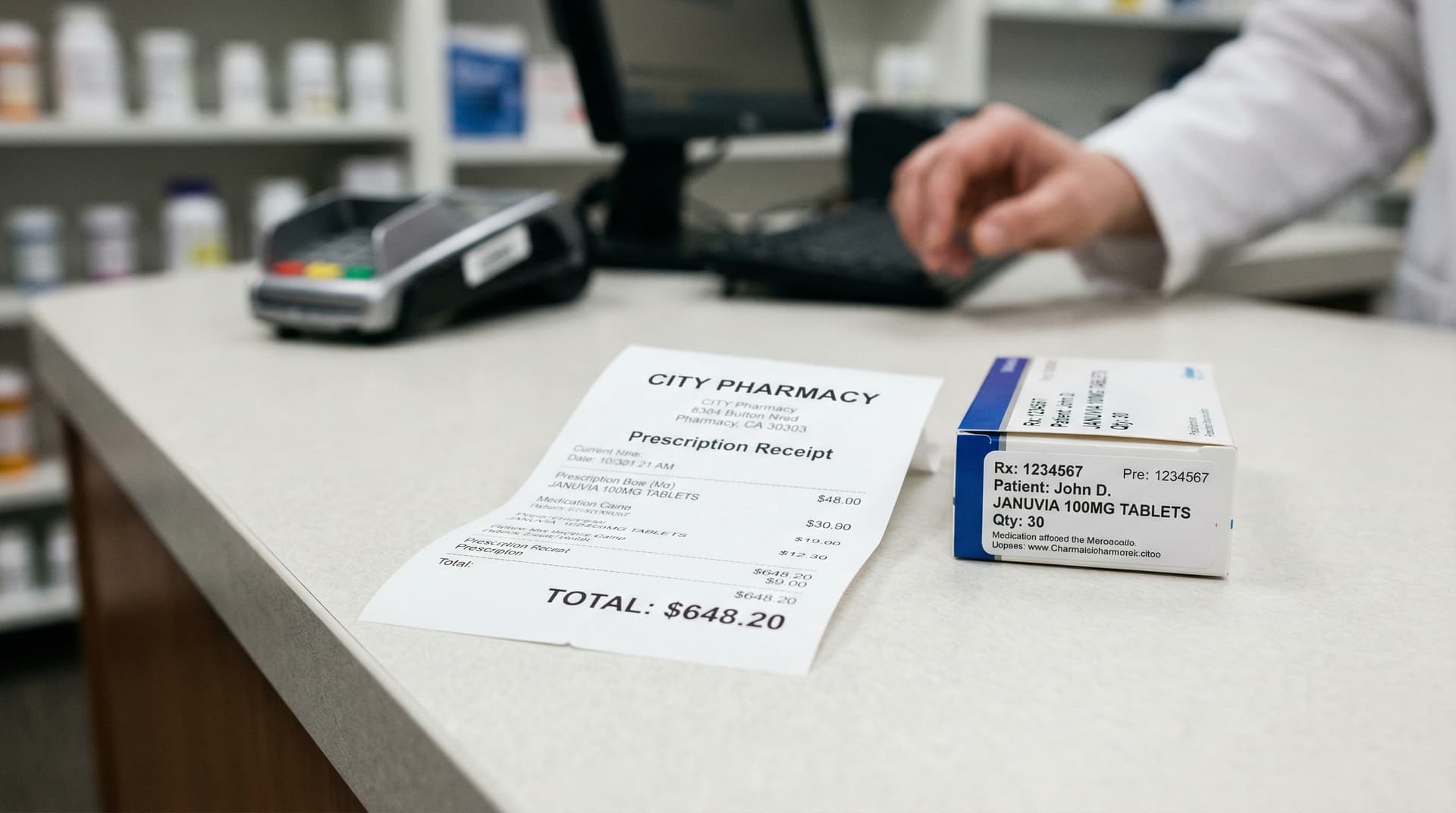
The Mounjaro Savings Card drops your monthly copay to as low as $25 — but only if you have commercial (employer or marketplace) insurance and a confirmed type 2 diabetes diagnosis. Patients without diabetes, on Medicare/Medicaid, or without commercial insurance are excluded by Eli Lilly's program terms.
Here's exactly how to qualify in 2026, the four things that disqualify you, the appeal path if your insurance denies prior authorization, and the legitimate alternatives if the $25 program isn't available to you.
Who actually qualifies for the $25 Mounjaro Savings Card?
Eli Lilly's official eligibility criteria, as of May 2026:
- You have commercial (private) insurance that covers Mounjaro for type 2 diabetes
- You have a confirmed type 2 diabetes diagnosis documented in your medical record (HbA1c ≥6.5%, fasting glucose ≥126 mg/dL, or random glucose ≥200 with symptoms)
- You are a US resident age 18+
- You are not enrolled in Medicare, Medicaid, TRICARE, VA, or any other federal/state program that pays for prescription drugs
If you meet all four: your copay is capped at $25/month for up to 13 fills per calendar year. Your insurance pays its share, the savings card covers the rest of your copay up to a maximum benefit (Lilly's program currently caps total Lilly contribution at $1,950/year, which is enough to cover the $25 copay for a full year on most commercial plans).
Who is excluded — the four disqualifiers
The four most common reasons patients don't qualify:
- No type 2 diabetes diagnosis. Mounjaro is FDA-approved only for type 2 diabetes. If your diagnosis is obesity, pre-diabetes, or metabolic syndrome (but not T2D), the Mounjaro card won't work. You'd need a Zepbound prescription instead — see our [Zepbound = Mounjaro identity guide](/blog/is-zepbound-the-same-as-mounjaro-2026).
- Medicare or Medicaid coverage. Federal law prohibits manufacturer savings cards from being applied to drugs paid by Medicare Part D, Medicare Advantage, Medicaid, TRICARE, or VA. If you're on any of these, the $25 program is closed to you.
- No insurance. The savings card layers on top of commercial insurance — it doesn't work as a standalone discount. Without commercial coverage, the card does nothing.
- Insurance refuses to cover Mounjaro. Even with commercial insurance, your plan may exclude Mounjaro entirely or require a prior authorization you can't get approved. The savings card only kicks in after insurance pays its portion.
How to enroll in the Mounjaro Savings Card
Three steps. Total time: about 10 minutes.
- Visit lilly.com/mounjaro and click "Savings Card." Or go directly to mounjaro.lilly.com/save.
- Fill out the online form. You'll provide your name, date of birth, ZIP code, and confirm you have commercial insurance and a Mounjaro prescription.
- Save the card. You'll get a digital card with a Group, BIN, PCN, and Member ID. Show it to your pharmacy when filling your prescription. Most major pharmacy chains (CVS, Walgreens, Rite Aid, grocery store pharmacies) accept it automatically when you present the card.
The card is reusable across the calendar year, up to 13 fills. It auto-renews each January if you remain eligible.
What if my insurance refuses to cover Mounjaro?
Mounjaro coverage by commercial plans varies dramatically. Common scenarios and the fix for each:
- "Not on the formulary." Roughly 15% of commercial plans don't list Mounjaro at all. Your options: appeal (rarely successful for formulary exclusion), switch to a covered alternative (Ozempic or Trulicity are commonly covered for T2D), or pay cash.
- "Requires prior authorization." This is the most common gate. Your prescriber submits documentation: HbA1c results, prior treatments tried, BMI, blood sugar trends. Approval rates run 60–80% on first submission with complete documentation, 90%+ after appeal with metabolic data.
- "Requires step therapy." Your insurer wants you to try cheaper drugs first (typically metformin, then a sulfonylurea or DPP-4 inhibitor) before approving Mounjaro. If you've already tried these and they didn't work, your prescriber documents the failures in the appeal.
- "Denied as off-label." Your insurer is treating your prescription as weight-loss off-label and refusing. If your diagnosis is genuinely type 2 diabetes, your prescriber needs to submit the lab evidence. If it isn't, you need Zepbound instead.
For complex insurance navigation, providers our readers most often recommend:
- [Eden Health](/reviews/eden-health) — Board-certified physicians, in-house prior-auth submission, named-MD oversight. Strong track record on insurance appeals.
- [TrimRx](/reviews/trim-rx) — Personalized doctor consultations include insurance navigation. Helpful for patients with PA complications.
- [Ro](/reviews/ro) — Only prescribes FDA-approved Mounjaro (and Zepbound), handles prior auths directly with insurer. Higher monthly cost than compounded options, but cleaner insurance path.
For the full ranking by which providers handle insurance complications, see our best GLP-1 telehealth programs list.
What if I can't get the $25 card? Legitimate alternatives in 2026
If the Mounjaro Savings Card is off the table for you, the cheapest legitimate paths to tirzepatide in 2026:
- Foundayo (oral tirzepatide, $149/month) — FDA-approved April 2026 via LillyDirect. Same molecule as Mounjaro and Zepbound, daily pill format. See our [Foundayo how-to guide](/blog/foundayo-ships-today-how-to-get-lilly-glp1-pill).
- Zepbound self-pay vials ($349–$549/month via LillyDirect) — Cheaper than Mounjaro pens at list price. Same molecule. Available without insurance.
- Compounded tirzepatide ($99–$299/month) — Available through telehealth providers. Legitimate when prescribed for medical necessity, but FDA enforcement against unsafe compounders has tightened. Use LegitScript-certified providers only — see our [provider screening criteria](/best).
- Medicare Bridge Program (~$50/month, launching July 1, 2026) — CMS's new Balance Model caps copays for Medicare Part D patients with qualifying diagnoses. See our [Medicare GLP-1 Bridge Program guide](/blog/medicare-glp1-bridge-what-to-know).
What about the Zepbound Savings Card?
Eli Lilly also offers a Zepbound Savings Card with similar mechanics, but with a key difference: Zepbound's card caps at $650/month with commercial insurance, not $25. That's because Zepbound is for chronic weight management (often not covered) rather than type 2 diabetes (usually covered). When insurance does cover Zepbound, copays typically run $25–$200/month; the card brings down the patient cost but doesn't drop it to $25.
For weight-loss patients specifically, the LillyDirect Zepbound vial program at $349–$549/month is often cheaper than what the Zepbound Savings Card produces after a partial insurance payment.
Frequently asked questions
Is the Mounjaro Savings Card really $25 a month? Yes, for eligible patients. You may pay a small amount above $25 if your insurance has a higher copay design (some plans set Mounjaro at $200/month copay, in which case the card reduces it to $25 — you pay nothing more out of pocket up to the annual cap).
Does the Mounjaro card work without insurance? No. It only works as a layer on top of commercial insurance that covers Mounjaro. Without commercial coverage, the card does nothing.
Can I use the Mounjaro card with Medicare? No. Federal law prohibits manufacturer copay cards from being applied to drugs paid by Medicare Part D. This is firm — no workarounds.
What if I have type 2 diabetes but no insurance? Then the savings card doesn't apply. Cheapest path is GoodRx pricing on Mounjaro (typically $900–$1,000/month — still expensive), Foundayo at $149/month via LillyDirect (oral version), or a compounded tirzepatide program at $99–$299/month.
Can I get Mounjaro for weight loss with the $25 card? No. The card requires a type 2 diabetes diagnosis. If you have obesity but no diabetes, Mounjaro is off-label for you and won't qualify for the $25 card. Use Zepbound (the weight-management label of the same drug) instead — see our identity guide.
How long does the Mounjaro Savings Card last? Up to 13 fills per calendar year, auto-renews each January if you remain eligible. Annual maximum savings benefit is $1,950 in 2026.
What's the difference between the $25 card and the $25 coupon I see on GoodRx? GoodRx coupons are not Lilly's official Mounjaro Savings Card. GoodRx pricing on Mounjaro typically runs $900–$1,000/month with their coupon — not $25. The $25 figure refers only to Lilly's manufacturer savings card layered on top of commercial insurance.
Bottom line
The $25 Mounjaro Savings Card is real, easy to enroll in, and works seamlessly at the pharmacy — if you have commercial insurance and a confirmed type 2 diabetes diagnosis. For roughly half of patients seeking Mounjaro, those two conditions are met and the $25 path works immediately.
For the other half — patients with obesity (no diabetes), patients on Medicare/Medicaid, or patients without insurance — the realistic 2026 cheapest paths are Foundayo ($149/month oral pill) or compounded tirzepatide through a verified telehealth provider.
The single biggest factor between "this works" and "this is a nightmare" is whether your prescriber's office handles prior authorizations competently. Most large telehealth platforms now offer in-house PA submission. See our top-rated GLP-1 providers for the shortlist of programs with strong insurance navigation track records. `, "how-long-do-zepbound-side-effects-last-2026": ` Most Zepbound side effects start within 24–72 hours of an injection and resolve within 1–2 weeks at any given dose. They typically reappear briefly with each dose escalation, then fade again. Side effects persisting beyond 4 weeks at the same dose are a signal to talk to your prescriber — usually about pausing escalation, not stopping the drug.
Here's the timeline by side effect — what to expect, when to act, and why your provider's willingness to customize the dose matters more than the molecule itself.
When do Zepbound side effects start?
Most side effects begin 24–72 hours after your weekly injection and peak around days 3–5. The timing reflects how tirzepatide is absorbed: it has a half-life of about 5 days, so blood levels rise for the first few days, peak, and slowly fall before the next weekly dose.
The pattern that catches most new patients off guard:
- Days 0–1 (injection day and the day after): usually feel normal
- Days 2–3: nausea, fatigue, sometimes a metallic taste begin
- Days 4–5: GI symptoms peak (nausea, vomiting, diarrhea, constipation depending on the patient)
- Days 6–7: symptoms ease as drug levels start declining
- Day 7 (next injection): the cycle restarts, usually less intense as you become tolerant
By weeks 2–3 at the same dose, most patients report the cycle has muted significantly. By weeks 3–4 it's often barely noticeable.
Then you escalate. The titration ladder (2.5 → 5 → 7.5 → 10 → 12.5 → 15 mg) means each step roughly doubles drug exposure. Expect the side-effect cycle to come back at each new dose level, though usually less severe than the first time. This pattern is why dose escalation should happen no faster than every 4 weeks per the FDA label.
How long do Zepbound side effects last by symptom?
Nausea (most common — affects ~33% of patients)
- When it starts: 24–72 hours after each injection
- Peak: days 3–5
- Duration at each dose level: 1–2 weeks before the body adjusts
- Typical total course: Comes back briefly with each escalation, then fades. Most patients report it's barely noticeable by month 3 at a stable dose.
- When to worry: persistent nausea preventing food intake for more than 3 days, or any vomiting more than once per day, warrants a prescriber call.
Fatigue and tiredness (~10–15% of patients)
- When it starts: day 2–4 after injection
- Peak: days 4–6
- Duration at each dose level: 1–3 weeks, sometimes longer
- Typical total course: This one tends to linger. Some patients report fatigue throughout dose escalation, fading only after they reach maintenance. Often improves significantly when caloric intake stabilizes.
- When to worry: fatigue severe enough to affect work or driving warrants a dose pause.
Constipation (~17% of patients)
- When it starts: 3–7 days after starting any new dose level
- Peak: week 2 of each dose level
- Duration: can persist throughout treatment if not addressed
- Fix: fiber (psyllium 5–10g/day), 2.5–3L water/day, regular movement. Magnesium citrate as needed.
Diarrhea (~22% of patients)
- When it starts: typically days 1–3 after injection
- Peak: days 2–4
- Duration at each dose level: 1–2 weeks
- When to worry: more than 5 loose stools/day or any sign of dehydration.
Vomiting (~13% of patients)
- When it starts: days 3–5 if it happens
- Duration: usually 1–3 days per episode
- When to worry: any vomiting more than twice in 24 hours, or inability to keep fluids down for 12+ hours.
Injection site reactions (~5% of patients)
- When it starts: within minutes to hours of injection
- Duration: typically 24–72 hours
- Fix: rotate sites between abdomen, thigh, upper arm. Ice before injection. Let the pen warm to room temperature for 30 minutes before use.
Hair shedding (~5–6% of patients on highest dose)
- When it starts: weeks 12–20 of treatment
- Duration: 6–12 months after weight stabilizes
- Mechanism: telogen effluvium driven by rapid weight loss, not the drug directly. See our [GLP-1 hair loss meta-analysis](/blog/glp1-hair-loss-2026-meta-analysis) for prevention and treatment.
How long does Zepbound take to work?
Appetite suppression usually starts within 1–7 days of your first injection. Weight loss takes longer:
- Week 1–4 (2.5 mg dose): Appetite drops noticeably for most patients. Average weight loss: 1–4 lbs.
- Week 4–8 (5 mg dose): Continued appetite suppression. Average weight loss to this point: 5–9 lbs (~2–4% of body weight).
- Week 12 (10–12.5 mg): ~5% body weight loss in average responders, ~10%+ in strong responders.
- Week 24 (maintenance dose): ~10–15% body weight loss in average responders.
- Week 72 (final pivotal trial endpoint): mean 20.9% weight loss on 15 mg (SURMOUNT-1).
If you're 8+ weeks into treatment and have lost less than 2% of body weight at the appropriate dose for your titration step, that's a "non-responder" signal worth discussing with your prescriber. About 10% of patients are non-responders.
For the full Zepbound vs Wegovy efficacy comparison, see our Zepbound vs Wegovy head-to-head.
What makes Zepbound side effects worse?
Five patterns that consistently amplify side effects:
- Rapid escalation. Going up doses faster than the 4-week label minimum. Don't let your provider push you up just because the calendar says it's time — go up when the prior dose is well-tolerated.
- Dehydration. GLP-1 drugs delay gastric emptying. Inadequate water makes constipation and nausea dramatically worse. Aim for 2.5–3L/day.
- Fried, fatty, or very large meals. These exacerbate nausea and reflux. Most patients learn within 2 weeks to eat smaller, lower-fat meals.
- Alcohol. Slows GI motility further, intensifies nausea. Many patients report alcohol tolerance drops on tirzepatide regardless.
- Skipping doses then restarting. Each restart triggers the first-week side-effect cycle again. If you miss by 1–3 days, take it. If 4+, ask your prescriber.
When persistent side effects mean it's time to adjust
The textbook answer: side effects persisting beyond 4 weeks at the same dose are not normal. They mean either (a) your body needs more time at a lower dose before going up, or (b) you've reached your individual tolerated dose and shouldn't escalate further.
The right move is almost never to stop the drug entirely — stopping leads to rapid weight regain (see our stop-restart muscle loss analysis). The right move is usually:
- Hold at the current dose for 4–8 additional weeks
- Step back one dose level if symptoms are severe
- Stay at a lower-than-label maintenance dose if you're near goal weight (see our [low-dose Wegovy maintenance guide](/blog/can-you-stay-on-low-dose-wegovy-maintenance-2026) — same principle applies to Zepbound)
The hardest part is finding a provider who'll customize this. Many telehealth providers follow a rigid fixed-schedule titration and refuse to deviate.
Which providers will customize your Zepbound dose?
Providers our readers consistently report success with for dose flexibility, in our most recent comparison:
- [TrimRx](/reviews/trim-rx) — Personalized doctor consultations explicitly include dose customization. Patients with side effects routinely work with held or stepped-down doses.
- [Eden Health](/reviews/eden-health) — Board-certified physicians, named-MD oversight, willingness to adjust based on individual response. Comprehensive baseline labs.
- [Yucca Health](/reviews/yucca-health) — LegitScript-certified, prescribes based on individual clinical assessment rather than rigid schedules.
- [ShedRx](/reviews/shedrx) — Compounded options with explicit support for stepped-down dosing.
For the full ranking and what to ask any prospective provider, see our best GLP-1 telehealth programs list.
Frequently asked questions
Do Zepbound side effects get better over time? Yes, almost always. The first 2–3 weeks at each dose level are the worst. By the time you've been stable on maintenance for 8+ weeks, most patients report only mild lingering effects (some constipation, mild fatigue) or none at all.
Do Zepbound side effects feel like Mounjaro side effects? Yes — Mounjaro and Zepbound are the same drug (tirzepatide). The side-effect profile is identical. See our Zepbound = Mounjaro identity guide.
How long does Zepbound nausea last? Usually 1–2 weeks at each dose level. If nausea is preventing you from eating for more than 3 days at a stretch, call your prescriber — that's not normal and not necessary.
Is Zepbound nausea worse than Wegovy nausea? No — counter-intuitively, Zepbound (the more potent drug) tends to have LESS nausea than Wegovy. Pivotal trial rates: ~33% on Zepbound vs ~44% on Wegovy. See our Zepbound vs Wegovy comparison.
Does Zepbound make you tired forever? No. Fatigue is most common during active weight loss, particularly weeks 4–16. Once weight stabilizes and you're at a maintenance dose, fatigue typically resolves.
When should I stop Zepbound because of side effects? Almost never. The standard answer is "hold or step down the dose," not "stop entirely." Stopping triggers ~two-thirds weight regain within a year (per the SURMOUNT-4 discontinuation trial). Talk to your prescriber about pausing or stepping down first.
Do side effects come back when I switch to Foundayo (oral tirzepatide)? Yes, but usually milder. The first 2–3 weeks on oral tirzepatide can mimic the first dose escalation cycle. Same molecule, similar tolerance profile.
Bottom line
Most Zepbound side effects start within 24–72 hours of an injection, peak at days 3–5, and resolve within 1–2 weeks at any stable dose. They come back briefly with each dose escalation and fade as your body adjusts. Total course at any given dose level is usually 1–4 weeks before steady state.
The pattern that separates a successful Zepbound experience from a miserable one is the willingness of your prescriber to slow down, hold, or step down doses based on how you're tolerating it. Rigid titration kills more programs than any individual side effect. Look for providers offering named-MD oversight and explicit dose customization — see our top-rated GLP-1 telehealth programs for the shortlist.
If you're 4+ weeks into a single dose and side effects haven't faded, that's information — it means your body is telling you the dose isn't right yet. The fix is dose adjustment, not stopping. `, "is-zepbound-the-same-as-mounjaro-2026": ` Yes — Zepbound and Mounjaro are the exact same drug. Same active ingredient (tirzepatide), same manufacturer (Eli Lilly), same milligram strengths, same auto-injector pen. The only difference is the FDA-approved label: Mounjaro is approved for type 2 diabetes, while Zepbound is approved for chronic weight management.
That distinction matters enormously for your cost and insurance coverage. A patient with type 2 diabetes can get tirzepatide as Mounjaro for under $30/month copay on many insurance plans. A patient with obesity (but no diabetes) usually pays $549/month or more for the same molecule labeled as Zepbound. Here's exactly why that happens and how to navigate it in 2026.
Are Zepbound and Mounjaro the same drug?
Yes, chemically identical. Both are tirzepatide — a dual GIP/GLP-1 receptor agonist molecule developed by Eli Lilly. The chemistry is indistinguishable. The pens are virtually identical (different label color, same mechanism, same dose dial). Both are administered as a once-weekly subcutaneous injection.
Side-by-side facts:
- Active ingredient: Tirzepatide (both)
- Manufacturer: Eli Lilly (both)
- Dose strengths: 2.5 mg, 5 mg, 7.5 mg, 10 mg, 12.5 mg, 15 mg (both)
- Administration: Weekly subcutaneous auto-injector pen (both)
- Approved year: Mounjaro May 2022, Zepbound November 2023
- FDA-approved use: Mounjaro = type 2 diabetes; Zepbound = chronic weight management (BMI ≥30, or ≥27 with weight-related comorbidities)
If a pharmacist gave you a Zepbound pen and a Mounjaro pen, the only way to tell them apart would be the label. The molecule, the injection device, and the clinical effect are the same.
Why does Eli Lilly sell the same drug under two different names?
This is standard pharmaceutical industry practice — and it's not unique to tirzepatide. Novo Nordisk does the same thing with semaglutide: Ozempic is the diabetes label, Wegovy is the weight management label. Liraglutide: Victoza for diabetes, Saxenda for weight management.
The reasons:
- Separate FDA approvals. Each indication requires its own clinical-trial package and labeling. The FDA approves drugs for specific uses, not for the molecule generically.
- Pricing flexibility. Insurance plans cover diabetes drugs differently than weight-loss drugs. Splitting the brand lets the manufacturer set different prices for different payers.
- Marketing. Healthcare professionals prescribe Mounjaro through endocrinology and primary-care diabetes pathways; they prescribe Zepbound through obesity-medicine and weight-management pathways. Separate branding reinforces those channels.
- Supply allocation. During the 2023–2024 tirzepatide shortage, Eli Lilly prioritized Mounjaro for diabetes patients. Having separate SKUs let them ration each label independently.
The pharmacology is identical. The business model is what's split.
Mounjaro vs Zepbound: cost in 2026
This is where the same-drug, different-name reality bites — or saves you, depending on which label you have access to.
If you have type 2 diabetes (Mounjaro)
- List price: $1,069/month
- Insurance copay: typically $25–$30/month if covered as a Tier 2 diabetes drug
- Mounjaro Savings Card: as little as $25/month for commercially insured patients
- LillyDirect Mounjaro: not available — Lilly's direct-pay program is Zepbound-only for cash payers
If you have obesity (Zepbound)
- List price: $1,089/month
- Insurance copay: typically $25–$200/month if covered (many plans require prior authorization and BMI documentation)
- Self-pay vials (LillyDirect): $349 (2.5 mg) to $549 (15 mg) per month — significantly cheaper than the auto-injector pens
- Foundayo (oral tirzepatide pill): $149/month — FDA-approved April 2026, shipping via LillyDirect
For full state-by-state cost data including Medicaid coverage, see our Zepbound cost analysis.
The kicker: the same molecule, prescribed via the diabetes pathway, costs roughly $25/month. Prescribed via the obesity pathway, it costs $549/month minimum (without insurance). That's a 22× price difference for chemically identical drug.
Can I take Mounjaro for weight loss?
Technically yes (off-label), but practically harder than you'd think. Three scenarios:
- You have type 2 diabetes AND obesity. Easy. Your doctor prescribes Mounjaro for the diabetes diagnosis, and the weight loss comes along for free. This is the cheapest path to tirzepatide for weight loss in 2026.
- You have pre-diabetes or insulin resistance but not type 2 diabetes. Some endocrinologists will prescribe Mounjaro off-label here, citing metabolic-syndrome guidelines. Coverage varies — many insurers deny Mounjaro without a confirmed type 2 diabetes diagnosis (HbA1c ≥6.5%, fasting glucose ≥126, or 2-hour OGTT ≥200).
- You have obesity but normal blood sugar. Most prescribers won't write Mounjaro for you off-label, and even if they do, insurance will deny it. You'll need Zepbound (or compounded tirzepatide — see below).
Important: prescribers who write Mounjaro for patients without diabetes are taking on real liability if the FDA, the state board, or insurance auditors scrutinize the prescribing pattern. Don't pressure them.
Compounded tirzepatide: the cheapest legitimate path
This is where many cash-pay weight-loss patients have ended up in 2025–2026. Compounded tirzepatide — made by 503A/503B compounding pharmacies — is the same molecule, priced $99–$299/month depending on provider.
Important caveats:
- The FDA briefly allowed compounded tirzepatide during the 2023–2024 shortage. That shortage resolved in late 2024, and the FDA has been actively cracking down on unsafe compounders since.
- Compounded tirzepatide is legal to prescribe and dispense when it's medically necessary and patient-specific (the standard 503A test), but the FDA enforces aggressively against pharmacies producing it at scale or making safety/quality claims they can't back up.
- See our [FDA compounding crackdown update](/blog/fda-compounding-crackdown-march-2026) for the active enforcement list.
Providers our readers most frequently report success with for tirzepatide (compounded or brand), in our most recent comparison:
- [Eden Health](/reviews/eden-health) — Board-certified physicians, prescribes both Zepbound (insured paths) and compounded tirzepatide. Comprehensive baseline labs.
- [ShedRx](/reviews/shedrx) — Compounded tirzepatide programs, transparent pricing, LegitScript-certified.
- [TrimRx](/reviews/trim-rx) — Personalized doctor consultations, willingness to prescribe both Zepbound and compounded alternatives.
- [Yucca Health](/reviews/yucca-health) — LegitScript-certified, BNPL financing for cash-pay patients.
- [Ro](/reviews/ro) — Only prescribes FDA-approved Zepbound and Mounjaro (not compounded). Higher cost, but no compounding-related risk.
For our full ranking including pricing tiers, credentialing, and which providers prescribe brand vs compounded, see our best GLP-1 telehealth programs list.
Should I switch from Mounjaro to Zepbound (or vice versa)?
The molecule is the same, so there's never a *clinical* reason to switch. The reasons to switch are administrative:
- Insurance change. If your insurer covers one but not the other, switch labels (not molecules). Get your prescriber to rewrite the same dose, just under the other label.
- Diagnosis change. If you developed type 2 diabetes while on Zepbound, your insurer may now cover Mounjaro at a lower copay — request the switch.
- Self-pay program. If you're paying cash and want the cheaper LillyDirect vials, your prescription needs to be written as Zepbound, not Mounjaro. The vial program is Zepbound-only.
What you should not do:
- Take both at the same time. They're the same molecule — you'd be double-dosing tirzepatide, dramatically increasing adverse-event risk.
- Switch back and forth based on cost alone without telling your prescriber. The titration history matters; restarting the ladder unnecessarily means new side effects.
How does this compare to Wegovy?
Wegovy is semaglutide — a different molecule from tirzepatide (Mounjaro/Zepbound). For the head-to-head clinical and cost comparison, see our Is Zepbound Better Than Wegovy? 2026 guide.
Short version: in the head-to-head SURMOUNT-5 trial, tirzepatide (Mounjaro/Zepbound) produced ~20% mean weight loss vs ~14% for semaglutide (Wegovy). Tirzepatide is the more potent molecule — which is why the "same molecule, different label" arbitrage matters so much.
Frequently asked questions
Are Zepbound and Mounjaro the same chemically? Yes. Both are tirzepatide. Same molecular formula (C225H348N48O68), same manufacturer, same dose strengths.
Is tirzepatide the same as Mounjaro? Tirzepatide is the generic (chemical) name of the active ingredient. Mounjaro and Zepbound are both brand names for tirzepatide — Mounjaro for diabetes, Zepbound for weight management.
Can I use my Mounjaro for weight loss? If you have diabetes and a prescription for Mounjaro, the weight loss is a clinical benefit your prescriber is monitoring. You don't need a separate prescription for weight loss. If you don't have diabetes, your prescriber and insurer will usually push you toward Zepbound instead.
Is Mounjaro cheaper than Zepbound? With insurance and a diabetes diagnosis, yes — typically by an order of magnitude. Without insurance, the LillyDirect Zepbound vial program ($349–$549/month) is cheaper than cash-pay Mounjaro pens, which run $1,069/month list.
Does Medicare cover Mounjaro or Zepbound? Medicare Part D currently covers Mounjaro for patients with type 2 diabetes. Zepbound coverage for obesity is changing under the CMS Balance Model launching July 2026 — see our Medicare GLP-1 Bridge Program guide.
Can I get a compounded version of tirzepatide? Legally, yes, when prescribed for medical necessity. Practically, the FDA has tightened enforcement since the shortage resolved. Use a LegitScript-certified provider. See our provider screening guide.
Will the same dose of Mounjaro and Zepbound produce the same weight loss? Yes. Same molecule, same dose = same effect. The brand name doesn't change anything biological.
Bottom line
Zepbound and Mounjaro are the same drug. Same molecule, same manufacturer, same dose strengths, same clinical effect. The split exists for regulatory and pricing reasons, not pharmacological ones.
What that means practically in 2026:
- If you have type 2 diabetes: Mounjaro is your path. Cheapest route to tirzepatide, period.
- If you have obesity without diabetes: Zepbound or compounded tirzepatide. LillyDirect vials at $349–$549/month, or Foundayo at $149/month if you want the oral pill, are the cheapest legitimate brand options.
- Don't try to game the system by getting a Mounjaro prescription without a diabetes diagnosis. Insurance will deny it, prescribers won't write it sustainably, and the FDA monitors prescribing patterns.
For the full comparison of every GLP-1 option in 2026 — cost, mechanism, side effects, and how to pick — see our Wegovy vs Zepbound head-to-head and our GLP-1 price war breakdown.
