

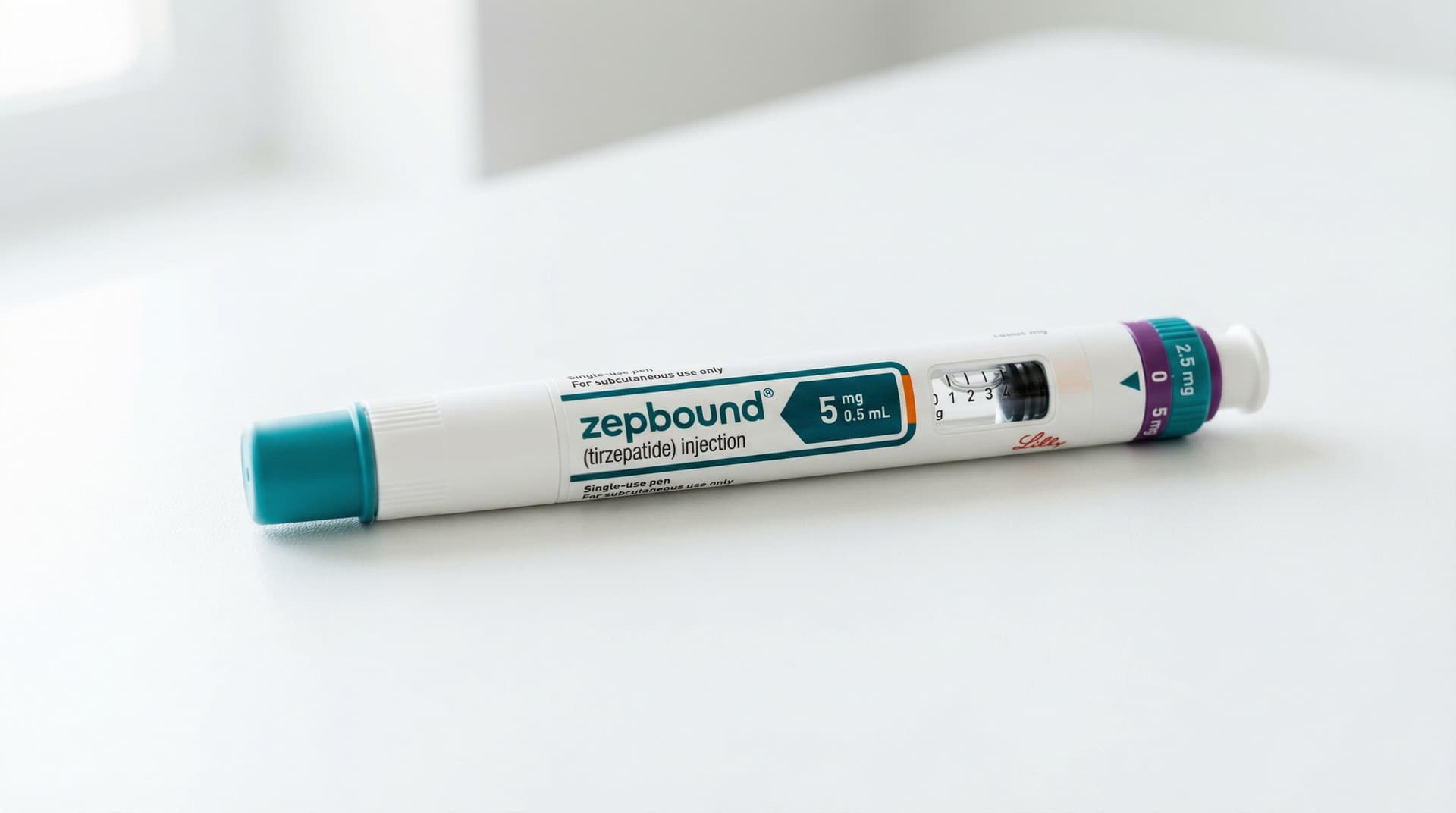
Zepbound (tirzepatide) starts at 2.5 mg once weekly and titrates up every 4 weeks through 5, 7.5, 10, 12.5, and 15 mg. The 2.5 mg starter dose is not a treatment dose — its job is building GI tolerance before the therapeutic doses begin. Most patients see meaningful weight loss from 5-10 mg, and a large share never need the 15 mg max: in SURMOUNT-1, the 10 mg group lost 21.4% body weight vs 22.5% at 15 mg — a small gap for a meaningful tolerability difference. The overlooked cost trap: brand Zepbound pricing scales with dose. LillyDirect vials run $349/mo at 2.5 mg but $499/mo at 7.5 mg and above — a built-in $1,800/year price increase just for titrating like the label says. Compounded tirzepatide is flat-priced at any dose: from $119/mo via Embody (advertised starting rate; some checkout funnels quote about $149 month-to-month), $125/mo via Trimi (annual plan), or $259/mo flat via TrimRx (Highest Rated — the flat pricing is exactly why it wins for titrating patients). With commercial insurance, the Zepbound Savings Card is $25/mo at any dose; on Medicare, the Bridge Program is $50/mo at any dose. Here's the full titration schedule, what to expect at each dose, missed-dose rules, the plateau protocol, and the cost math at every tier.
Quick answer: the standard Zepbound titration schedule
| Weeks | Dose | Purpose | What to expect |
|---|---|---|---|
| 1-4 | 2.5 mg/wk | Tolerance building — not a treatment dose | Mild appetite reduction, possible nausea/fatigue; 1-3% weight loss |
| 5-8 | 5 mg/wk | First therapeutic dose | Clear appetite suppression; 3-6% cumulative |
| 9-12 | 7.5 mg/wk | Escalation (optional pause point) | "Food noise" quiets; 6-9% cumulative |
| 13-16 | 10 mg/wk | Escalation (many patients stop here) | Strong effect; 8-13% cumulative |
| 17-20 | 12.5 mg/wk | Escalation (optional) | Marginal gains over 10 mg for many |
| 21+ | 15 mg/wk | Maximum dose | 20.2-22.5% at 72 weeks (SURMOUNT trials) |
The 4-week intervals are minimums, not deadlines. If you're losing weight well and tolerating a dose, there is no clinical requirement to escalate. If side effects flare after a step-up, dropping back for 4-6 weeks and retrying is standard practice.
The rule most patients miss: 2.5 mg is not a treatment dose
Eli Lilly's label is explicit: 2.5 mg is for treatment initiation only. Its purpose is letting your GI tract adapt to tirzepatide's dual GLP-1/GIP action before therapeutic dosing starts.
Practical implications:
- Don't judge the drug at 2.5 mg. If you're four weeks in with modest appetite change and 2 lbs lost, that's normal — the treatment doses haven't started.
- Don't stay at 2.5 mg to save money on brand vials. The $299/mo LillyDirect 2.5 mg vial looks attractive, but you're paying $299/mo for a sub-therapeutic dose. If budget is forcing that choice, flat-priced compounded at a therapeutic dose is the better spend — Embody from $119/mo covers any dose.
- Some prescribers do keep low responders at 2.5 mg if weight loss is somehow strong there — it happens in a minority of highly sensitive patients. That's a prescriber call, not a cost hack.
What dose does Zepbound actually work at?
The SURMOUNT-1 dose-response data (72 weeks, obesity without T2D):
| Dose | Average body weight loss | % of patients losing ≥20% |
|---|---|---|
| 5 mg | 15.0% | 30% |
| 10 mg | 21.4% | 50% |
| 15 mg | 22.5% | 57% |
| Placebo | 2.4% | 3% |
Read that table carefully: the jump from 5 to 10 mg is large (+6.4 points). The jump from 10 to 15 mg is small (+1.1 points). Meanwhile GI side effects scale with dose the whole way up. This is why many prescribers now treat 10 mg as the default maintenance target and reserve 12.5-15 mg for patients who plateau below goal.
A defensible dosing philosophy: escalate until you're losing 0.5-1% of body weight per week, then hold. Chasing the max dose for its own sake buys marginal extra loss at real tolerability cost — and faster loss also raises muscle-loss and Ozempic-face risk.
Missed dose rules
Zepbound is once weekly, same day each week. The official rules:
- ≤4 days late (96 hours): take it as soon as you remember, then resume your normal schedule.
- >4 days late: skip the missed dose entirely, take the next one on your regular day. Do NOT double up.
- Missed 2+ consecutive weeks: call your prescriber. Depending on the gap, you may restart at a lower dose — tirzepatide tolerance fades within 2-4 weeks off the drug, and returning at your old dose after a long gap is the classic trigger for severe nausea/vomiting.
- Switching your injection day: allowed, as long as 72+ hours separate the two doses.
Dose conversion: switching to or from Zepbound
Mounjaro ↔ Zepbound: same molecule (tirzepatide), same manufacturer, same doses. 1:1 conversion, no restart. The switch is a label/insurance decision — see our Zepbound = Mounjaro explainer.
Brand Zepbound ↔ compounded tirzepatide: 1:1 mg conversion, no titration restart. See our brand-to-compounded switching guide — the protocol applies identically to tirzepatide.
Wegovy/Ozempic (semaglutide) → Zepbound: NOT mg-for-mg — different molecules. Standard protocol: start Zepbound at 2.5 mg regardless of your semaglutide dose, titrate by response. Most switchers reach 5-10 mg. See tirzepatide vs semaglutide.
Zepbound → Wegovy: start Wegovy at 0.25 mg and titrate normally. The receptors reset.
The cost trap: brand pricing scales with dose, compounded doesn't
This is the part of Zepbound dosing nobody explains upfront. Cash-pay costs by dose tier in July 2026:
| Dose | LillyDirect vials | Zepbound Savings Card | Medicare Bridge | Compounded (TrimRx) | Compounded (Embody) |
|---|---|---|---|---|---|
| 2.5 mg | $349/mo | $25/mo | $50/mo | $299/mo flat | $149/mo flat |
| 5 mg | $449/mo | $25/mo | $50/mo | $299/mo flat | $149/mo flat |
| 7.5 mg | $499/mo | $25/mo | $50/mo | $299/mo flat | $149/mo flat |
| 10 mg | $499/mo | $25/mo | $50/mo | $299/mo flat | $149/mo flat |
| 12.5 mg | $499/mo | $25/mo | $50/mo | $299/mo flat | $149/mo flat |
| 15 mg | $499/mo | $25/mo | $50/mo | $299/mo flat | $149/mo flat |
| Retail pens (any dose) | $1,086/mo | — | — | — | — |
What this means in practice:
- Insured (commercial) patients: dose is cost-irrelevant — $25/mo at every tier with the Savings Card. Titrate purely on clinical response.
- Medicare Bridge patients: same — $50/mo flat at any dose. The Bridge launched July 1.
- Cash-pay LillyDirect patients: titrating from 2.5 mg to 7.5+ mg raises your cost $150/mo ($1,800/year). Budget for the $449 tier from the start, because that's where treatment actually happens.
- Cash-pay compounded patients: dose has zero cost impact. This is the structural reason flat-priced compounded wins for titrating patients — TrimRx holds one flat rate at every dose (compounded tirzepatide from $259/mo), and Embody holds $119/mo at any dose likewise. Full ranking: Cheapest Compounded Tirzepatide.
Managing side effects at each dose step
Each escalation typically triggers 1-3 weeks of returning GI symptoms before your gut re-adapts. The dose-step protocol:
- Week 1 after any step-up: smaller meals, avoid fatty/greasy food, hydrate aggressively. Expect the nausea window.
- Constipation (the tirzepatide signature): magnesium citrate 200-400 mg at bedtime, fiber ramped gradually, 80-100 oz water/day.
- If symptoms are severe at a new dose: drop back to the prior dose for 4-6 weeks, then retry. Patients who titrate slowly end up at higher final doses than patients who push through severe symptoms and quit.
- If symptoms persist 4+ weeks at a dose: that may be your ceiling. Holding at 7.5 or 10 mg long-term is a legitimate maintenance strategy.
Full protocols: Mounjaro side effects week-by-week — identical molecule, identical management.
The plateau protocol
Weight loss on Zepbound typically slows around months 12-15. If you plateau before your goal:
1. Confirm you're actually plateaued — 3+ weeks with no change despite adherence. Normal weekly fluctuation is 1-2 lbs. 2. Audit the basics first: protein ≥1.2 g/kg/day, resistance training, sleep ≥7 hours, alcohol intake. These blunt response more than dose does. 3. Escalate if you're below max — the 10→12.5→15 mg steps exist for exactly this case. 4. At 15 mg and plateaued: you're likely at your new set point. Options: hold for maintenance, or discuss adding metformin with your prescriber. 5. Don't stop. Stopping produces regain — SURMOUNT-4 showed patients who withdrew tirzepatide regained most lost weight within a year, while continuers kept losing. See quitting and restarting risks.
Maintenance dosing: what happens after you hit goal
There's no official "maintenance dose" on the label — the working standard among obesity-medicine prescribers:
- Hold your final titration dose for 3-6 months after reaching goal, then
- Test a step-down (e.g., 15 → 10 mg, or 10 → 7.5 mg) while watching weekly weights, or
- Stretch the interval — some prescribers move stable patients to every 10-14 days off-label. Evidence is thin but real-world use is common.
The goal of maintenance is the lowest dose that holds your weight — cheaper on brand tiers, gentler on GI, and it preserves headroom to re-escalate after holidays or regain. See low-dose GLP-1 maintenance — the logic transfers directly from Wegovy to Zepbound.
FAQ
What is the starting dose of Zepbound? 2.5 mg once weekly for 4 weeks. It's a tolerance-building dose, not a treatment dose — expect modest effects until 5 mg.
How long do you stay on each Zepbound dose? Minimum 4 weeks per step. Longer is fine and often smarter — escalate only if weight loss is inadequate and tolerability is good.
Is 5 mg of Zepbound enough to lose weight? For many patients yes — 15% average body weight loss at 72 weeks in SURMOUNT-1. If you're losing 0.5-1% body weight weekly at 5 mg, there's no requirement to escalate.
Do I need to reach 15 mg? No. The 10 mg group in SURMOUNT-1 lost 21.4% vs 22.5% at 15 mg. Many prescribers treat 10 mg as the default ceiling and reserve 15 mg for plateaus.
What happens if I miss a Zepbound dose? Within 4 days: take it when you remember. Past 4 days: skip and resume your schedule. Never take two doses within 72 hours. After 2+ missed weeks, call your prescriber — you may need to restart lower.
Can I cut Zepbound doses to save money? Splitting brand pens is not recommended (dosing accuracy, sterility). The legitimate cost levers are the Savings Card ($25/mo), Medicare Bridge ($50/mo), or flat-priced compounded (Embody from $119/mo, TrimRx $259/mo) — all of which make dose-stretching pointless.
Is compounded tirzepatide dosed the same as Zepbound? Yes — same molecule, same titration schedule, 1:1 mg conversion. Compounded is supplied in vials (manual draw) rather than pens. See Cheapest Compounded Tirzepatide.
What's the difference between Zepbound and Mounjaro dosing? None — identical molecule, identical dose ladder. Mounjaro is the T2D label, Zepbound the obesity label. See Zepbound = Mounjaro explainer.
For our full provider grid see the cheapest GLP-1 programs page. For every legitimate Zepbound discount, see the Zepbound coupon breakdown and How to Get Zepbound Cheaper. For the molecule comparison, see tirzepatide vs semaglutide. Medicare patients: the Bridge Program is now live at $50/mo.