

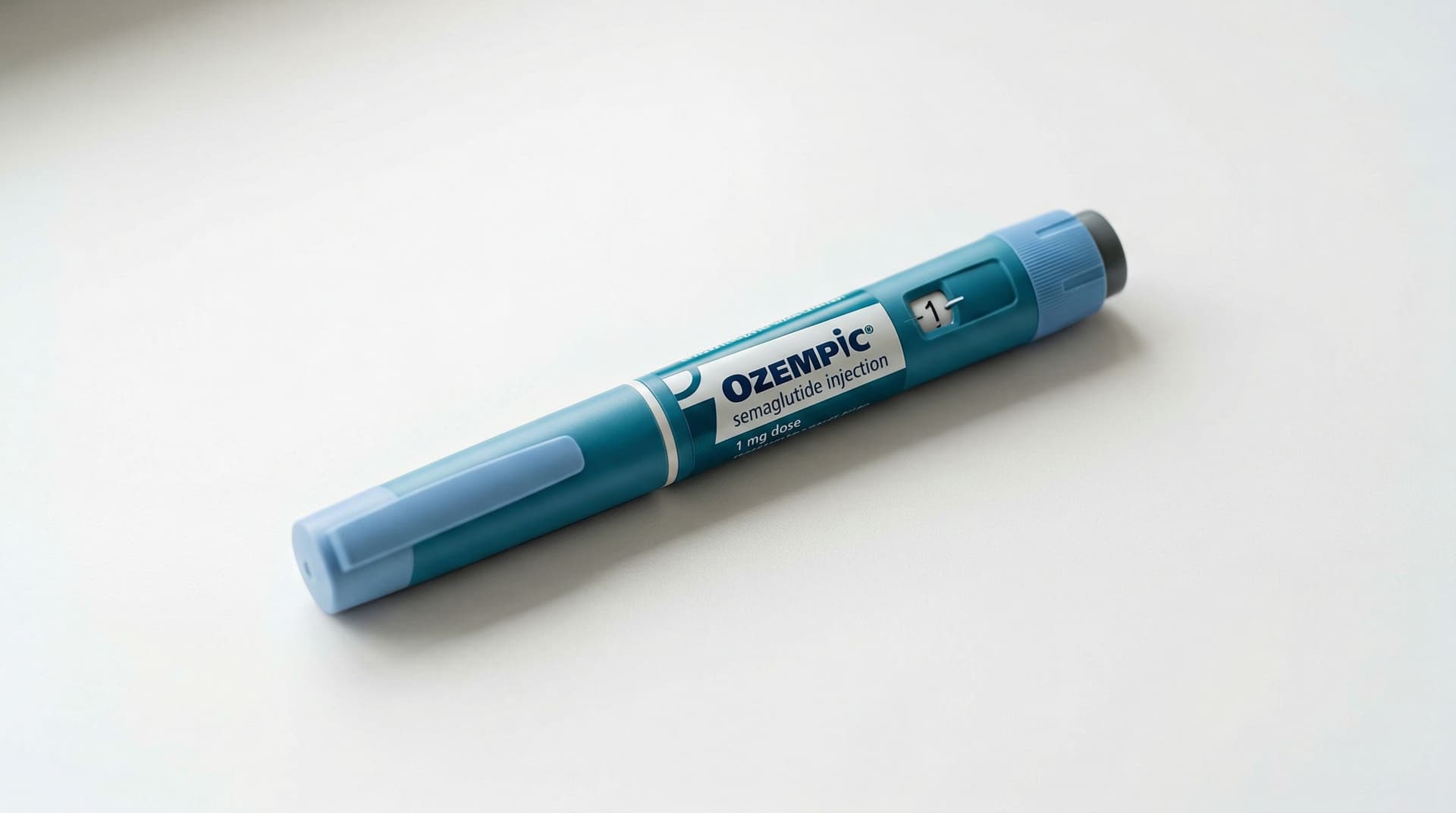
"Ozempic face" is not caused by Ozempic specifically. It's the media label for a real physiological phenomenon: rapid loss of subcutaneous facial fat — which sits closer to the skin surface than fat elsewhere on the body and therefore shows first. It happens on Wegovy, Mounjaro, Zepbound, compounded semaglutide, compounded tirzepatide, bariatric surgery, and any calorie-restricted diet that drops body weight faster than ~1% per week. Rate is the driver, not the drug. The prevention protocol has four evidence-backed pillars: (1) slow your weight-loss pace to <1% body weight per week; (2) protein intake at 1.2-1.6 g/kg/day; (3) resistance training 2-3× per week to preserve lean mass; (4) hydration + sleep. When the cost of your GLP-1 forces rapid titration to "finish before I run out of savings," you get more Ozempic face than you would on a slower, sustainable pace. The cheaper paths — Ozempic Savings Card at $25/mo, Medicare Bridge $50/mo (launched today, July 1), or compounded semaglutide from $69/mo via Embody (advertised starting rate; some checkout funnels quote about $99 month-to-month), $99/mo via Trimi (annual plan), or $179/mo via TrimRx (Highest Rated) — make the "slow and steady" protocol financially feasible. Here's the actual mechanism, who's at highest risk, the prevention protocol, and the cosmetic remediation options if it's already happened.
Quick answer: what is Ozempic face and what do you do about it?
| Question | Answer |
|---|---|
| Is it caused by Ozempic specifically? | No — happens on any rapid weight loss. Not drug-specific. |
| Is it permanent? | Mostly reversible in 12-24 months if you slow the loss, stabilize weight, and rebuild muscle. Some volume loss is permanent past age 55. |
| Who's at highest risk? | Older patients (>45), women, patients losing >1% body weight/week, patients under-eating protein (<0.8 g/kg/day). |
| Best prevention? | Slower titration + protein 1.2-1.6 g/kg/day + resistance training 2-3×/week + hydration + sleep. |
| If it's already happened? | Cosmetic fillers (HA-based) restore volume for 9-18 months; biostimulators (Sculptra, Radiesse) trigger collagen regrowth for 18-24 months. |
| Does compounded semaglutide cause less Ozempic face than brand Ozempic? | Same molecule → same effect at same dose. What differs is that lower monthly cost lets you titrate slowly and lose weight at a healthier pace — which prevents it. |
What "Ozempic face" actually is
The term became common in 2022-2023 as celebrity Ozempic use accelerated. Dermatologists picked it up as a shorthand for a specific pattern: hollowing of the cheeks, temples, and under-eye area, with loss of jawline definition and increased visibility of nasolabial folds — all appearing on patients within 3-8 months of starting rapid weight loss.
The pattern isn't unique to GLP-1s. Dermatologists have seen the same face changes on:
- Bariatric surgery patients (documented since the 1970s)
- Very-low-calorie diet patients (Cambridge Diet, Optifast, medically supervised fasting)
- Any patient losing weight >2 lbs/week consistently
- Chemotherapy patients with rapid weight loss
- HIV patients on early antiretroviral regimens (before combination therapy)
The core biology: the face has a proportionally high ratio of subcutaneous fat to total tissue. That subcutaneous fat provides the "youthful" volume that fills out cheeks and temples. When body fat drops fast, facial subcutaneous fat is metabolized on approximately the same schedule as body fat elsewhere, but the visual consequence is more dramatic because the face has less "reserve" volume to lose without visible change.
Why some patients get "Ozempic face" and others don't
Four variables that determine severity:
1. Rate of weight loss. The single biggest driver. Patients losing <0.5% body weight per week (e.g., 1 lb/week on a 200 lb frame) rarely develop noticeable Ozempic face. Patients losing >1.5% per week almost always do.
2. Starting age. Facial collagen and elastin decline ~1% per year after age 25. Older patients start with less structural reserve and less capacity to bounce back from volume loss. Risk climbs sharply after age 45.
3. Baseline BMI. Patients starting at BMI 40+ have more facial subcutaneous fat to lose before hollowing appears. Patients starting at BMI 30-35 hit the "hollow" threshold faster.
4. Muscle preservation. GLP-1 weight loss can be up to 25-30% lean mass without intervention. Facial appearance depends partly on the muscle beneath the fat (temporalis, masseter, zygomaticus). Losing masseter and temporalis muscle amplifies the "sunken" visual effect.
5. Sex. Women report Ozempic face more often than men — likely because women have proportionally more subcutaneous fat in the face and slightly less collagen density at any given age.
What the trial data says (indirectly)
No RCT has "Ozempic face" as a primary endpoint. But we can infer risk from the weight-loss trials:
| Trial | Drug | Weight loss rate | Estimated facial impact |
|---|---|---|---|
| STEP-1 (Wegovy 2.4mg) | Semaglutide | ~0.22% body weight/week average | Moderate risk at 68 weeks endpoint |
| SUSTAIN-6 (Ozempic 1.0mg) | Semaglutide | ~0.05% body weight/week | Low risk |
| SURMOUNT-1 (Zepbound 15mg) | Tirzepatide | ~0.31% body weight/week average | Higher risk — more weight loss = more facial change |
| SURMOUNT-5 (tirz vs sema, max doses) | Both | 0.28% (tirz) vs 0.19% (sema) | Tirzepatide slightly higher risk |
| Real-world compounded (JAMA 2024) | Both | 0.14% body weight/week (drop-outs at month 3-6) | Ironically lower risk because adherence is lower |
Practical implication: patients who tolerate the medication, titrate fully to top dose, and stay on for the full trial duration have the highest weight loss AND the highest Ozempic face risk. This is a preservation problem, not a prevention-by-abstinence problem. You want the weight loss; you just want it distributed over more time and with muscle preserved.
The prevention protocol: four pillars that actually work
Pillar 1 — Slow your weight-loss pace
Target: ≤1% body weight per week. For a 200 lb person, that's 2 lbs/week; for 150 lb, 1.5 lbs/week. Slower is better for facial appearance, even better for muscle preservation, and roughly the same total weight loss at 12 months.
How to actually slow it: - Stay at each titration step 6-8 weeks (not the standard 4) if you're already losing >1%/week. - Skip the last dose escalation if you're at your target weight loss zone. Many patients do well at semaglutide 1.7 mg or tirzepatide 7.5-10 mg maintenance rather than pushing to max. - If you're already at max dose and losing fast, work with your prescriber to drop back one step.
Pillar 2 — Protein at 1.2-1.6 g/kg/day
The single most-cited nutrition intervention in the weight-loss-preservation literature. For a 200 lb (91 kg) person, that's 109-146 g of protein per day.
Why: without adequate dietary protein, your body catabolizes muscle (including facial muscle) at the same rate as fat during weight loss. Patients hitting 1.2+ g/kg reliably preserve ~85-90% of lean mass; patients at <0.8 g/kg typically lose ~25-30% of lean mass.
How to actually hit it on GLP-1: - Eat protein first at every meal. Appetite vanishes 15-20 minutes into a meal on GLP-1. Start with protein, add carbs and fats after. - Protein-first snacks: Greek yogurt, cottage cheese, jerky, protein powder + water, boiled eggs. - Distribute across the day: 30-40 g per meal × 3-4 meals beats 100 g in one meal (muscle protein synthesis has a per-meal ceiling around 40 g). - Whey or casein powder if you can't hit target with food alone. 1-2 scoops fills the gap.
Pillar 3 — Resistance training 2-3× per week
Non-negotiable if you care about facial appearance and body composition. Any resistance training works — bodyweight, dumbbells, machines, resistance bands — as long as you're progressively overloading.
Minimum effective dose: - 2 sessions per week, 30-45 min each - Compound movements: squats, deadlifts, presses, rows, pulldowns - 3 sets × 8-15 reps per movement - Progressive overload: add weight or reps every 1-2 weeks
For facial muscle specifically: the temporalis (chewing muscle at the temples) and masseter (jaw muscle) respond to chewing load. Some dermatologists recommend chewing sugar-free gum 15-20 min/day to maintain facial muscle tone during rapid weight loss. Small effect, no downside.
Pillar 4 — Hydration + sleep
Hydration: dehydrated skin loses volume visually. Target 80-100 oz water/day. GLP-1's delayed gastric emptying + appetite loss both increase dehydration risk.
Sleep: growth hormone is released during deep sleep. GH supports muscle preservation and skin collagen turnover. Patients sleeping <6 hours/night lose ~30% more lean mass on the same weight-loss trajectory than patients sleeping 7-8 hours.
Why cost drives Ozempic face
The under-discussed connection: patients paying $998/month cash for off-label Ozempic often try to "finish faster to save money" — pushing dose escalation weekly instead of every 4 weeks, or trying to hit their target weight in 6 months instead of 12. That accelerated pace is exactly what causes Ozempic face.
Cheaper monthly cost = longer sustainable time on medication = slower weight loss pace = less Ozempic face.
The four legitimate cheaper paths that enable a slow-titration protocol:
1. Ozempic Savings Card $25/mo — commercial insurance + T2D. See our Wegovy cheaper paths guide for the parallel semaglutide-for-obesity route.
2. Medicare GLP-1 Bridge $50/mo — launched today, July 1, 2026. Medicare Part D + qualifying tier. See our Medicare Bridge enrollment guide.
3. Compounded semaglutide $99-$249/mo — same active molecule, US 503A licensed pharmacy, no diagnosis required. The path that most often enables slow titration because monthly cost is 4-10× lower than cash Ozempic. See our Cheapest Compounded Semaglutide ranking.
4. NovoCare Wegovy $349/mo direct ($199 first two fills) — brand Wegovy from Novo Nordisk, no insurance navigation.
Compounded provider list (commission-first)
If cost is what's compressing your titration schedule and driving faster-than-ideal weight loss, these programs offer sustainable monthly pricing that enables the slow protocol:
- TrimRx — Highest Rated. Semaglutide $179/mo flat at any dose. US-licensed prescribers, monthly check-ins, protein/training coaching available. Best for patients who want the full "prevent Ozempic face" protocol supported clinically.
- Embody. Semaglutide from $69/mo (injection). Cheapest floor — $828–$1,188/year makes 12-18 month titration timelines financially trivial.
- SnagRx. Semaglutide $69/mo on the 12-month plan ($99 month-to-month), locked in for life so the rate never rises as your dose climbs. LegitScript-certified.
- Trimi. Semaglutide $99/mo on the annual plan ($1,188 paid once; $175 month-to-month), flat at every dose.
- bmiMD. Semaglutide $119/mo on the 12-month plan ($159 month-to-month). Not available in Louisiana or Mississippi.
- ShedRx. Semaglutide $159/mo on the 12-month plan ($199 monthly, 2-month minimum). Ships to all 50 states, with a brand-name pathway if you later move to FDA-approved Wegovy.
For the parallel tirzepatide provider list see our Cheapest Compounded Tirzepatide ranking.
Cosmetic remediation: if Ozempic face has already happened
If you're already 6-12 months into significant weight loss and the facial changes are visible, three cosmetic paths — in ascending order of invasiveness:
HA fillers (hyaluronic acid — Restylane, Juvederm, RHA) - Cost: $600-$1,200 per syringe; typical face uses 3-6 syringes over multiple sessions - Duration: 9-18 months, then dissolves; needs re-treatment - Reversal: can be dissolved with hyaluronidase if you don't like the result - Best for: cheeks, tear troughs, temples, nasolabial folds. First-line for reversibility.
Biostimulators (Sculptra, Radiesse) - Cost: $800-$1,500 per vial; 2-4 vials over 3-6 sessions - Duration: 18-24+ months by triggering your own collagen production - Reversal: not reversible; results build over 3-6 months - Best for: volume replacement across the whole face, especially for older patients with collagen loss.
Autologous fat grafting - Cost: $4,000-$8,000, in-office surgical procedure - Duration: roughly 50-70% of transferred fat survives long-term (potentially permanent) - Reversal: not reversible - Best for: patients who don't want to repeat filler cycles and are stable at their goal weight.
Adjuncts - Microneedling with radiofrequency (Morpheus8, Vivace) — improves skin quality and collagen production, doesn't restore volume alone but pairs well with fillers. - Ultrasound skin tightening (Ultherapy) — tightens loose skin from significant weight loss; doesn't add volume.
Practical order of operations: if you're on GLP-1 and the face changes are recent, start with hydration + protein + resistance training for 2-3 months before pursuing cosmetic work. Some volume returns as the body stabilizes and rebuilds muscle. Then evaluate what remains.
When to see a dermatologist vs a plastic surgeon vs your GLP-1 prescriber
GLP-1 prescriber first: if you're mid-titration and rapid weight loss is the driver, the fastest fix is to slow the pace (drop back one dose step, extend the interval between step-ups). Cost $0. Discuss before booking cosmetic consultations.
Dermatologist for non-invasive: HA fillers, biostimulators, microneedling, laser. Board-certified dermatologist with cosmetic training. Look for injectors with high volume (200+ syringes per year).
Plastic surgeon for structural: fat grafting, deep-plane facelift, cheek implants. Reserve for patients who are 12+ months stable at their goal weight and have severe volume loss.
FAQ
Is Ozempic face permanent? Mostly no. Patients who slow their weight loss, stabilize at goal weight, and rebuild muscle regain a meaningful amount of facial volume over 12-24 months. Some age-related volume loss (especially past 55) is permanent regardless.
Does compounded semaglutide cause Ozempic face too? Yes — same active molecule, same physiology. What differs is affordability: lower monthly cost lets you titrate slowly, which is the single biggest prevention lever.
Do injectable and oral GLP-1s differ on face effects? No meaningful difference — face effects depend on the rate of weight loss, not the delivery route. Oral semaglutide (Rybelsus) and oral orforglipron (Foundayo) cause the same facial changes at equivalent weight loss rates.
Should I stop Ozempic if I get Ozempic face? Almost always no. Stopping causes weight regain (STEP-4: two-thirds regained by week 68 after stopping), which is worse for cardiometabolic health than the cosmetic issue. The right response is to slow titration and add cosmetic support if wanted.
Does drinking more water fix Ozempic face? Partially — dehydration exaggerates volume loss. Adequate hydration (80-100 oz/day) makes the face look fuller without changing underlying fat/muscle composition. It's an easy win, not a full solution.
Can I prevent Ozempic face while still losing weight fast? Not really. The two are directly coupled. If you want max weight loss speed, you accept more visible facial change. If you want to preserve facial appearance, you accept slower weight loss. Most people find a compromise around 0.7-0.9% body weight per week.
Do collagen supplements help? Weak evidence. Collagen peptide supplements have some clinical support for skin elasticity but modest effect. Won't hurt at 10-15 g/day; won't replace the four prevention pillars.
Is tirzepatide (Mounjaro/Zepbound) worse for Ozempic face than semaglutide? Slightly — because tirzepatide produces more weight loss on average, faster. If you're specifically concerned about facial appearance and you're deciding between molecules, semaglutide at a moderate maintenance dose has a slightly lower face-change risk. See our tirzepatide vs semaglutide guide and Mounjaro vs Ozempic head-to-head.
For our full provider grid see the cheapest GLP-1 programs page. For the long-term cardiovascular and kidney case for staying on a GLP-1 (which meaningfully outweighs cosmetic concerns for most patients), see our 90,000-patient Ozempic safety analysis. For the parallel side-effect trilogy, see our Ozempic side effects guide and Mounjaro side effects guide. Medicare-eligible patients: today's the day the Medicare GLP-1 Bridge Program actually starts dispensing.