

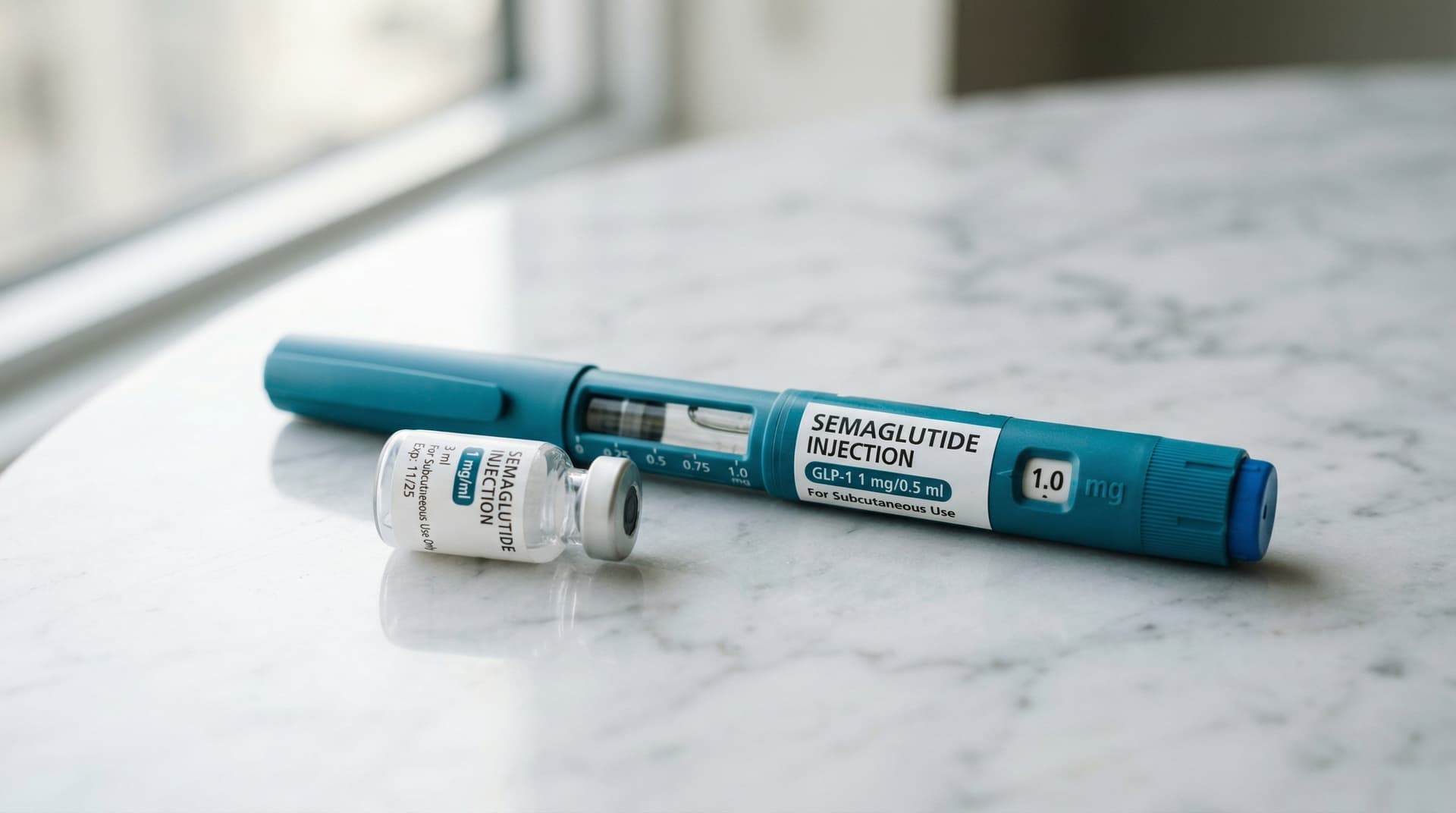
Yes — and for many patients who hit their goal weight, a lower maintenance dose is the smart play. The FDA label says the Wegovy "maintenance dose" is 2.4 mg weekly (the highest dose). But real-world clinical practice routinely uses 1.0 mg, 1.7 mg, or even lower for long-term maintenance — and the limited published data supports it for patients near their goal weight.
What "low dose maintenance" actually looks like, whether you'll keep losing or just maintain, what insurance will pay for at lower doses, and which telehealth providers will customize the protocol (most won't) — here's the 2026 breakdown.
What is the maintenance dose of Wegovy?
According to the FDA label, the maintenance dose of Wegovy is 2.4 mg once weekly. The titration schedule:
- Week 1–4: 0.25 mg
- Week 5–8: 0.5 mg
- Week 9–12: 1.0 mg
- Week 13–16: 1.7 mg
- Week 17+: 2.4 mg (maintenance)
If a patient cannot tolerate the next dose level, the label permits staying at 1.7 mg as the maintenance dose. Going lower — to 1.0 mg or below — is off-label maintenance but is widely practiced in obesity medicine and telehealth clinics.
The reason: the FDA approval studied 2.4 mg specifically because that produced the largest weight loss in the pivotal STEP trials. The approval doesn't say lower doses don't work for maintenance — it says they weren't formally tested as the *primary* endpoint for chronic weight management.
Can I stay on a low dose of Wegovy?
Yes, with caveats. Three patient profiles where it makes clinical sense:
- You hit your goal weight on the standard titration and want to maintain. Stepping down to 1.0–1.7 mg for maintenance is a common clinical decision. Roughly two-thirds of obesity-medicine clinics in a 2025 American Society of Bariatric Physicians survey reported using lower-than-label doses for maintenance.
- You're tolerating 2.4 mg poorly. If GI side effects (nausea, vomiting) are limiting your quality of life and weight loss is stable, dropping to the previous well-tolerated dose is standard practice. The label explicitly allows 1.7 mg as an alternative maintenance.
- You're paying out of pocket and want to lower cost. This is where compounded options come in — see the cost section below.
Scenarios where staying on a low dose is not the right call:
- You haven't hit your goal weight yet. Maintenance dosing during the active weight-loss phase usually under-dose-responds. You'll lose less than you would on the full titration. The STEP trial data is unambiguous on this.
- You're using "microdosing" as marketing. Be skeptical of telehealth clinics that put new patients directly on low doses with promises of weight loss. The clinical evidence supports low-dose *maintenance*, not low-dose *induction*.
For more on this distinction, see our GLP-1 microdosing analysis.
Do you still lose weight on a maintenance dose of Wegovy?
It depends on the dose, your current weight, and how long you've been on it. Here's what the data shows:
On 2.4 mg maintenance (label-approved)
The STEP-5 extension trial followed patients on 2.4 mg semaglutide for 104 weeks (2 years). Average weight loss continued through month 6, plateaued by month 12, and was largely maintained through month 24. Patients who continued at 2.4 mg lost ~15% of body weight on average — and kept it off.
On 1.0–1.7 mg maintenance (off-label, real-world)
Smaller observational studies and clinical case series suggest patients can maintain 70–85% of their peak weight loss on a stepped-down dose, with markedly fewer side effects. Some studies report continued slow weight loss (0.5–1 lb/month) on lower maintenance doses — likely a function of the patient still being above their long-term setpoint.
On 0.25–0.5 mg maintenance ("microdose")
Evidence is thinner. Anecdotal data from compounding-pharmacy programs and a few small observational series suggest people can maintain a meaningful fraction of their weight loss at very low doses for 6–12 months, especially when combined with behavioral and dietary structure. Don't expect ongoing weight loss at these doses — expect maintenance with occasional drift.
What happens if you stop entirely
This is the comparison that matters most. STEP-4 (the discontinuation trial) randomized patients who had reached 2.4 mg to either continue or switch to placebo at week 20. The discontinuation group regained 11 of the 17 percentage points of weight they had lost — within 48 weeks of stopping.
The takeaway: staying on a low dose almost always beats stopping entirely. Low-dose maintenance is a defensible long-term strategy. Cold-turkey discontinuation is not.
For the full breakdown of what stopping (or stop-restarting) does to body composition, see our GLP-1 stop-restart muscle loss analysis.
Cost of low-dose vs full-dose Wegovy
This is where the math gets interesting in 2026.
Brand-name Wegovy (full dose 2.4 mg)
- List price: $1,349/month
- NovoCare direct-pay: $499/month for any dose
- Insurance copay: typically $25–$200/month if covered
Critically: brand-name Wegovy pens come in fixed-dose presentations. You can't fractionally adjust the pen. Stepping down means switching to a lower-dose pen (1.7 mg, 1.0 mg, 0.5 mg, or 0.25 mg). NovoCare charges the same $499/month regardless of dose.
Oral Wegovy (pill, launched January 2026)
- $149/month at the lowest dose (3 mg pill)
- Escalates with dose
The oral pill is actually one of the cheapest ways to access *any* dose of semaglutide. For maintenance specifically, staying on the lowest oral dose is a legitimate $149/month strategy.
Compounded semaglutide (off-label, customizable)
- $99–$299/month depending on provider
- Doses can be fractionally adjusted — this is the main reason compounding pharmacies are popular for maintenance
- Quality varies dramatically by provider — see our provider quality screening criteria
For a state-by-state breakdown of Wegovy pricing including Medicaid coverage, see our Wegovy cost analysis.
Which providers will customize a maintenance dose?
This is where most patients hit a wall. Many telehealth clinics follow the FDA titration schedule rigidly — they prescribe 2.4 mg as maintenance and will not adjust. Major insured-only providers (Ro, etc.) almost always stick to the label.
Providers that will work with you on lower maintenance doses, in our most recent comparison:
- TrimRx — Personalized doctor consultations explicitly include dose customization. Patients on maintenance protocols routinely work with reduced doses. All-inclusive monthly pricing.
- ShedRx — Compounded semaglutide options with explicit support for stepped-down maintenance dosing. Lower price point for cash-pay maintenance.
For the full ranking of providers willing to do non-standard protocols (including the cheapest options for cash-pay maintenance), see our best GLP-1 providers list.
What to ask any prospective provider before signing up:
- "Will you prescribe at 1.7 mg or 1.0 mg as a long-term maintenance dose if I'm at my goal weight?"
- "Do you require monthly visits to maintain my prescription, or is it less frequent for stable patients?"
- "Can I switch to a compounded version at a lower dose without restarting the program?"
Providers that refuse to answer these specifically, or that route you to a fixed-schedule protocol regardless of clinical need, are not the right fit for long-term maintenance.
Risks of staying too low
Three risks to know:
1. Weight regain. If your dose is too low for your individual setpoint, you'll slowly drift upward. The fix is dose adjustment, not stopping. Most clinics check weight monthly during maintenance — if you've regained 5+ pounds, talk to your prescriber about going back up.
2. Hunger return ("food noise"). Lower doses provide less appetite suppression. Some patients describe a "ceiling" where below 1.0 mg the appetite suppression noticeably weakens. This is highly individual — some maintain well at 0.5 mg, others need 1.7 mg.
3. Hair shedding rebound. Counter-intuitively, *changing* the dose (up or down) can trigger a fresh round of telogen effluvium in about 2–3% of patients. Slow changes (one dose step every 8+ weeks) minimize this. See our GLP-1 hair loss meta-analysis.
Frequently asked questions
What's the lowest dose of Wegovy that still works for maintenance? Highly individual. Published data is strongest for 1.0–1.7 mg. Most clinicians won't go below 0.5 mg without a specific reason. Below 0.25 mg is essentially homeopathic and unlikely to do much.
Is 1.7 mg considered a maintenance dose? Yes, per the FDA label as an alternative if 2.4 mg is not tolerated. Many obesity-medicine specialists use 1.7 mg as their default maintenance dose for stable patients.
Can I go from Wegovy to oral Wegovy for maintenance? Yes, and many patients do for cost and convenience. The lowest oral dose is $149/month via NovoCare. Talk to your prescriber about the conversion — there's no exact 1:1 mg equivalence between injectable and oral semaglutide.
Will insurance pay for low-dose Wegovy as maintenance? Usually, yes — once you have an approved prescription, the dose doesn't typically change coverage. The exceptions are insurers that have started requiring patients to be at 2.4 mg specifically (CVS Caremark has done this in some plan designs). Check your formulary.
Is Zepbound better than Wegovy for maintenance? Same question logic — both can be used at maintenance doses, both have similar plateau patterns. The choice usually comes down to what got you to goal weight in the first place. See our Zepbound vs Wegovy comparison.
Should I switch to compounded semaglutide for cheaper low-dose maintenance? Maybe. Pros: cost ($99–$199/month), dose flexibility. Cons: quality varies, FDA enforcement is active against unsafe compounders. Use our provider screening criteria and verify LegitScript certification before signing up.
How long can I stay on a maintenance dose? Indefinitely, based on the available data. STEP-5 showed sustained benefit at 2 years. Real-world cohorts in Europe (where semaglutide has been used longer) show 3+ years of safe continuous use. This is treated as a chronic medication, like blood pressure or cholesterol drugs.
Bottom line
Staying on a low dose of Wegovy is clinically reasonable, well-supported by post-trial real-world data, and often the right move for patients who have hit their goal weight. The FDA-labeled 2.4 mg maintenance is the dose that produced the headline weight-loss number in trials — but for patients in maintenance phase, lower doses preserve most of the benefit with fewer side effects and (often) lower cost.
The hardest part is finding a provider who will actually work with you on a non-standard maintenance plan instead of forcing you to follow a fixed schedule designed for active weight loss. Our top-rated providers for flexible dosing is the shortlist we'd send a friend — every one of them will customize based on your response and goals, not follow a rigid protocol.
If you stopped Wegovy entirely, you'd very likely regain most of the weight (per STEP-4). A low-dose maintenance plan is almost always the better long-term answer.