

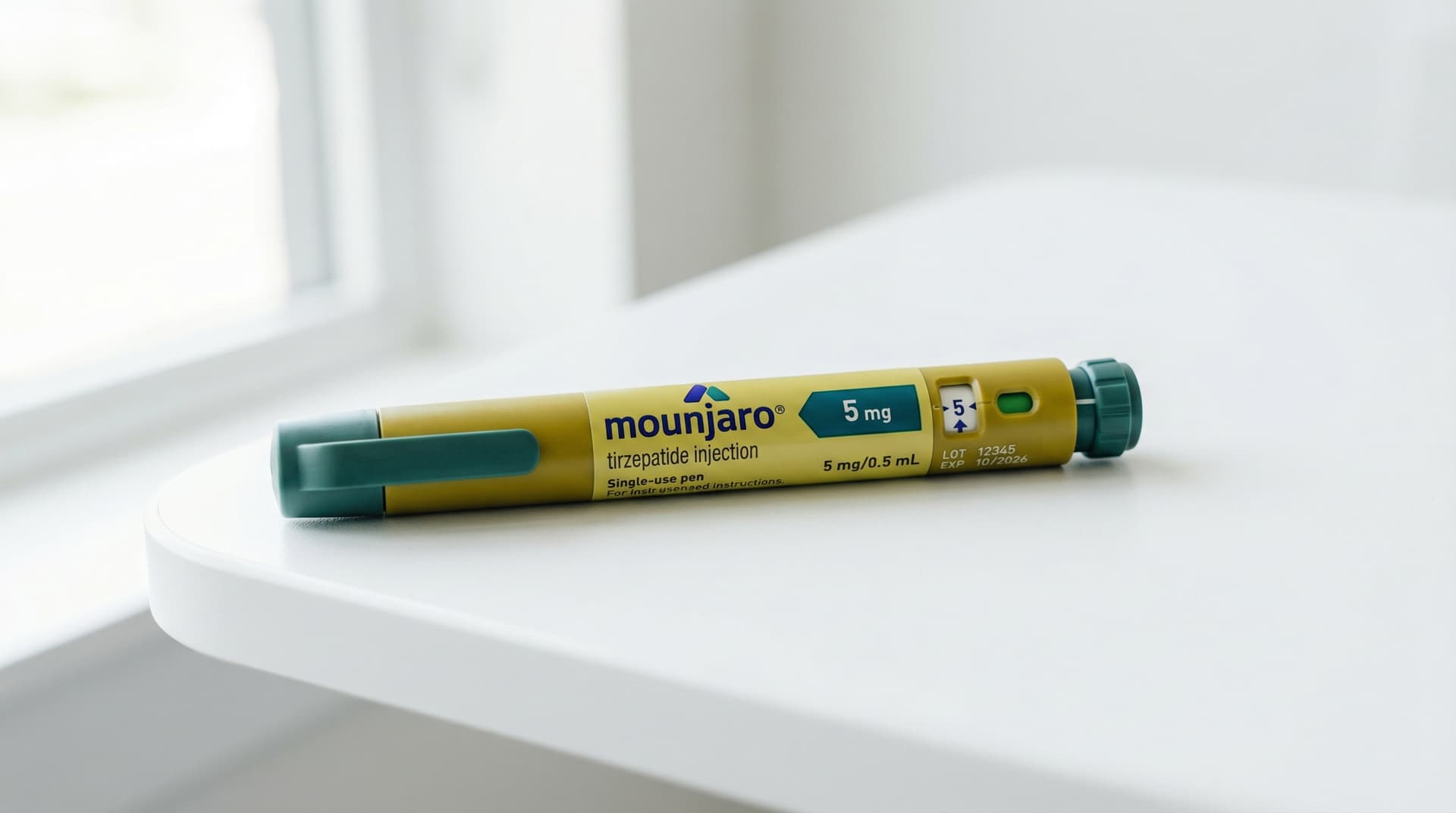
Mounjaro (tirzepatide) is FDA-approved only for Type 2 diabetes — but it's the exact same molecule, at the exact same doses, as Zepbound, which IS approved for weight loss. If your prescriber put you on Mounjaro for weight loss off-label and you're paying $1,069/month cash, you have three legitimate cheaper paths in June 2026: get an A1C drawn (prediabetes A1C 5.7-6.4 unlocks the $25 Mounjaro Savings Card), switch to brand Zepbound ($25-$549/month depending on path), or move to compounded tirzepatide at $99/month via Embody, $146/month via Yucca Health, $199/month via TrimRx (Highest Rated), $224/month via MyStart Health, or $179 first-month via MEDVi. Here's the decision tree and the cost math.
Can Mounjaro be used for weight loss?
Yes — but only off-label. The FDA approved Mounjaro in 2022 exclusively for Type 2 diabetes management. Weight loss is documented as a side effect in the clinical trials (~15% body weight reduction at the 15mg dose), and prescribers can legally prescribe Mounjaro off-label for weight loss in patients who don't have T2D. About 1 in 4 Mounjaro prescriptions in 2025 were written off-label, primarily for obesity.
But there's a catch that costs most off-label patients thousands of dollars: without a T2D diagnosis, you don't qualify for the Mounjaro Savings Card ($25/month). And insurance plans typically won't cover Mounjaro at all without a T2D diagnosis. That leaves cash retail ($1,069/month) — the most expensive legitimate path to GLP-1 weight loss anywhere in the US.
Mounjaro vs Ozempic vs Wegovy vs Zepbound: which is right for weight loss?
Quick orientation on the four major brand GLP-1s:
| Brand | Molecule | FDA-approved for | Max dose | Retail/mo |
|---|---|---|---|---|
| Ozempic | Semaglutide | Type 2 diabetes | 2.0mg/wk | $998 |
| Wegovy | Semaglutide | Obesity (BMI ≥30 or ≥27+comorbidity) | 2.4mg/wk | $1,349 |
| Mounjaro | Tirzepatide | Type 2 diabetes | 15mg/wk | $1,069 |
| Zepbound | Tirzepatide | Obesity (BMI ≥30 or ≥27+comorbidity) | 15mg/wk | $1,089 |
Two pairs, same molecules: Ozempic = Wegovy (both semaglutide, different approved indications). Mounjaro = Zepbound (both tirzepatide, different approved indications). For deeper detail see our Zepbound = Mounjaro identity explainer and Ozempic vs Mounjaro comparison.
For pure weight loss in cash-pay patients, tirzepatide (Mounjaro/Zepbound) is the most effective brand option — clinical trial average weight loss at 15mg/week was 22.5% body weight at 72 weeks, vs ~15% for semaglutide at 2.4mg/week. If your prescriber put you on Mounjaro specifically, they likely picked it (or its sister Zepbound) for the dose response.
What does Mounjaro cost without insurance in 2026?
Without insurance and without a T2D diagnosis, brand Mounjaro retails between $1,069 and $1,200/month at major US pharmacies (June 2026 data). Eli Lilly's own LillyDirect program does not currently offer Mounjaro vials at a discount (they sell discounted Zepbound vials at $349-$549 — for the obesity indication).
Real-world cash prices today:
| Pharmacy | Cash price /mo |
|---|---|
| CVS, Walgreens | $1,089-$1,150 |
| Walmart, Costco | $1,069-$1,099 |
| GoodRx best price | $978-$1,050 (varies by ZIP) |
| Lilly Insulin Value Program | Not eligible (T2D-specific Lilly insulin program) |
If you're paying any of those numbers and don't have a T2D diagnosis, the math heavily favors switching paths. Compounded tirzepatide at $99/month is the same molecule at 1/10th the cost.
The 3 cheaper paths for off-label Mounjaro patients
Path 1: Get an A1C drawn — $25/month if you have prediabetes or undiagnosed T2D
This is the path most patients miss. The Mounjaro Savings Card requires a Type 2 diabetes diagnosis, but the definition of "diabetes" for prescription qualification is broader than most people realize:
- A1C 6.5+ = Type 2 diabetes (qualifies for Mounjaro Savings Card)
- A1C 5.7-6.4 = Prediabetes (may qualify for Mounjaro depending on your prescriber's coding; check insurance prior auth)
An A1C blood test is ~$20-$40 at LabCorp or Quest, or covered by most plans. Roughly 1 in 3 US adults has prediabetes, and 80% don't know it. If you've been on Mounjaro for a few months and your blood sugar control wasn't tested before, ask for the test now.
If your A1C qualifies you: apply the Mounjaro Savings Card and pay $25/month copay for up to 13 fills per year through commercial insurance. This is the cheapest legitimate Mounjaro path.
If your A1C doesn't qualify you: move to Path 2 or Path 3.
Path 2: Switch to brand Zepbound — same molecule, FDA-approved for weight loss
Zepbound is the obesity-indicated version of Mounjaro. Identical molecule (tirzepatide), identical doses (2.5/5/7.5/10/12.5/15mg weekly), identical clinical effect. The only difference is the FDA-approved indication on the label.
Why this matters for weight-loss patients: Zepbound has its own savings programs Mounjaro doesn't offer for obesity patients:
- Zepbound Savings Card: $25/month for commercially insured patients with Zepbound on formulary (BMI ≥30 or ≥27+comorbidity)
- LillyDirect Zepbound vials: $349-$549/month direct-from-Lilly cash-pay (no insurance, no savings card needed)
- Medicare GLP-1 Bridge Program: $50/month from July 1, 2026 (Part D, qualifying conditions — see our Bridge Program guide)
To switch: ask your prescriber to write a new prescription for Zepbound instead of Mounjaro. Dose conversion is 1:1 — 7.5mg Mounjaro becomes 7.5mg Zepbound. Full transition steps in our how to get Zepbound cheaper guide.
Path 3: Compounded tirzepatide — $99-$249/month cash-pay
Compounded tirzepatide is the same active molecule (tirzepatide) prepared by a licensed US compounding pharmacy. Same doses, same dosing schedule, same clinical effect — at 1/10th the cash-retail price of brand Mounjaro.
The 6 verified compounded tirzepatide programs in June 2026, ranked commission-first:
- TrimRx — $199/month (Highest Rated). Flat all-inclusive pricing at every dose, LegitScript-listed pharmacy, real telehealth visits with continuity-of-care prescribing.
- Yucca Health — $146/month on 6-month plan. Best price-to-credentialing balance; Klarna/Affirm financing available.
- MyStart Health — $224/month with code SELFLOVE25. Unlimited clinician access + labs included; brand pathway built in if you ever want to switch back to Mounjaro or Zepbound.
- MEDVi — $179 first month, $299 refills. Lowest entry point for trialing.
- Embody — $69/month. Cheapest credentialed option; HSA/FSA eligible.
- SkinnyRx — $199/mo (last published standing rate; SkinnyRx currently advertises only a $99 first month with no renewal price). No commitment, multi-format delivery.
Switch-friendly programs explicitly designed for patients moving from brand Mounjaro to compounded: TrimRx and MyStart Health intake forms have a "currently taking Mounjaro" path that prescribes your existing mg dose without restarting titration. Full step-by-step in our switching guide (same protocol applies to tirzepatide).
For the full compounded tirzepatide comparison see our cheapest compounded tirzepatide ranking.
Regulatory note: the FDA's June 29 compounded comment period
If you're considering Path 3, you should know: the FDA published a proposed rule on May 1, 2026 to permanently exclude tirzepatide (and semaglutide and liraglutide) from the 503B Bulks List — the legal pathway most outsourcing facilities use to compound in bulk. The comment period closes June 29, 2026 (14 days from today).
What this means for compounded tirzepatide patients in June 2026:
- Today: No change. Programs still ship compounded tirzepatide normally.
- If finalized (late 2026 at earliest): 503B large-batch compounding ends. 503A patient-specific pharmacies (separate statute, not affected by the proposal) continue. Some programs transition; some don't.
- Programs with multiple pharmacy partners (TrimRx, MyStart Health, Yucca Health) are best positioned to keep shipping if the rule lands.
Full analysis in our FDA 503B compounded ban explainer.
Practical implication: if you're starting compounded tirzepatide this month, avoid 12-month prepayment commitments. Pick month-to-month programs (Embody, MEDVi) or short 3-6 month plans you can pause.
Decision matrix: which path fits your situation
| Your situation | Best path | Monthly cost |
|---|---|---|
| Commercial insurance + A1C 6.5+ (T2D) | Mounjaro Savings Card | $25 |
| Commercial insurance + A1C 5.7-6.4 (prediabetes, prescriber will code) | Mounjaro Savings Card | $25 |
| Commercial insurance + Zepbound on formulary (no T2D needed) | Switch to Zepbound + Savings Card | $25 |
| Medicare Part D + qualifying conditions (BMI ≥35, or ≥30/≥27 with conditions) | Switch to Zepbound + Medicare Bridge | $50 |
| Cash-pay, no insurance, no T2D, want brand product | Switch to LillyDirect Zepbound vials | $349-$549 |
| Cash-pay, no insurance, comfortable with compounded | Embody (cheapest) or TrimRx (Highest Rated) | $99-$199 |
FAQ
Is Mounjaro for weight loss covered by insurance? Almost never if you don't have Type 2 diabetes. Commercial insurance plans cover Mounjaro for T2D only. For weight loss alone, you need Wegovy or Zepbound coverage instead (which most plans also restrict).
Can my doctor prescribe Mounjaro off-label for weight loss? Yes — prescribing off-label is legal. But the prescription typically won't be covered by insurance, and you won't qualify for the $25 Savings Card without a T2D diagnosis.
What's the difference between Mounjaro and Zepbound? Same molecule (tirzepatide), same doses, same manufacturer (Eli Lilly), same clinical effect. Mounjaro is FDA-approved for T2D; Zepbound for obesity. Lilly maintains them as separate brands for regulatory and pricing reasons.
Is compounded tirzepatide the same as Mounjaro? The active ingredient (tirzepatide) is the same molecule. Compounded versions are prepared by licensed US compounding pharmacies; brand Mounjaro is manufactured by Eli Lilly. Clinical effects at equivalent doses are equivalent. Legal status differs — see our FDA compounded explainer.
Will I lose progress switching from Mounjaro to compounded tirzepatide? No. Same molecule, 1:1 mg dose conversion, no titration restart needed if the new prescriber continues your existing dose. Full step-by-step protocol in our switching guide.
What if I'm on Mounjaro 15mg (max dose)? All six compounded tirzepatide programs above prescribe up to 15mg/week. Confirm with your chosen program's intake — most have a "high-dose" path that confirms the prescribing clinician can write at max dose.
For the full provider grid, see our cheapest GLP-1 programs page. For the parallel breakdown of Wegovy cost paths, see our Wegovy cheaper guide.