
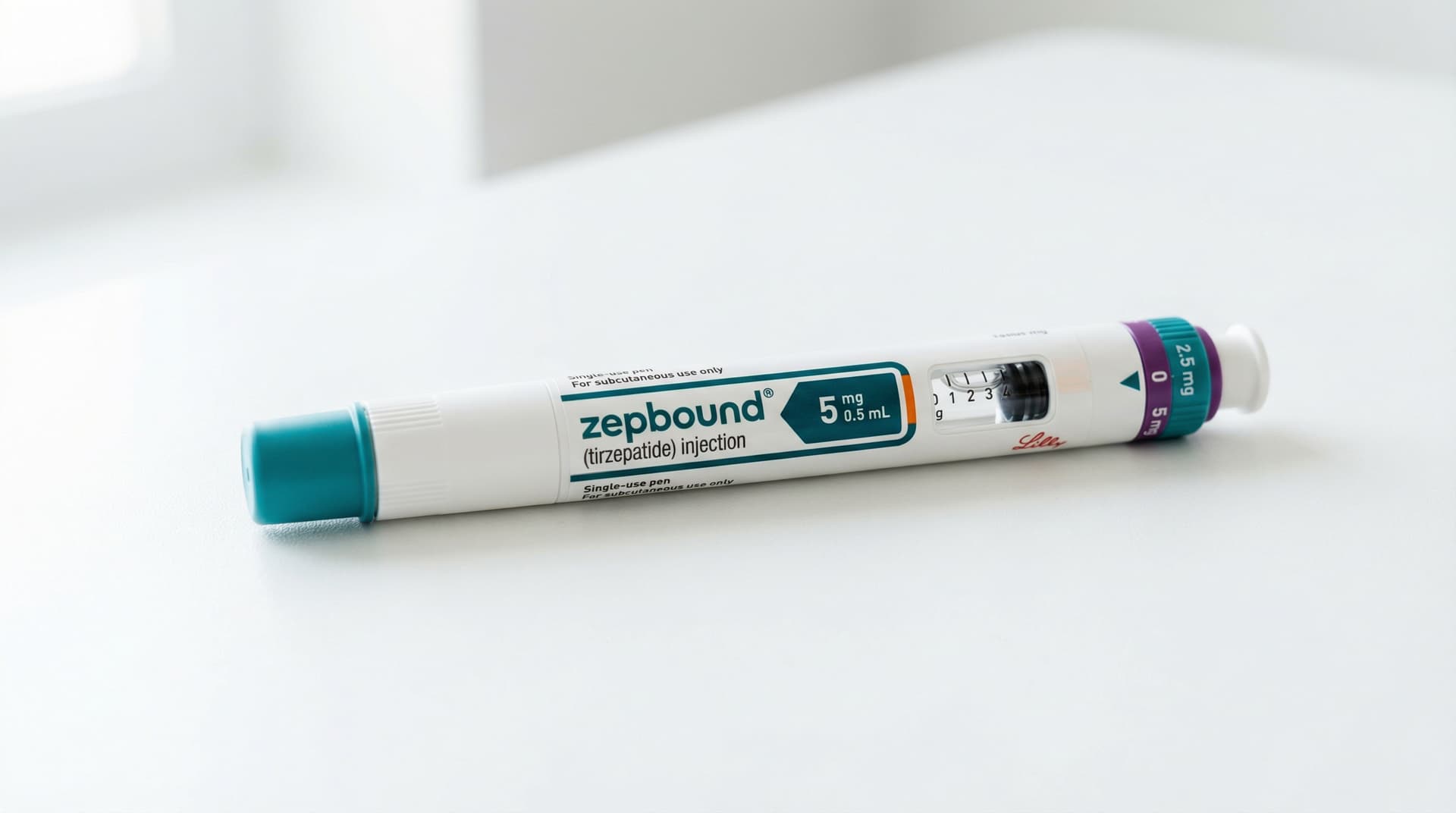
Eli Lilly's Zepbound Savings Card can bring your cost down to as little as $25 per month — but only if you have commercial insurance that actually covers Zepbound for weight management. Roughly half of US employer plans still exclude weight-loss drugs, and when your plan doesn't cover Zepbound, the card's non-covered tier only brings a 1-month KwikPen down to as low as $299 — not $25. If you're on Medicare, Medicaid, or any government plan, federal law bars you from using the card at all. That "does your plan cover it?" test is what separates the patients who pay $25 from the ones who pay $299 or more — and there's a legitimate $119–$299 path for everyone the card leaves out.
Here's exactly who qualifies in 2026, the four things that disqualify you, how to enroll in about 10 minutes, the prior-authorization appeal path, and the cheapest legitimate route to the same tirzepatide molecule when the $25 card isn't available to you.
Who actually qualifies for the Zepbound Savings Card?
Eli Lilly's official eligibility criteria, as read in July 2026 and re-checked September 2026:
- You have commercial (private) insurance — an employer plan or a marketplace plan you bought yourself
- Your plan covers Zepbound for chronic weight management — this is the requirement most people fail
- You have a valid Zepbound prescription from a licensed US prescriber (BMI ≥30, or ≥27 with a weight-related condition like high blood pressure, high cholesterol, or sleep apnea)
- You are a US resident age 18+
- You are NOT enrolled in Medicare, Medicaid, TRICARE, VA, or any other federal or state healthcare program
If your plan covers Zepbound and you meet the rest, your copay is capped at as low as $25/month for up to 13 fills per calendar year. If your plan does NOT cover Zepbound, a separate "non-covered" tier of the same card brings a 1-month KwikPen down to as low as $299 (up to 11 fills per calendar year) — nowhere near $25, and in line with LillyDirect's own self-pay vials and KwikPens at $299–$449/month.
The one requirement most people fail: does your plan actually cover Zepbound?
This is where most Zepbound searchers get stuck. Zepbound is labeled for weight loss, and a large share of US commercial plans still carve out obesity medications completely — even though they'll happily cover the identical molecule (tirzepatide) as Mounjaro for type 2 diabetes.
Here's the mechanic that trips people up: the $25 tier only works after your insurance pays its share. If your plan doesn't cover Zepbound for weight management, there's no copay to reduce — so you land on the non-covered tier instead — a cash price of as low as $299 per 1-month KwikPen, not a $25 copay cap.
To find out in five minutes whether your plan covers it, call the number on the back of your insurance card and ask: "Is Zepbound on my formulary for chronic weight management, and what tier?" If the answer is "not covered" or "excluded," the $25 card is off the table — skip to the cash-pay section below, where the same molecule runs $119–$299/month.
Who is excluded — the four disqualifiers
- Medicare or Medicaid coverage. Federal anti-kickback law prohibits manufacturer savings cards from being applied to any drug paid by Medicare Part D, Medicare Advantage, Medicaid, TRICARE, or the VA. This is firm — there is no workaround, coupon code, or loophole. If you're on Medicare, your 2026 path is the new Medicare GLP-1 Bridge Program at roughly $50/month, not the savings card.
- Your plan excludes weight-loss drugs. The single most common reason the card fails at the $25 level. If your formulary doesn't list Zepbound for weight management, you're on the non-covered tier.
- No commercial insurance. The $25 tier is a copay-reduction layer, not a standalone coupon. Without commercial coverage paying a share, there is no copay for it to lower.
- No qualifying prescription. You need a documented BMI ≥30 (or ≥27 with a comorbidity). Without a valid Zepbound prescription, the card can't be issued.
How to enroll in the Zepbound Savings Card
Three steps. Total time: about 10 minutes.
- Go to zepbound.lilly.com and click "Savings & Support." Lilly runs the program through its official portal.
- Complete the online form. You'll enter your name, date of birth, ZIP code, and confirm you have commercial insurance and a Zepbound prescription.
- Save your digital card. You'll receive a card with a Group, BIN, PCN, and Member ID. Present it at the pharmacy with your prescription. Major chains — CVS, Walgreens, Rite Aid, grocery pharmacies — apply it automatically.
The card is reusable across the calendar year — up to 13 fills on the covered tier, 11 on the non-covered tier — and the current card runs through December 31, 2026, re-verifying your eligibility each January.
What if my insurance won't cover Zepbound? The prior-authorization path
Even when a plan lists Zepbound, it almost always requires prior authorization. Common gates and the fix for each:
- "Requires prior authorization." Your prescriber submits documentation: BMI, weight history, prior weight-loss attempts, and any comorbidities (hypertension, dyslipidemia, sleep apnea, prediabetes). First-pass approval is far likelier with complete records, higher on appeal.
- "Requires step therapy." The plan wants you to try a lifestyle program or an older, cheaper drug first. If you've already tried and failed those, your prescriber documents it.
- "Excluded — weight-loss benefit not purchased." Your employer chose a plan without obesity-drug coverage. Appeals rarely reverse this. Your realistic options: cash-pay compounded tirzepatide, LillyDirect self-pay vials, or — if you have type 2 diabetes — switching to Mounjaro, the exact same molecule, where the $25 diabetes savings card is far easier to unlock.
Telehealth programs that handle prior authorization in-house — worth it when your plan is fighting you:
- Ro — prescribes brand-name Zepbound and files prior auths directly with your insurer. Cleaner insurance path, higher monthly cost than compounded.
- TrimRx — doctor consultations include insurance navigation, plus a low-cost compounded tirzepatide fallback if coverage is denied.
For the full ranking of providers by insurance-navigation track record, see our best GLP-1 telehealth programs list.
What if I can't get the $25 card? The cheapest legitimate paths in 2026
If the $25 tier is off the table — no coverage, Medicare/Medicaid, or no insurance — these are the real cheapest routes to the same tirzepatide molecule, ranked by monthly cost:
| Path | Monthly cost | Insurance needed? |
|---|---|---|
| Compounded tirzepatide — Embody | from $119/mo | No |
| Compounded tirzepatide — SnagRx | $119/mo (12-month plan) | No |
| Compounded tirzepatide — TrimRx (Provider record) | from $259/mo | No |
| LillyDirect self-pay vials or KwikPens (brand Zepbound) | $299–$449/mo by dose | No |
| Zepbound Savings Card (non-covered tier) | as low as $299/mo (1-month KwikPen, 11 fills/yr) | Commercial, non-covering |
| Zepbound retail cash price (pens) | ~$1,086/mo | None |
Compounded tirzepatide is the same active molecule as Zepbound — tirzepatide — prescribed by US-licensed telehealth doctors and dispensed by US compounding pharmacies. It requires no insurance and no prior authorization, which is why it's the default cash-pay answer for the roughly half of weight-loss patients whose plans exclude Zepbound. The tradeoffs, and how to screen for a legitimate LegitScript-certified provider, are in our is compounded semaglutide safe guide (the same screening rules apply to tirzepatide).
Our current listed pick for a full-service tirzepatide program is TrimRx — US-licensed prescribers, all-inclusive pricing, and dose-management support built in. If price is your single deciding factor, Embody is the lowest entry point. For the complete set of legitimate discounts, see our every legitimate Zepbound discount guide.
On Medicare? The savings card won't work — here's your path
If you're on Medicare Part D or Medicare Advantage, the Zepbound Savings Card is legally closed to you, no matter how your plan covers weight-loss drugs. Your 2026 options:
- Medicare GLP-1 Bridge Program (~$50/month) — a CMS demonstration live since July 1, 2026, caps copays at $50/month for qualifying Part D patients. Approval requires prior authorization that can take weeks. Full walkthrough in our Medicare GLP-1 Bridge guide.
- Cash-pay compounded tirzepatide ($119–$299/month) — available regardless of your Medicare status, because you're paying out of pocket rather than billing the government. This is the immediate path if you don't qualify for the Bridge or don't want to wait on prior authorization.
Frequently asked questions
Is the Zepbound Savings Card really $25 a month? For patients whose commercial plan covers Zepbound for weight management, yes — the card caps your copay at as low as $25/month. If your plan doesn't cover Zepbound, you fall to the non-covered tier — as low as $299 for a 1-month KwikPen, the same range as LillyDirect's self-pay vials and KwikPens at $299–$449/month.
Does the Zepbound card work without insurance? Not at the $25 level. The $25 tier layers on top of commercial insurance. Without commercial coverage, you'd be looking at the ~$1,086 retail price, LillyDirect self-pay vials or KwikPens at $299–$449/month by dose, or cash-pay compounded tirzepatide at $119–$299/month from tracked telehealth providers.
Can I use the Zepbound Savings Card with Medicare? No. Federal law prohibits manufacturer copay cards on any Medicare-paid drug. Use the Medicare Bridge Program instead.
Why does my card say $299 instead of $25? Because your commercial plan doesn't cover Zepbound for weight management, so you're on the non-covered tier. That tier brings a 1-month KwikPen down to as low as $299 (up to 11 fills per calendar year) — the same as LillyDirect's $299–$449 self-pay range, and still well above compounded tirzepatide, which starts at $119/month.
What's the difference between the Zepbound Savings Card and a GoodRx coupon? They're not the same. GoodRx coupons on brand Zepbound land close to the $1,086 list price — no meaningful discount, and not Lilly's copay card. The $25 figure refers only to Lilly's official savings card layered on commercial insurance that covers Zepbound.
I have type 2 diabetes — is there an easier path? Yes. Zepbound and Mounjaro are the exact same molecule (tirzepatide). With a type 2 diabetes diagnosis, the Mounjaro Savings Card is usually far easier to unlock at $25/month, because diabetes coverage is much more common than weight-loss coverage.
How long does the Zepbound Savings Card last? Up to 13 fills per calendar year on the covered tier (11 on the non-covered tier). The current card expires December 31, 2026, and eligibility is re-verified each January while you remain eligible.
Bottom line
The Zepbound Savings Card is real, easy to enroll in, and can genuinely get you to $25/month — if you have commercial insurance that covers Zepbound for weight management. For patients who clear that bar, apply the card and you're done.
For everyone else — the roughly half of weight-loss patients whose plans exclude obesity drugs (the non-covered tier), plus everyone on Medicare, Medicaid, or no insurance — the $25 headline is a mirage. The honest cheapest path to the same tirzepatide molecule in 2026 is compounded tirzepatide through a verified telehealth provider: Embody or SnagRx from $119/month, bmiMD at $179/month on the 12-month plan, or our listed TrimRx from $259/month — no insurance, no prior authorization, shipped to your door.
Start by comparing every verified program side by side on our best GLP-1 providers list.