

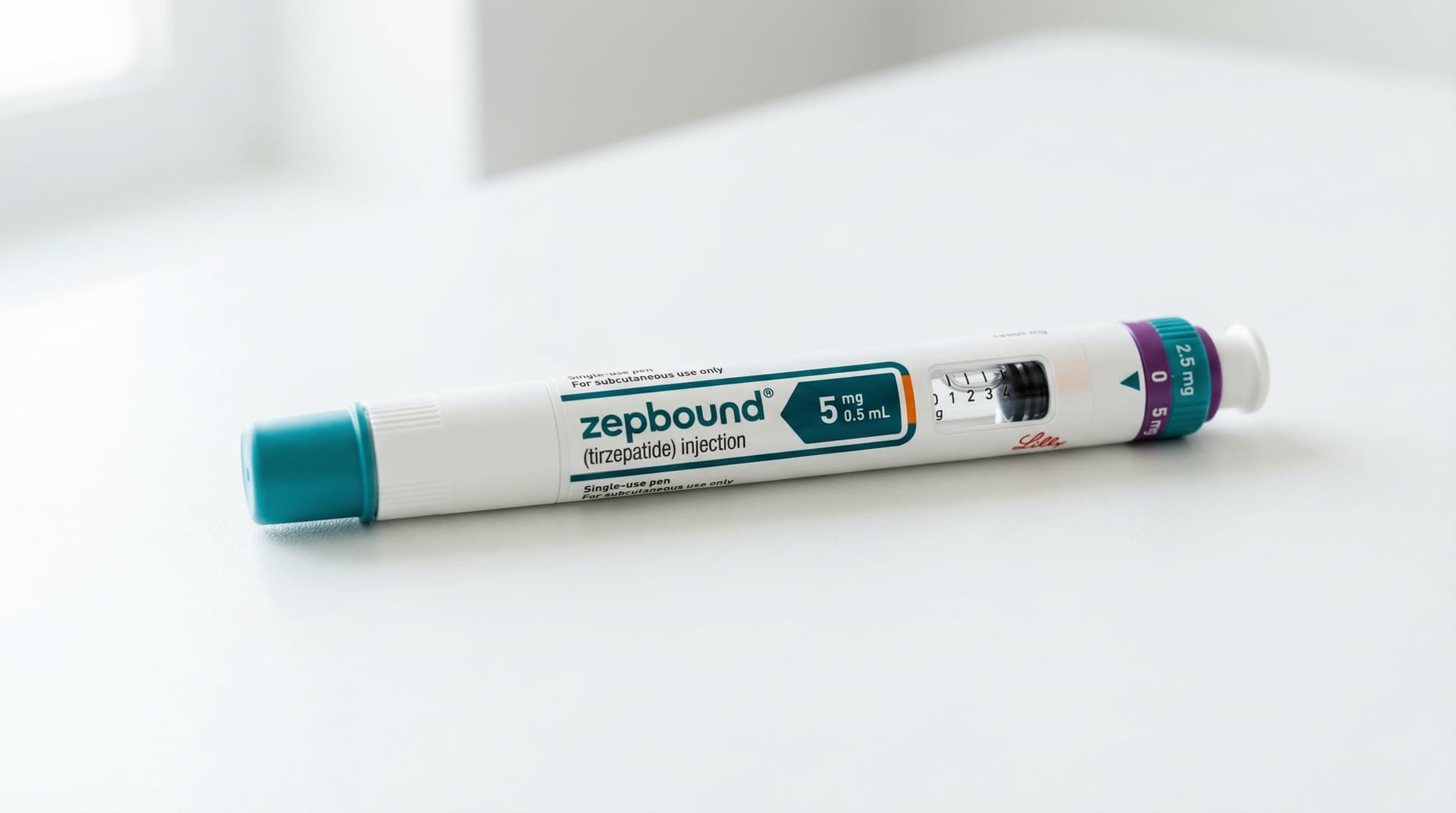
Zepbound (tirzepatide) is the first and only FDA-approved medication for obstructive sleep apnea (OSA) — approved in December 2024 for adults who have moderate-to-severe OSA and obesity. In the SURMOUNT-OSA trial it reduced sleep apnea severity (the apnea-hypopnea index, or AHI) by an average of 55%, and up to 51.5% of participants improved enough to meet the criteria for disease resolution — while also producing about 18% body-weight loss. It's the same drug sold for weight loss, now with a dedicated OSA indication.
Here's how Zepbound treats sleep apnea, who qualifies, what the trial actually showed, whether insurance covers it for OSA (often better than for weight loss alone), what it costs, and how it fits alongside CPAP.
Is Zepbound FDA-approved for sleep apnea?
Yes. In December 2024 the FDA approved Zepbound as the first-ever prescription medication for moderate-to-severe obstructive sleep apnea in adults with obesity — used alongside a reduced-calorie diet and increased physical activity. Before this, there was no approved drug for OSA; treatment meant CPAP machines, oral appliances, surgery, or weight loss. Zepbound is a genuine first.
The indication is specific: moderate-to-severe OSA and obesity, together. It is not approved for mild OSA, or for OSA in people without obesity.
How well does Zepbound work for sleep apnea?
In the SURMOUNT-OSA trial, Zepbound cut the apnea-hypopnea index (AHI) — the number of breathing interruptions per hour — by an average of 55%, versus 5% on placebo. That's about 27 fewer events per hour, and up to 51.5% of participants improved enough to meet the criteria for disease resolution.
The trial enrolled 469 adults with moderate-to-severe OSA and obesity across two arms — one in people not using PAP (CPAP) therapy, one in people who were — at the 10 mg or 15 mg dose:
- AHI reduction: ~25–29 fewer events/hour on tirzepatide vs ~5 on placebo
- Percent AHI reduction: 55% vs 5%
- Disease resolution: up to 51.5% of participants
- Body weight: 18.1% reduction vs 1.3% on placebo
The mechanism is straightforward: excess weight — especially around the neck and abdomen — is a major driver of airway collapse during sleep, and losing it reduces the obstruction. That's why the OSA benefit tracks closely with the weight loss.
Who qualifies for Zepbound for sleep apnea?
You qualify if you have moderate-to-severe obstructive sleep apnea, confirmed by a sleep study, plus obesity (typically BMI ≥ 30). Your prescriber will usually want documentation of both — a sleep study showing your AHI in the moderate-to-severe range, and a qualifying BMI. Because it's now an approved medical indication, an OSA diagnosis can strengthen your case for coverage in ways a weight-loss-only prescription can't.
Does insurance cover Zepbound for sleep apnea?
Often better than for weight loss alone — because OSA is a recognized medical condition, many commercial plans that exclude "weight-loss drugs" will still cover Zepbound when it's prescribed for diagnosed obstructive sleep apnea. This is one of the most useful things to know: same drug, same molecule, but a different (medical) indication can unlock coverage a weight-management prescription wouldn't.
- Commercial insurance: if your plan covers Zepbound for OSA, copays often run $25–$200/month; a prior authorization citing your sleep study is usually required.
- Medicare: Zepbound is covered at $50/month through the Medicare GLP-1 Bridge (through December 31, 2027), and its OSA indication may support Part D coverage.
- No coverage: if your plan still says no, the cash paths below apply.
Ask your prescriber to submit the prior authorization with the OSA diagnosis and sleep-study AHI front and center — that's the detail that flips many denials.
How much does Zepbound for sleep apnea cost?
Zepbound lists at about $1,060/month, but almost nobody pays that: it's $50/month on the Medicare Bridge, $349–$499/month for LillyDirect self-pay vials, or $25–$200 with commercial coverage. The molecule itself — tirzepatide — is also available compounded for far less if cost is the barrier.
| Path | Monthly cost |
|---|---|
| Medicare GLP-1 Bridge | $50/mo |
| Commercial insurance (covered for OSA) | $25–$200/mo |
| Compounded tirzepatide (same molecule, cash) | $119–$149/mo |
| LillyDirect self-pay vials | $349–$499/mo |
| Retail cash (list) | ~$1,060/mo |
Can you use compounded tirzepatide for sleep apnea?
Compounded tirzepatide is the same active molecule as Zepbound and is far cheaper cash-pay ($119–$149/month), but the FDA's OSA approval is specifically for brand Zepbound — compounded versions are prescribed for weight management, not OSA as a labeled indication. In practice, the OSA improvement comes from the weight loss, which the same molecule delivers. So for people whose real goal is "lose the weight driving my apnea" and who are paying cash, compounded tirzepatide from a verified telehealth provider is a legitimate, much cheaper route to the same drug — just prescribed under the weight-management indication rather than the OSA one.
If insurance coverage for the OSA indication is your path, brand Zepbound is what gets covered. If you're paying cash and want the molecule affordably, compare verified compounded tirzepatide programs — Trimi ($125/mo), Embody, and TrimRx — on our best providers list.
Zepbound vs CPAP: does it replace your machine?
Not necessarily — Zepbound is a powerful new option, but for many people it works best alongside CPAP rather than replacing it, and you should never stop CPAP without your doctor's guidance. In the trial, half the benefit was studied in people already using PAP therapy. Some patients improve enough to reduce or stop CPAP; others use both. The right call depends on your follow-up sleep study — treat AHI improvement as something to confirm and monitor with your sleep physician, not assume.
What are the side effects?
The side effects are the same as Zepbound for weight loss — mostly gastrointestinal (nausea, diarrhea, constipation, vomiting), worst early and after dose increases, then settling. It uses the same titration (2.5 mg up to a maximum of 15 mg weekly). See our Zepbound side-effect timeline for the week-by-week picture.
Frequently asked questions
Is Zepbound approved for sleep apnea? Yes — the FDA approved it in December 2024 for moderate-to-severe OSA in adults with obesity, the first drug ever approved for the condition.
How much does Zepbound lower AHI? By about 55% on average (roughly 27 fewer breathing events per hour) in the SURMOUNT-OSA trial, with up to 51.5% of participants meeting disease-resolution criteria.
Will insurance cover Zepbound for sleep apnea? More often than for weight loss alone, because OSA is a medical diagnosis. Coverage still varies; a prior authorization with your sleep-study results is usually required.
Can Zepbound replace my CPAP? Sometimes, but not automatically. Some people reduce or stop CPAP after improvement; many use both. Only change CPAP use under your doctor's guidance and a follow-up sleep study.
Does Ozempic or Wegovy treat sleep apnea? Neither is FDA-approved for OSA. Only Zepbound (tirzepatide) has the indication — though weight loss from any GLP-1 can improve OSA severity.
Bottom line
Zepbound is a landmark: the first drug approved to treat obstructive sleep apnea, and in the trial it cut apnea severity by more than half while driving 18% weight loss. If you have moderate-to-severe OSA and obesity, it's worth discussing with your doctor — and the OSA diagnosis may unlock insurance coverage that a weight-loss prescription wouldn't.
If cost is the barrier and you're paying out of pocket, the same molecule (tirzepatide) is available compounded for a fraction of the brand price — compare verified programs on our best GLP-1 providers list. Either way, keep your sleep physician in the loop and confirm improvement with a follow-up sleep study before changing any CPAP use.